Mercedes pad Constructors' lead at Austrian GP as Ferrari and McLaren slip
Mercedes extended their advantage at the top of the Constructors' standings after the Austrian Grand Prix, with Ferrari and McLaren unable to close the gap on a weekend that exposed how thin the margins have become at the front of the grid.
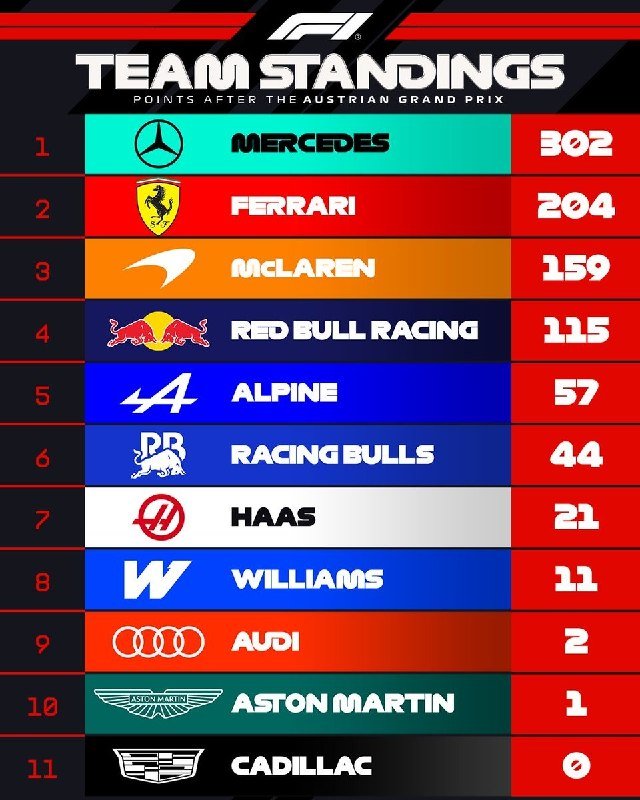
Mercedes arrived at the Red Bull Ring as the team to beat in the 2026 Constructors' race and left it the same way. By the chequered flag on 28 June 2026, the Brackley-based operation had done enough to stretch their lead over Ferrari and McLaren, the two rivals most plausibly positioned to mount a sustained challenge across the second half of the season. The point swings at the front of the field were modest on paper; in practice, they exposed how brittle the chasing order has become.
What the Austrian weekend demonstrated is not that Mercedes have built a dominant car in the classic sense — the qualifying gaps and race-pace deltas on a single lap remain tight — but that the operational layer around the car is now functioning at a level Ferrari and McLaren cannot match over a full race distance. Strategy calls, tyre management, pit-stop execution and the management of a long, abrasive stint all favoured the silver arrows. In a campaign decided by the accumulation of small margins, that consistency is the championship.
How the weekend unfolded
The Red Bull Ring's compact four-kilometre layout produces short lap times and minimal tyre degradation in normal conditions, which tends to compress the field and reward outright qualifying pace. Mercedes nonetheless converted their Saturday grid position into a workable Sunday afternoon, with their drivers extracting a points haul that reflected the car's race-trim strengths rather than its one-lap ceiling. Ferrari, by contrast, saw a weekend that began with promise and ended with diminishing returns: the kind of Sunday where the strategy room and the garage cannot quite recover the lost tenths that defined the previous afternoon.
McLaren's position is the more uncomfortable one. The Woking outfit has shown flashes of genuine race-winning pace across 2026, but Austria reinforced the pattern of a team that can win on its day and finish fourth the next. Constructors' championships are not won on flashes; they are won by the team that minimises the weekends where nothing goes right. Mercedes have become that team.
The counter-read on the standings
The reading from Maranello and Woking will be more cautious. Both teams will point out — accurately — that the points gap after a single grand prix is not a season, that development curves in the current regulations are steep, and that the next block of races, with a heavier weighting towards circuits that reward different aerodynamic and mechanical trade-offs, has historically rewarded reset rather than consolidation. The Constructors' race is now a five-month campaign; a handful of points swung at a single venue rarely decides it.
That counter-narrative is fair, but it does not explain the more troubling pattern visible across the last three race weekends. Ferrari have not been unfortunate so much as imprecise: the kind of operational underperformance that costs four points here, six points there, and a championship lead by season's end. McLaren's issue is different — they look like a team capable of winning individual races, but not yet of denying Mercedes the consistent podiums that build constructors' tallies.
What the standings actually measure
Constructors' championships reward something subtler than which car is fastest in isolation. They reward the sum of two drivers finishing in the points, week after week, with a car that rarely breaks and a pit wall that rarely makes the wrong call. The structural pattern visible at the top of the 2026 table — Mercedes ahead, Ferrari second, McLaren third — is the product of exactly that kind of accumulation. It is not glamorous and it is rarely the story of any single race, but it is the story of a championship.
This is also why the constructors' race tends to be settled later than the drivers'. Individual brilliance can mask a struggling second seat for several rounds; a constructors' table exposes the weakness within a handful of races. Mercedes have two drivers delivering at a level the other leading teams cannot yet match across both cars, and that depth is the basis of the Austrian swing.
Stakes for the run to Abu Dhabi
If the current operational pattern holds, Mercedes will not need to win every remaining race to take the constructors' title — they simply need to keep finishing with both cars inside the top six while their rivals continue to leak points on difficult weekends. That is a low bar relative to the volatility that has marked the chasing teams. The realistic fight now appears to be for second: Ferrari have the infrastructure and the budget to mount a development response, while McLaren's challenge depends on whether they can stabilise their race-weekend execution to match their one-lap pace.
What remains genuinely uncertain is how the midfield responds. The constructors' table is decided at both ends: by who leads, and by who bleeds points to the teams behind. If Williams, Aston Martin or Red Bull can begin taking points off Ferrari and McLaren with any consistency, the mathematical ceiling on the championship tightens further. The Austrian weekend moved Mercedes closer to a constructors' title, but it did not move them close enough to treat the rest of the season as a procession — not yet.
The Monexus desk framed this as an operational and structural story rather than a single-race report, because constructors' championships are settled by accumulation rather than by Sunday-afternoon drama.
Wire provenance
This editorial synthesis draws on the following public wire/social posts:
- https://t.me/s/formula1