Russell delivers Austrian GP pole after Wolff's blunt mid-session intervention
A clipped radio exchange at the Red Bull Ring turned a stuttering Q3 run into pole position for George Russell — a small moment that says plenty about how Mercedes is managing its 2026 season.
George Russell will line up first on the grid at the Austrian Grand Prix after a piece of pit-wall bluntness from Mercedes team principal Toto Wolff reframed his final qualifying run on Saturday, 27 June 2026. Speaking to reporters after the session, Russell said the two-word instruction — "just drive" — arrived at exactly the moment his preparation threatened to unravel, and that hearing it on the radio was the difference between scrapping for the front row and claiming pole.
It is the kind of detail that sounds trivial until the lap sheet is read out: Russell took pole by a margin measurable in thousandths, on a circuit where Red Bull has historically enjoyed the strongest correlation between car and venue. In a season in which Mercedes has been chasing the kind of consistency that eluded its 2025 campaign, the moment is a small vindication of an older management style — fewer words, more weight per word.
A short message, a long lap
Russell told ESPN that the exchange came during the prep lap for what would be his decisive Q3 effort at the Red Bull Ring in Spielberg. His account of the moment was unadorned: he had begun over-thinking the run, and Wolff's terse two-word instruction cut through. The phrasing matters because it is not what Formula 1 listeners are used to hearing from a Mercedes pit wall more readily associated with data-led, multi-clause communications. The driver's reaction — pole, by a sliver — is the kind of feedback loop teams chase but rarely engineer.
Andrew Benson's write-up for BBC Sport reaches a similar conclusion from a different angle. Benson frames the lap as the product of experience, composure, and what he describes as a "magic lap" — a phrase long used in qualifying analysis to describe a run in which a driver extracts the absolute ceiling of the package. Russell, still in the early phase of his career as the team's senior driver, has not always been credited with that quality. Saturday suggests the credit is overdue.
The counter-narrative: pole is not pace
The temptation is to read too much into a Saturday. Pole position at the Red Bull Ring is decided over a single lap on a 4.318-kilometre circuit that rewards mechanical grip and traction out of the final two corners — both areas where the current Mercedes chassis has been competitive in 2026 — rather than the long-run tyre degradation that decides Sunday. The counter-narrative, therefore, is straightforward: Russell's lap was excellent; it tells the audience relatively little about whether the W17 has solved the tyre-management problems that cost Mercedes results earlier in the season.
It is also worth noting that qualifying margins in the current regulatory era are routinely within a tenth of a second across the top six. A pole by a few hundredths does not establish a hierarchy so much as it resets the conversation. The Russell–Wolff moment is a story, but it is a qualifying story. The race story at Spielberg will be written over 71 laps on Sunday.
What the radio tells us about the garage
The more durable insight sits one layer down. Wolff's instinct to use the team radio at a high-pressure moment — and Russell's subsequent description of the message as helpful — points to a working relationship that has settled into something more direct than the public impression suggests. Mercedes' senior management has spent the last 18 months answering questions about whether the team had lost its edge after Lewis Hamilton's departure; the radio transcript is a small piece of evidence that the answer is no.
It also signals the kind of internal communication that the team's rivals, particularly Red Bull and Ferrari, have spent the last two seasons trying to replicate. A driver who listens, a principal who chooses his words, and a moment in which both trust each other enough to make the call work: this is the human architecture that sits underneath any technical advantage.
Stakes for Sunday and the season
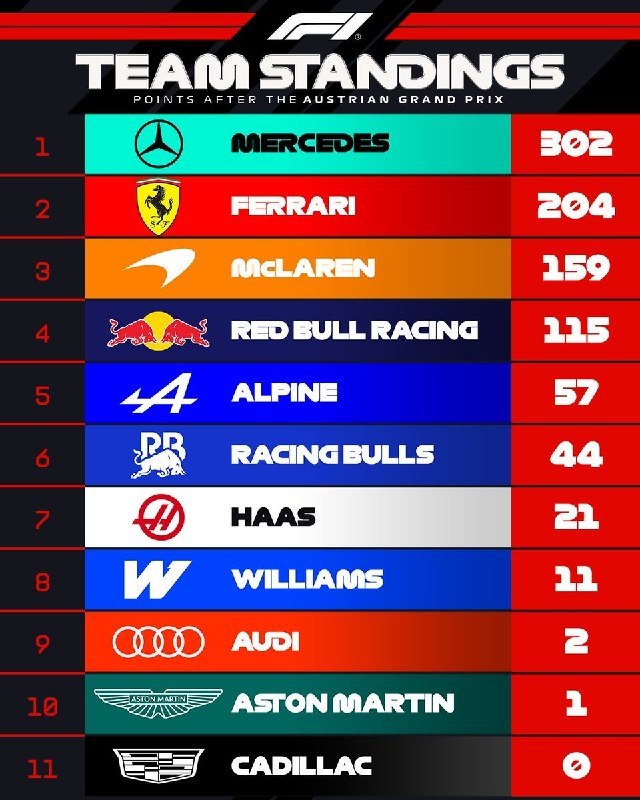
The Austrian Grand Prix is round 11 of the 2026 Formula 1 calendar and the second of three consecutive European weekends before the summer break. For Russell, pole is a chance to convert a strong Saturday into a first win of the season, and to consolidate his position as the team's lead driver in a year in which Mercedes is racing against both McLaren and a resurgent Ferrari in the constructors' championship. For Wolff, it is a quieter kind of validation: the radio button still works.
What remains uncertain is whether Saturday's form translates. Qualifying trim and race trim at Spielberg are not the same specification, and the sources do not specify how the long-run pace comparisons stack up between Mercedes, McLaren and Red Bull on the medium and hard compounds. If Russell converts pole into a win on Sunday, the moment becomes a turning point; if he does not, it becomes a footnote in a season defined by what happens elsewhere.
This article was compiled from wire and outlet reporting around the qualifying session at the Red Bull Ring on 27 June 2026, with no on-site reporting by Monexus. The framing centres the driver's account and the BBC's analysis over secondary commentary, and notes where the qualifying result does not by itself settle the race-day question.