Brazil edge Japan at the death as age question refuses to go away
Gabriel Martinelli's stoppage-time goal spared Brazil an early exit and renewed the debate over whether an ageing Seleção can still go deep in the United States.
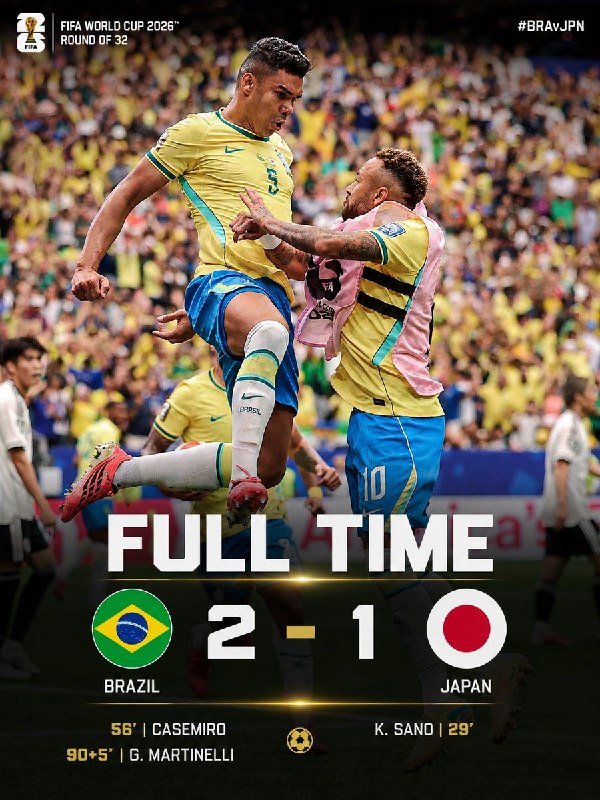
Gabriel Martinelli's strike in the 96th minute spared Brazil an ignominious exit from the World Cup on Saturday night, finishing a 2-1 comeback win over a Japan side that had spent most of the round-of-32 tie leading and, for long stretches, looking the more coherent team. The Arsenal forward turned the ball in from close range after goalkeeper Keisuke Osako had parried a loose pass, sending the Seleção through to the last 16 and landing them in the bracket alongside either Norway or Ivory Coast.
The drama papered over a performance that, for 80 minutes, exposed every question that has followed this Brazil squad since the squad was announced. An ageing midfield, a centre-forward pair whose combined age exceeds 60 and a back line that looked genuinely uncomfortable against Japan's vertical pressing: the structural doubts that journalists and rival scouts have raised for months were not so much answered as postponed by one act of late-game improvisation.
A win built on scramble, not shape
For most of the second half the pattern was familiar to anyone who has watched this Brazil side in 2026. The Seleção held the ball in comfortable, glossy passages — the kind that draw applause in midfield and produce little in the way of clear chances. Japan, by contrast, contested the game on its terms. They pressed high, they ran the channels, and they took the lead through a goal that reflected tactical discipline rather than fortune: a vertical ball into the corridor behind the Brazil centre-backs, a half-yard of separation earned, a finish placed beyond Alisson.
Brazil's equaliser came from a set piece, headed in by a substitute centre-back who had been on the pitch roughly ten minutes. The winner, as BBC Sport noted in its minute-by-minute commentary, arrived in the 95th minute — one of the latest winning strikes Brazil have scored at a World Cup. The headline "Brazil survive World Cup scare against Japan," used by ESPN, was not editorial flourish; it was the plainest description of what the tape showed.
The age problem that will not be argued away
Brazil's squad is the oldest in the tournament's recent history by some distance, and the two players at its centre — captain Casemiro and the frontman who led the line on Saturday — are entering the closing phase of careers at the highest level. The question raised by ESPN's match report is no longer whether they will be available for 2030; it is whether the supporting cast has the depth to compensate for the minutes they can no longer dominate.
Saturday offered a partial answer and a fuller reminder. The substitutes, including Martinelli, changed the geometry of the attack. The starters, particularly in central midfield, did not. Japan succeeded where several CONMEBOL sides have succeeded in qualifying: they denied Brazil the corridors to play through, forced turnovers in advanced areas, and trusted that the Brazilian press would tire before the Japanese block did.
CBS Sports' feature on Brazil's "energy" and the link between Seleção football and samba was written before kickoff, and read at full-time as a description of a quality on display rather than an analytical frame: the team still moves to its own rhythm. Whether that rhythm can now be reproduced four more times against fresher opponents is a question the next round will answer more conclusively.
What the bracket actually says
Brazil meet the winner of Norway versus Ivory Coast. That is, on paper, the kind of last-16 tie the format rewards — a continental powerhouse against either a Scandinavian counter-pressing side or an African team carrying the weight of a continent's expectations. Neither opponent will offer Japan-level space in transition; neither will sit deep the way Japan were forced to once Martinelli's introduction opened the pitch.
The deeper structural test arrives after that. Brazil's most likely quarter-final opponent sits in the upper half of the bracket and is, on form, the side most capable of punishing a Seleção team that cannot dictate midfield. An ageing team can beat one or two of those opponents on a night; it cannot beat four of them without producing something more systematic than what was shown on Saturday.
What remains uncertain
The sources do not specify the exact minutes played by Brazil's frontline pair, nor the precise xG figures for the match. What is contestable is how much of Brazil's second-half improvement was personnel and how much was Japan's natural fatigue — a distinction the post-match punditry will argue about for the next 72 hours, and that the next round of fixtures will begin to clarify.
Desk note: Monexus frames this as a near-miss for a heavy favourite, not as a springboard. The wire consensus — that Brazil escaped rather than imposed themselves — is the reading the body of the piece adopts, with the squad's age as the structural frame rather than the result as the headline.