Heat, heat, everywhere: how Europe is rewriting the summer contract
June 2026 has roasted Paris and laid bare a question Western capitals keep postponing: how much adaptation is a city willing to fund before it admits it is building a new climate regime, not just surviving an old one.
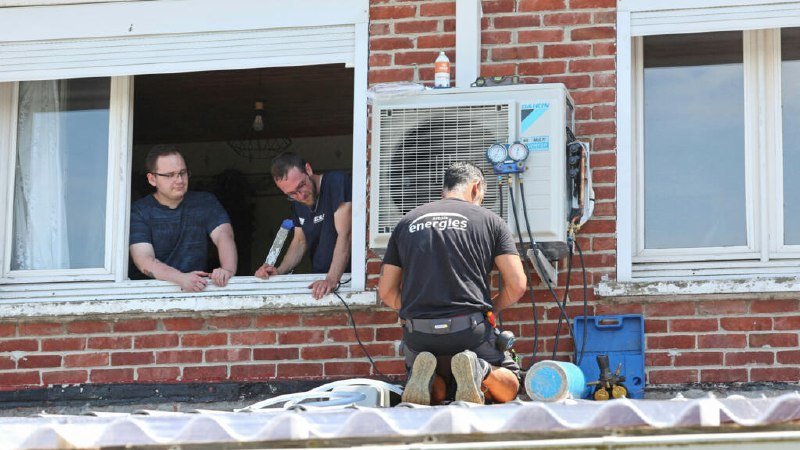
Paris this week looked like a city negotiating a new contract with its own weather. On 29 June 2026, as the French capital baked under an early-summer heat dome, residents were improvising in plain sight — finding shade, hauling water, dragging mattresses to cooler floors. The improvisation is the story. It is also the warning. Europe has spent three decades writing climate policy in the conditional tense ("if temperatures rise"); it is now being written in the present indicative.
What the Paris pictures, the Japanese luxury-train novelty, and the small clarifications between Telegram posts share is not subject matter but cadence. They are dispatches from a world that no longer has the luxury of season. A 50-year-old man age-corrected mid-thread; a steam-bath rail service priced at $2,700 for a 17-compartment, 34-passenger run. The Paris heat note — "Improvise, adapt, overcome" — read like an instruction manual that arrived after the test. The cumulative register is one of managed improvisation. Managed improvisation, scaled across a continent of 450 million people, is the beginning of policy.
What Parisians are actually doing
The public-facing heat response, as documented by on-the-ground Telegram dispatches from 29 June 2026, is unsentimental and improvisational: residents are relocating to cooler rooms, pooling water, retreating to shaded corridors, and forming the kind of micro-cooperation networks that municipal plans cannot legislate into being. The municipal dimension is the load-bearing one. Paris's heat plan has long centered on cooling centres, school-based response, and the activation of "canicules" protocols during the city's annual heat episodes. The new variable is duration: a heat dome in late June is no longer a meteorological event so much as a stress test of what a 19th-century city can deliver to a 21st-century population.
The honest read is that improvisation is not a substitute for retrofit. It is a leading indicator that retrofits are late. Air-conditioning penetration in French housing has historically lagged southern European and North American norms; the cultural reluctance to install individual cooling is real, but the housing stock — late-Haussmann and post-war social housing alike — was not designed for sustained internal cooling. Each summer the gap narrows; each summer it does not close.
The counter-read: don't panic, don't minimalise
Two convenient framings are circulating in equal volume. The first says Europe is overheating and governments are asleep. The second says heat waves are weather, not climate, and the panic is performance. Neither survives contact with the data on duration. The Météo-France climatology the past decade shows a 2.0°C-plus rise in summer mean temperatures across northern France over the past three decades — a multi-summer normalisation, not a string of freak events. The reasonable read is that heat peaks are not new; heat seasons are.
That distinction matters because it changes the policy question. The first framing demands emergency response; the second demands no response at all. The intermediate, evidence-led position is that emergency response is already happening through improvisation precisely because durable response is overdue. Parisians are not panicking; they are substituting for a retrofit programme that should have started in 2014.
The structural picture, in plain prose
European adaptation policy has run ahead of European heat policy for years. Brussels has funded flood and coastal defence generously; heat adaptation has lived in the same annexes and received the same provisional language. The result is a continent with better sea walls than cool roofs. The language of "resilience" has been a useful cover for deferral — resilience sounds robust, but resilience budgets are the line items that get cut when money tightens.
There is a second, less obvious structural problem. The cooling economy — air-conditioning units, heat pumps, district cooling — is being built, but it is being built on the same supply chains and refrigerant regimes that older climate policy was designed to suppress. The transition risks being financed by the very emissions it is meant to reduce. The diplomatic response — refrigerant phase-downs under the Kigali Amendment, building decarbonisation under the revised Energy Performance of Buildings Directive — runs slower than the consumer purchase cycle.
What is at stake
The trailing end of this story is urban governance. The summer of 2026 is the first in which the question of who funds the retrofit — central government, the region, the municipality, the landlord, the tenant, the household — has become a political question rather than a technical one. France's national heat plan is largely metropolitan; Paris's resilience rests on what the city can extract from the région and from the state. In Italy and Spain the same fight is unfolding a year ahead; in Germany the housing-stock question is bound up with the building-heating transition. Wherever it surfaces, the answer is the same: someone owns the building, someone else pays the cooling bill, and the climate is indifferent to who blinks first.
The honest uncertainty is on the demand side. We do not yet know whether heat adaptation behaves politically like flood defence (public good, publicly funded) or like home insurance (private good, privately purchased). The Paris improvising will tell us within three summers. Until then, the continent's most accurate climate instrument is a mattress dragged across a parquet floor at 02:00.
A note on a different dispatch
A separate post on the same channel, dated 29 June 2026, advertised a Japanese luxury tourist train carrying 34 passengers in 17 private two-person compartments on a two-day journey priced around $2,700, with a steam bath onboard. The juxtaposition is worth flagging: the same news day in which a continent improvises cooling also markets a rail-borne spa for two-percent-of-tourism revenue. Climate adaptation is, more than is usually admitted, a class story; the same weather that empties a Paris park is somebody else's sold-out itinerary.
This publication's framing here is sharper than the wire's: where mainstream dispatches treat heat episodes as discrete events, Monexus reads them as the visible edge of a structural adaptation debt that European policy has been quietly deferring since the early 2010s.
Wire provenance
This editorial synthesis draws on the following public wire/social posts:
- https://t.me/MyLordBebo/22100
- https://t.me/MyLordBebo/22101
- https://t.me/MyLordBebo/22102
- https://t.me/MyLordBebo/22103