Tehran draws a line at Hormuz: who clears the mines matters more than who laid them
A deputy foreign minister's claim that only Iran will sweep Hormuz of mines turns a technical question into a sovereignty test — and exposes how thin the diplomatic runway still is.
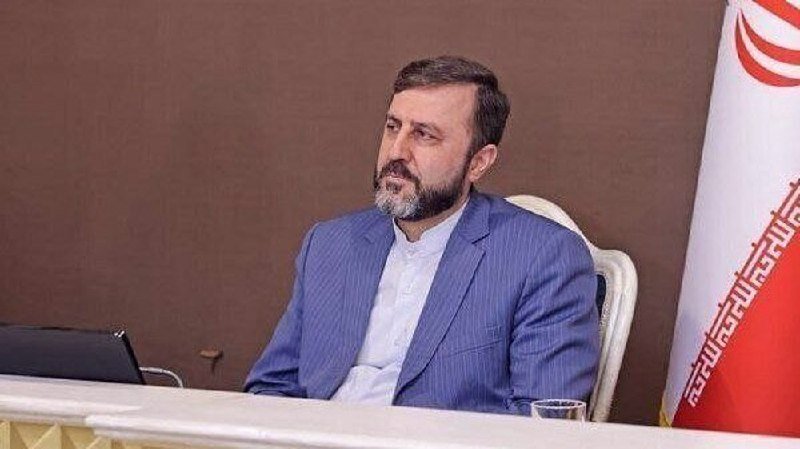
On 29 June 2026, with a US-Iran peace accord reportedly scheduled for signing, Iran's deputy foreign minister dropped a line that sounded technical and was anything but. Demining of the Strait of Hormuz, he said, would be carried out by Iran alone, if needed. The phrasing was deliberate. The strait carries roughly a fifth of the world's seaborne oil. Whoever decides what floats, and what gets removed from the water, decides who controls the throat of the global energy system.
The mine-clearing question is not a footnote to a peace deal. It is a sovereignty test disguised as a logistics issue, and it exposes how thin the runway still is between a signed accord and a working one. The deputy minister's statement, picked up by Middle East Eye's live blog and circulated by open-source monitors on Telegram at 18:25 UTC and again at 18:13 UTC, did not specify what kind of accord or which mines. It did not need to. The phrase "solely by Iran" does the diplomatic heavy lifting.
What is actually being claimed
The claim is narrow on its face. If mines are found in the waterway, Iranian crews handle the disposal. It is a position with a logic of its own: a state that regards the strait as its own maritime jurisdiction, and a state that has spent decades investing in mine warfare as the cheapest asymmetric counter to a superior navy, may reasonably insist on being the only one who touches the ordnance. Foreign demolition teams in Iranian-claimed waters is, from Tehran's vantage, less a technical courtesy than a sovereign admission.
The wrinkle is that the question presumes mines exist. Neither the deputy minister nor the wire reporting on his remarks specifies a confirmed lay-down. Speculation about Iranian mining of the strait has accompanied every crisis cycle of the past decade; the practical question of whether a fresh pattern has now been sown remains open. Until that is established, the demining authority is, in effect, a claim about who would be trusted to verify a threat that may or may not be present.
Why the markets aren't buying the calm
The demining statement landed into a market that is still pricing risk. According to a Telegram-circulated screenshot from open-source monitors at 17:43 UTC on 29 June, Polymarket users assign an 81% probability that the Strait of Hormuz will still be disrupted on 15 July 2026. That is the prediction market's view, not a wire confirmation, and it carries the usual caveats: thin liquidity on niche contracts, sentiment-prone retail flow, the occasional trader with skin in the outcome. But it is also a number worth sitting with. Two and a half weeks after a scheduled accord signing, the crowd with money on the line is still pricing the strait as more closed than open.
The read is straightforward. A signed agreement reduces the probability of a future incident; it does not by itself reopen a waterway that may still contain hazards, or that shipping insurers, with their own finely calibrated war-risk premia, may still treat as exposed. The demining question, in other words, is also an insurance question, a Lloyd's Joint War Committee question, a tanker-master question. Each layer answers it on its own clock.
The structural read
What is being negotiated is not a technical protocol. It is the post-accord architecture of the gulf. The US, in its dominant framing, wants a verifiable end-state: mines removed, naval traffic unimpeded, sanctions relief contingent on behaviour that can be measured. Iran, in its dominant framing, wants a sovereign end-state: its own crews operating in its own waters, sanctions relief delivered without the indignity of foreign technical missions under its flag. These are not reconcilable by a single sentence in a deputy minister's presser; they are reconcilable, if at all, by a side agreement whose details will leak out over weeks, not hours.
The deeper pattern is familiar. In any contest between a hegemon with global reach and a regional state with asymmetric geography, the technical language of "verification," "monitoring," and "clearance" becomes the vocabulary of who gets to be present. Maritime chokepoints have always been where that vocabulary is hardest. The strait is the narrowest and the most consequential. Whoever staffs the mine-countermeasure vessels is, in effect, staffing the early-warning architecture of the wider settlement.
What remains genuinely uncertain
Several things are not in the source material and should not be pretended to be. Whether any mines are presently laid in the strait is not confirmed by the Middle East Eye live coverage or the open-source monitors. Whether the US has accepted, rejected, or even been formally asked to accept the Iranian-only demining condition is not stated. The text of the accord scheduled to be signed on the Friday referenced by Middle East Eye has not been published in the thread sources; its existence is reported, not its contents. And the 81% Polymarket figure, while striking, is one snapshot from one contract on one platform, and the platform's track record on narrow event markets in the Middle East is mixed.
The honest summary is this. A diplomatic milestone is reportedly days away. The mine-clearing question has been surfaced, in language that points to a fight the headline writers would rather not have. And the markets — the ones that price risk in real time, without the comfort of communiqués — are still pricing a closed strait at the horizon of the deal.
This publication reads the Hormuz demining claim as the first sovereignty test of a notional accord, not as an operational briefing. Where the wires quote a deputy minister, we treat the quote as a diplomatic position; where prediction markets give a percentage, we treat the percentage as a sentiment reading. Both belong on the page; neither closes the question.
Wire provenance
This editorial synthesis draws on the following public wire/social posts:
- https://t.me/s/OsintLive
- https://t.me/s/OsintLive