Iran's Strait of Hormuz Gambit: Mine-Laying, Frozen Funds, and a 30-Day Window
Tehran has declared the Strait will remain under Iranian control for 30 days, says only Iranian crews will de-mine the chokepoint, and Washington is signalling it will not release frozen funds without a nuclear deal. The geometry of leverage is shifting fast.
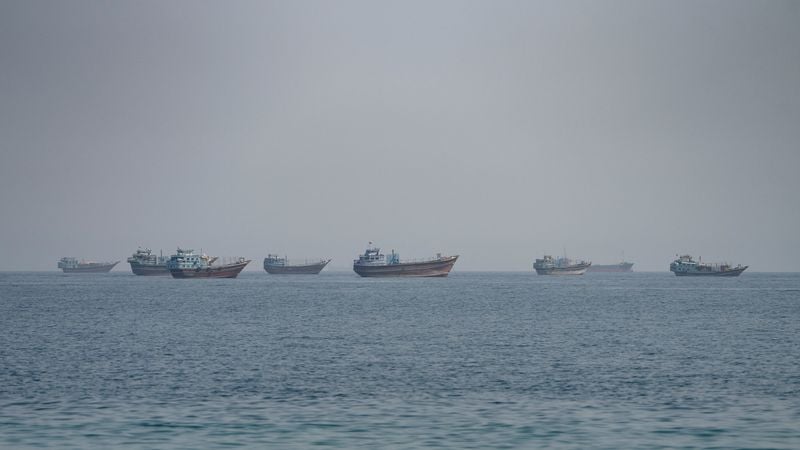
On 28 June 2026, Iran's foreign minister declared that the Strait of Hormuz will remain under Iranian control for thirty days. By the following afternoon the message had hardened: Tehran will not permit any foreign power to assist in clearing mines from the waterway, and Washington is publicly holding the line on frozen Iranian funds, conditioning their release on progress in nuclear diplomacy. Three statements, circulated within roughly twenty-four hours across Iranian and Western wires, describe a chokepoint economy being deliberately re-engineered under deadline pressure.
The pattern is less about mining than about custody. Roughly a fifth of the world's seaborne oil transits the strait each year; whoever decides when a vessel moves, when a lane is reopened, and which salvager touches a minefield, decides who sets the tempo of the global energy market. Iran's announcement converts a logistical claim into a political instrument, while Washington's insistence on nuclear-file progress before unlocking frozen assets ties the same chokepoint to a parallel negotiating track. Two clocks, one strait.
What Iran has actually said
Iran's foreign minister, on 28 June, framed the thirty-day window in jurisdictional terms: the strait remains under Iranian control for that period. Reporting circulated via the X-account at Polymarket captured the declaration as a "breaking" foreign-ministry statement. By the next day, 29 June, a deputy foreign minister had narrowed the operational question — de-mining would be carried out only by Iran, the foreign ministry said, citing the right to manage its own waters. The same position was repeated, in slightly stronger language, by Iranian-aligned channels: Iran will not allow any country to help clear mines from the Strait of Hormuz.
Read together, the three statements describe a layered doctrine. Politically, the strait is Iranian for the next month. Operationally, only Iranian crews will handle mines laid in Iranian waters. Diplomatically, foreign assistance is being framed not as welcome aid but as an infringement. Whether the country has the technical capacity to clear mines at the rate commercial traffic requires, especially under sanctions, is the implicit leverage point the doctrine is built on.
What the US has said back
Washington's response arrived in the same window. On 29 June, US messaging — relayed by Iran-watcher channel BRICS News — made the funding lever explicit: the United States will not release frozen Iranian funds without progress on a nuclear deal. The formulation is symmetric: Tehran controls the physical chokepoint; Washington controls the financial chokepoint. Neither side is offering to move first; both are signalling, in nearly identical twenty-four-hour cycles, that the other holds the prize the counterpart wants.
This is the structural shape of the moment. Iranian statements emphasise sovereignty and operational independence; US statements emphasise conditionality and negotiation. Each side's framing assumes that the other's pressure point can be held for longer than its own. That mutual confidence is what the next thirty days will test.
The structural frame: chokepoint economics, in plain language
A maritime strait that handles a fifth of seaborne oil is, by definition, an instrument of leverage before it is a piece of water. Long before mining enters the picture, the mere ability to slow, inspect, or reroute traffic is a switch that turns off and on with diplomatic moves. Iran's announcement does not invent that lever; it re-asserts it at a moment when several other levers — frozen funds, sanctions enforcement, nuclear-file momentum — are also in play. The structure is familiar across the region, and across recent history: whoever can credibly threaten a corridor gains negotiating weight without having to fire a shot.
What is unusual this round is the symmetry of the messaging. Iran's claim is jurisdictional and operational; Washington's counter is fiscal and conditional. Each side is signalling that it will not blink first. The risk calculus moves accordingly. A tanker operator booking through the strait has to weigh the probability of delay against the cost of rerouting around Africa or through pipelines to the Gulf. A state holding frozen funds has to weigh the cost of carrying them against the political value of not releasing them. A regional shipping insurer has to weigh the premium of transiting contested waters against the price of staying out.
Whether this resolves into a deal, a confrontation, or simply a managed hold depends on questions the public statements do not answer: how much de-mining capacity Iran actually commands, what level of traffic disruption Washington is willing to absorb in the interim, and whether third parties — Gulf monarchies, China, India, the European Union — can extract concessions by offering to broker or to insure in place of either principal.
Counter-narrative: what the framing leaves out
The dominant framing is that Iran is escalating and the United States is holding firm. A plausible alternative reading runs the other way. Iran's statements emphasise operational control and Iranian-only de-mining because giving foreign salvagers access would, from Tehran's vantage, concede exactly the kind of presence it has spent decades denying Western navies. The position is principled as well as strategic — a sovereign right to manage internal waters is a position most capitals, including Western ones, articulate as a baseline in other theatres. The US position on frozen funds is similarly grounded: releases without verified progress convert a financial asset into a strategic concession. Both postures are defensible within their own institutional logics.
The framing that fits the available statements less well is that either side is bluffing. Iranian messaging names specific operational details — who clears the mines, who runs the corridor. American messaging names a specific condition — nuclear progress — without a timetable. Both are statements of intent, not threats. Treat them as such and the next thirty days look like a period of management, not confrontation.
The framing that fits best, given the public record, is one of calibrated inertia: each side has decided that holding its present position is cheaper than moving first, and is willing to absorb the costs of that decision long enough for the other side to conclude the same.
Stakes: who wins, who loses, and over what horizon
Over the next thirty days the direct costs are concentrated in three groups. Commercial shippers face routing decisions: divert around the Cape of Good Hope (more time, more fuel), or transit and trust the corridor stays open enough to be commercially usable. Insurers face underwriting decisions: accept higher premiums on transit, or price strait traffic out of the market. Gulf monarchies face political decisions: reaffirm the existing security architecture, or quietly test whether alternative mediation is achievable.
Over a longer horizon, the structural question is whether chokepoint leverage is durable. Iran's announcement does not change the geography; the strait remains one of two maritime corridors carrying a meaningful share of seaborne oil. What it changes is who adjudicates its operation. If the thirty-day window passes and the chokepoint returns to nominal free transit, Iran's claim becomes a precedent: a power can assert corridor custody for a fixed window and revert. If the window extends, or escalates into active disruption, the precedent runs the other way — that shipping insurance, route decisions, and pipeline alternatives will have to be priced for a permanently contested corridor. Either outcome reshapes the region's political economy, but in opposite directions.
What remains uncertain
Three pieces of the picture are not in the public record the source items provide. First, whether mines have actually been laid, or whether the messaging refers to mines from prior incidents that are still classified as uncleared. The statements describe Iranian control and Iranian-only de-mining; they do not, in the material available to this publication, describe a new active mining operation of known scale.
Second, what "nuclear progress" means in operational terms from the US side. The condition is named without a metric. Whether the test is a return to the Joint Comprehensive Plan of Action framework, a new freeze-for-freeze arrangement, or a lower-key technical track is not specified in the public statements circulating on 29 June.
Third, whether third-party mediation is in play. The source items reflect direct bilateral signalling, not indirect diplomatic traffic. Gulf, Chinese, or European moves, if any, are not present in the available record. Their absence in the public messaging does not mean their absence in the diplomacy; it means a desk writer working from this thread cannot responsibly assert either way.
These gaps matter because the next thirty days are likely to be decided in the spaces the public statements are silent on, not in the declarations themselves. Coverage that treats the declarations as the whole story will misread the period it is trying to describe.
Desk note: this article works from a thin source packet — three Telegram-channel relays and one X-account wire, with no Western wire confirmation in the thread — and is structured accordingly. Where Western outlets would normally corroborate timing, casualty figures, or institutional language, this piece instead flags the absence and asks the reader to hold the framing at the standard a thin record warrants.
Wire provenance
This editorial synthesis draws on the following public wire/social posts:
- https://t.me/osintlive
- https://t.me/bricsnews
- https://t.me/bricsnews
- https://x.com/polymarket/status/
- https://en.wikipedia.org/wiki/Strait_of_Hormuz
- https://en.wikipedia.org/wiki/Iran%E2%80%93United_States_relations
- https://en.wikipedia.org/wiki/Joint_Comprehensive_Plan_of_Action
- https://en.wikipedia.org/wiki/Energy_in_Iran
- https://t.me/osintlive
- https://t.me/bricsnews
- https://t.me/bricsnews
- https://x.com/polymarket/status/
- https://en.wikipedia.org/wiki/Strait_of_Hormuz
- https://en.wikipedia.org/wiki/Iran%E2%80%93United_States_relations
- https://en.wikipedia.org/wiki/Joint_Comprehensive_Plan_of_Action
- https://en.wikipedia.org/wiki/Energy_in_Iran