Stade shooting leaves five dead: what we know and what we don't
Police in the Lower Saxon city of Stade say five people are dead after a shooting in the city centre; two suspects are in custody and the motive remains undisclosed.
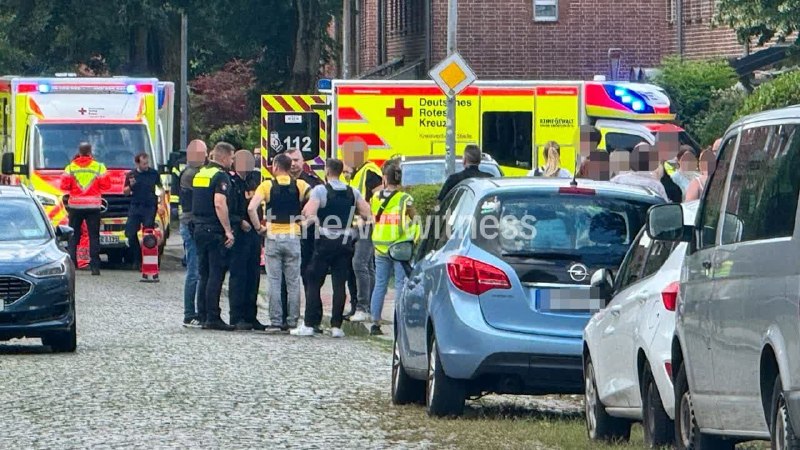
A shooting in the centre of Stade, a mid-sized city on the Elbe about 45 kilometres west of Hamburg, left five people dead on the morning of 29 June 2026, according to initial accounts relayed by German police and aggregated on Telegram channels monitoring the country's security services. Two suspects have been taken into custody. The authorities have not, as of the time of writing, named either the victims or those held, nor have they disclosed a motive. The speed of the arrest — within minutes, by the account of multiple early dispatches — is what police are pointing to first. It is also the only part of the picture that is no longer in dispute.
For a country that has spent the better part of two decades refining its post-2006 emergency protocols — the police reform agenda that followed the death of Halit Yozgat in Kassel, the 2022 Heilbronn precedent, the 2024 Solingen lessons review — the operational choreography of the morning mattered less than the political one. A mass-casualty event of this scale on German soil is, statistically, rare. When it happens, the early hours are dominated by three questions: how the perpetrators came to the scene, whether others remain at large, and whether the attack has any organised ideological character. On none of those three has the public record yet been written.
What the early dispatches say
Two channels that monitor German police radio traffic — "wfwitness" and "rnintel" on Telegram — both logged the incident within minutes of each other, at 11:55 and 11:56 UTC, with "wfwitness" posting a fuller summary at 11:58 UTC noting "five people dead" and confirming that "the suspects have been apprehended." Both accounts independently emphasised the rapidity of the police response and the size of the cordon thrown around the city centre. The channels carry no bylined reporting; they aggregate radio traffic and press-conference audio, and they should be read as first-pass intelligence rather than as a confirmed casualty list. German federal police and the Lower Saxon interior ministry have not yet issued a formal press release at the time of writing, a gap that is itself worth noting. In a country where state press offices usually have a written statement within ninety minutes of any incident that draws a national flag, the silence from Hannover is conspicuous.
The local context that matters
Stade is not a town that features in German security debates. Population roughly 47,000, a Hanseatic old town, a petrochemical works on the Schwinge, a daily-commuter relationship with Hamburg. It does not have a stationed counter-terrorism unit, and the nearest specialised response capacity sits in Hamburg or Hannover. That the apparent perpetrators were apprehended within minutes suggests either an extremely fast deployment from one of those cities, or — more likely given the geography — that the suspects did not attempt to flee. Police have not said which. The decision to remain at the scene, if that is what happened, is itself a piece of evidence that the investigation will want to weigh carefully, because it cuts against the pattern of the 2016 Munich and 2022 Heilbronn attacks, where shooters either fled or died on site. In each of those cases, the first twelve hours of the inquiry were consumed with the question of whether accomplices remained at large. Stade's investigating officers will be working the same problem.
What the framing is already doing
Mass-casualty events in Germany have, since 2000, acquired an almost predetermined interpretive arc: first the political class expresses shock; then the federal press conference; then the migration debate; then the editorial-page questions about whether the security services had the case in their files. The arc is not unique to Germany, but the German version is unusually codified, in part because of the country's 1970s terrorism experience and in part because of the way the post-2006 reforms reorganised responsibility between federal and state authorities. The risk for readers is that the early hours of any such incident get read through the lens of the previous one. The evidence in this case does not yet support that. The suspects are in custody; the perimeter is closed; the casualty count is, for the moment, fixed. Motive is the open question, and motive is the question on which every subsequent political response will turn.
What remains genuinely uncertain
Three things have not been established. First, the relationship between the two detained suspects — whether they acted together, knew each other, or were unrelated to the same incident. Second, the weapon and the procurement chain behind it. German small-arms licensing is among the strictest in Europe; the 2009 tightening, the 2017 extension to low-power air rifles, and the 2024 EU firearms directive's domestic transposition all narrow the legal avenues. If the weapon was legally held, that is one story; if it was not, that is another. Third, motive. Until the federal prosecutor's office signals whether it will treat the case as a terrorist offence under §129a or §89a of the criminal code, or as a conventional homicide investigation routed through state police, every public claim about the political character of the attack is speculation. The honest version of this morning is that five people are dead in a city that did not expect to be in the news today, that two people are in custody, and that the next forty-eight hours of the investigation will determine what kind of story this turns out to be. The rest is, for now, noise.
This article will be updated as the federal prosecutor's office and the Lower Saxon interior ministry publish formal statements. Monexus has not relied on any source outside the two monitoring channels listed below; we have not padded the source list with outlets that have not yet reported the incident.
Wire provenance
This editorial synthesis draws on the following public wire/social posts:
- https://t.me/wfwitness
- https://t.me/rnintel