Al-Mawasi, again: what an overnight strike on a tent camp tells us about Israel's declared safe zone
An Israeli airstrike on a displacement camp in Al-Mawasi killed a 23-year-old mother and her young daughter. The pattern, not just the casualty list, is the story.
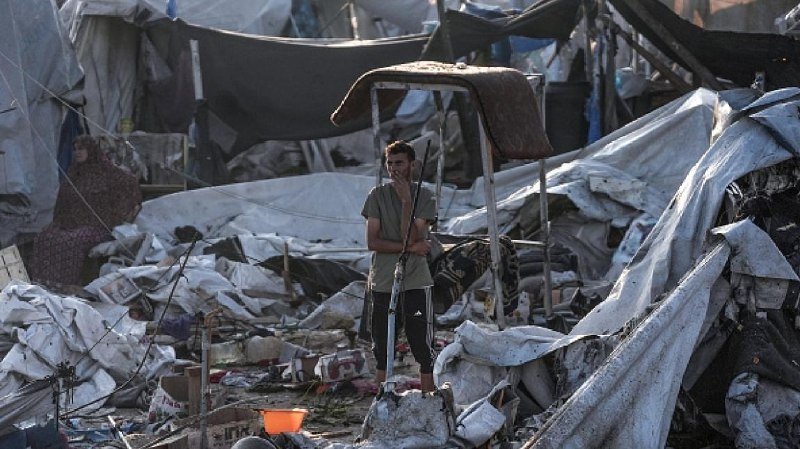
On the night of 29–30 June 2026, an Israeli airstrike hit a tent camp in Al-Mawasi, a narrow coastal strip west of Khan Yunis that the Israeli military has repeatedly designated as a humanitarian zone for displaced Palestinians. According to The Cradle Media, the strike killed 23-year-old Diana Abu Draz and her young daughter Siwar, and wounded others sheltering in the camp. The footage carried by the outlet shows torn canvas, scattered belongings, and residents pulling at rubble in the dark.
Al-Mawasi is supposed to be the safe zone. That is the framing baked into more than a year of Israeli military communiqués, which have directed civilians to relocate there from Rafah and northern Gaza and which have described the area, in the words of successive IDF briefings, as an expanded humanitarian zone. A strike that kills a mother and a child inside that zone, in tents the IDF itself told civilians to move into, is not a logistical error in the margins of policy. It is policy working as written.
The geography of a "safe zone"
Al-Mawasi is a thin band of dunes and orchards between Khan Yunis and the Mediterranean, never designed to absorb hundreds of thousands of people. Over the course of the war it has been re-designated, shrunk, and re-designated again as front lines moved. The Cradle's reporting from the morning of 30 June describes tents sheltering forcibly displaced people — language that matches what humanitarian agencies on the ground have used for months. The point is not that the camp was hidden. It was visible, advertised, and on every evacuation map.
When a designated safe zone is struck at night, the question that should follow is not what went wrong with targeting. It is what, in practice, the designation is worth. The wire services will run the IDF line: that the incident is under review, that Hamas operates from civilian areas, that Israel takes precautions. That line has been a constant through every previous strike on a school, a hospital, a UN-marked convoy. Each repetition makes the next one easier to print.
What the counter-narrative actually has to defend
The Israeli security argument is not invented. Rockets have been fired from Gaza into Israeli towns. Hostages were taken on 7 October 2023 and a number remain in captivity. The country has a right to defend its population, and that right does not evaporate because the war has gone on for twenty months. None of this is in dispute here.
What the argument cannot defend, and what is rarely confronted on the broadcasts that transmit it, is the logic of a safe zone that is unsafe by design. A humanitarian corridor that funnels civilians into a strip with no medical infrastructure, no sewage capacity, and no overhead protection is not a humanitarian corridor. It is a compression chamber. When an airstrike hits it, the term "incident" misdescribes the situation. The structural fact is that the people inside were there because the IDF told them to be there, and the people dropping the bombs knew they were there.
Sourcing and the asymmetry of the airwaves
A reader of the Western wires on 30 June will see, at most, a brief from Gaza correspondents. The fuller video record — tent poles bent sideways, a child's blanket, a man carrying a wounded relative — will run on outlets that Western editors describe, when they describe them at all, as aligned. Coverage routinely defers to the language of official spokespeople; the dissenting visual record gets pushed to channels the establishment press treats as不值得 citing. The result is not a lie. It is a tilt.
The Cradle's footage of the aftermath, posted on 30 June 2026, is not the only record. UN OCHA situation reports from earlier in the war have documented the progressive shrinkage of humanitarian space in Khan Yunis governorate, and Reuters and AP have run their own accounts of strikes in Al-Mawasi in previous months. But the gap between what is on the ground and what reaches a Western prime-time viewer on a Tuesday night in June remains wide, and it is widening rather than narrowing.
What is not yet known
The morning is too early for a verified casualty count beyond the names The Cradle has confirmed. The IDF had not, as of the timestamps on these reports, issued a public statement attributing the strike to a specific target. The sources do not specify whether the camp was inside the most recently declared boundaries of the expanded humanitarian zone or on its edge — a distinction that matters less to the dead than to the lawyers who will write about them later. What can be said with confidence is narrower than what is being said in any direction: a tent camp in a designated humanitarian area was struck overnight, a mother and her daughter were killed, and the pattern of such strikes has not, in twenty months, produced a course correction from any of the parties capable of ordering one.
That is the story. Not the names alone — the names matter, Diana Abu Draz and Siwar matter — but the structural fact that a safe zone, declared and re-declared, can absorb an airstrike that kills a child, and the news cycle continues to treat this as a footnote rather than a verdict. Until that framing changes, the war will continue to be covered in the language of incidents, and the incidents will continue to produce the same kinds of casualties.
Desk note: Monexus has run the available Telegram-sourced reporting on the Al-Mawasi strike as the factual baseline and resisted the temptation to attribute casualty figures beyond what the cited footage confirms. The framing — that a designated humanitarian zone has been struck and the dominant wire line has, as of 30 June 2026, yet to metabolise that fact — is editorial, drawn from the pattern of previous strikes rather than from any single report.
Wire provenance
This editorial synthesis draws on the following public wire/social posts:
- https://t.me/TheCradleMedia
- https://t.me/thecradlemedia