Alito, the birthright ruling, and a market that smells blood on the marble
A retracted NPR report, a public rebuke from a sitting justice, and a prediction market repricing in real time — the latest Alito episode is a stress test of how America's institutions communicate under algorithmic pressure.
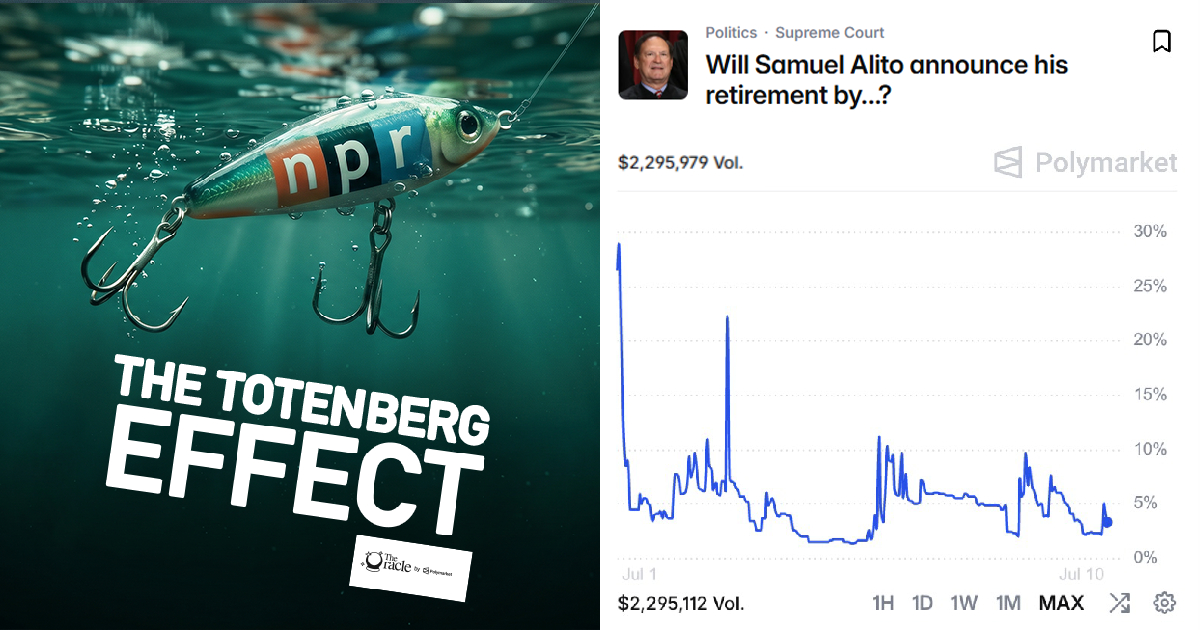
On the afternoon of 30 June 2026, a prediction market and a major newsroom disagreed — in public, in real time, and on the record. The friction is worth taking seriously.
The story so far. At 15:19 UTC, traders and journalists watching Polymarket saw a contract referencing Justice Samuel Alito light up after the justice publicly warned that the Supreme Court's recent birthright-citizenship ruling was "a mistake that will seriously affect the country's future." Roughly an hour later, at 16:35 UTC, NPR pushed back: it had retracted an earlier report claiming Alito was retiring, calling the piece a publish-in-error. By 16:36 UTC, the same Polymarket contract was sitting at a 45% implied probability that a retirement announcement would land before 31 December 2026.
The episode compresses three things that should be analysed separately. The first is a sitting justice's willingness, on the record, to publicly characterise his own court's work as a mistake — a posture more familiar from dissenting opinions than from active members of the majority. The second is a major outlet's decision to publish, and then retract, a retirement report, with the retraction itself distributed on the same prediction-market channel that traders were watching. The third is the way a market priced all of this inside an hour.
The Alito comment is the substantive anchor. Birthright citizenship — the constitutional question of whether the Fourteenth Amendment's citizenship clause ties to physical birth on U.S. soil regardless of parental status — is the kind of issue that exposes the fault lines inside a conservative supermajority. A justice publicly calling the majority's product a mistake, on a question this politically charged, is not normal decorum. It is a signal, and signals are tradable.
Then came the wire error. NPR's retraction is the kind of newsroom admission that used to live in a quiet editor's note. Here it was packaged as breaking news for an audience that already had skin in the game. The result: a single retracted report, filtered through a market, generated a tradable 45% number within an hour. A Polymarket contract of that size is no longer a curiosity — it is a public read on the probability of a Supreme Court vacancy.
The counter-narrative is straightforward and should be taken seriously. Prediction markets price narrative as readily as fact, and they are particularly reactive to ambiguous language from named officials. A justice calling a ruling "a mistake that will seriously affect the country's future" is, on its own, a statement of disagreement, not a resignation. The 45% figure could just as easily reflect market participants buying volatility, hedging existing positions, or front-running a future NPR correction. There is no retirement in evidence. There is a comment, a retraction, and a price.
The structural point underneath all of this is that the boundary between news, opinion, and tradeable signal has effectively collapsed. An institution speaks, an outlet misfires, a market reprices, and the misfire itself becomes the news. Every step is in public. None of it required a leak, a source, or a court filing. This is not a media failure so much as it is a communications stack designed for an earlier era trying to operate inside an information environment that prices its hesitation.
The stakes are concrete. A confirmed Alito retirement under a Republican administration would give a future president a second high-court vacancy and lock in a conservative supermajority for another generation. A non-retirement does not undo the comment — the comment is now in the public record, and a sitting justice calling his own court's product a mistake will be cited in briefs, op-eds, and confirmation hearings regardless of what Polymarket says. The market is not the story. The market is the meter.
What remains genuinely uncertain is whether Alito intended the remark as institutional dissent, a private grievance aired badly, or a precursor to something more. The sources do not resolve this. They give a quoted characterisation, a retracted wire report, and a probability. That is the entire evidentiary base — and it is, for now, enough to move a market but not enough to move a court.
This publication covers prediction markets as infrastructure for the news cycle, not as oracles. A 45% number is a price, not a forecast.
Wire provenance
This editorial synthesis draws on the following public wire/social posts:
- https://x.com/polymarket/status/2071996391807705088