Ankara's NATO line is hardening — and Washington is running out of room to ignore it
Turkey's defence minister says NATO is adapting to a new security environment and the US has no intention of leaving. The framing matters more than the reassurance.
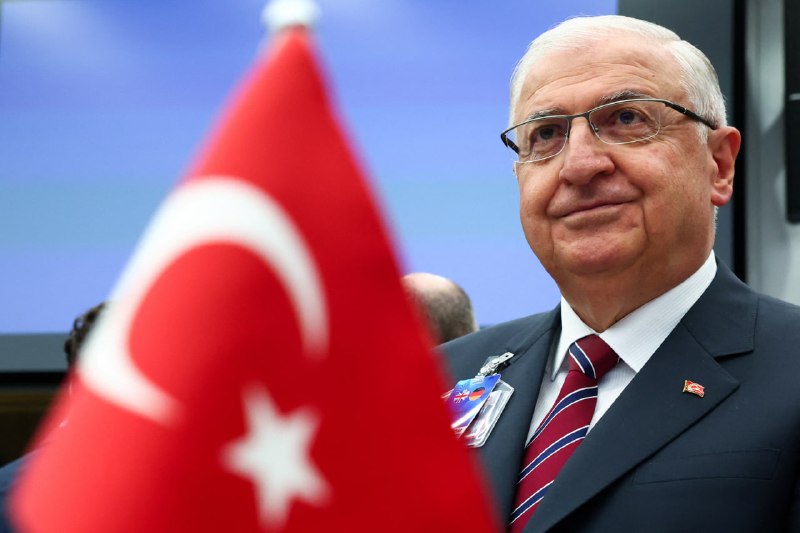
Ankara has spent the better part of two decades treating NATO as a relationship of managed friction — a useful shield, an awkward alliance, and a permanent irritant in equal measure. On 30 June 2026, the framing tilted again. Turkish Defence Minister Yasar Guler said NATO is "adapting to evolving security challenges," and that the United States "does not intend to withdraw from the alliance," according to a Telegram post by The Cradle Media summarising his remarks at 08:29 UTC. The two sentences, read separately, are a courtesy. Read together, they amount to a policy statement about who gets to define what adaptation means.
The reassurance that Washington is staying is, on its own, unremarkable. US forces remain forward-deployed across the Turkish east, Incirlik and Kürecik are still operational, and no serious reading of the transatlantic posture suggests an American exit. What is striking is the need for a Turkish defence minister to say it out loud, in public, in the same breath as "evolving security challenges." That is the language of an alliance whose members disagree about the direction of travel, and where the most strategically positioned member on NATO's southern and eastern flanks has decided it would rather anchor the public conversation than follow it.
What "adaptation" usually means in NATO
"Adaptation" is the alliance's favourite euphemism. In Brussels, it covers everything from command-structure reform and force-posture reviews to defence-spending benchmarks and the slow expansion of out-of-area missions. In Ankara, the same word has a narrower and harder meaning. Turkey's defence establishment has spent several years arguing that NATO's centre of gravity is drifting away from the conventional deterrence problems Turkey actually faces — long-range air defence in the eastern Mediterranean, missile and drone threats from the Levant, the persistent ambiguity on Cyprus, the question of Black Sea access after the war in Ukraine. Adaptation, in this telling, is not a synonym for enlargement. It is a synonym for relevance.
That is the subtext of Guler's line about a "new security environment." It is a polite way of saying that the threat picture NATO was designed around in 1989, or even 2002, is not the one its southeastern flank is staring at in 2026. Turkey is signalling, in other words, that any future alliance compact which leaves the eastern Mediterranean and the Caucasus as secondary concerns will be a compact Turkey is prepared to talk about, but not one it intends to follow passively.
The reassurance, and what it does not reassure
The second half of Guler's statement — that the US does not intend to withdraw — is the line the wire desks will lift, because it reads like the headline reassurance markets and European chancelleries want. Strip it of that framing, though, and the reassurance is thin. The United States is not, in any documented US policy text, on the verge of leaving NATO. Saying so is not a concession; it is the baseline. The interesting question is what the United States intends to do inside the alliance, and on whose terms.
Three points of friction are visible from Ankara's vantage, and Guler's careful wording does not paper over any of them. First, the S-400 question, where US-Turkish relations have been frozen around a sanctions framework that Congress has not shown any appetite to revisit. Second, the Syria and Iraq file, where Turkish operations proceed on a logic that is not always synchronised with US basing priorities at Incirlik or with the posture of US partner forces in the Kurdish north-east. Third, the Black Sea security architecture, where Ankara's position — a closed sea for warships of the littoral, under the Montreux framework, with Turkey as the gatekeeper — has acquired new weight since 2022. None of these files is resolved by a general statement of alliance loyalty.
Why Turkey is talking now
The timing matters. NATO's Washington summit in July 2025 produced the usual communiqués and a set of defence-spending commitments that have aged quickly in real terms. The alliance is heading into a 2026 cycle dominated by the question of sustained support for Ukraine, the future of the NATO Response Force, and a renewed debate over how to fund the eastern flank. Turkey, with the second-largest standing military in the alliance and the only NATO member that can credibly project into three contiguous theatres at once, has leverage at exactly this moment. Speaking first, and speaking in a register that combines reassurance with redefinition, is the cheapest way to use that leverage. It sets the terms of the next round of adaptation debates before Brussels or Washington has a chance to.
There is also a domestic audience. Guler's statement lands in a Turkish media environment where every NATO headline is read through the lens of national autonomy, and where the phrase "the US does not intend to withdraw" functions as a quiet rebuttal of the opposition talking point that Turkey is being slowly downgraded within the Western architecture. The reassurance is for Ankara's voters, as much as for Brussels.
The structural read
What we are watching is the slow hardening of a Turkish position that has been in formation for at least a decade. Turkey is not leaving NATO. It does not need to. It is doing something more durable: it is making its continued presence conditional on a definition of alliance purpose that fits its own threat environment. The reassurance Guler offered — that the US is staying — is paired with an implicit claim: and we are staying too, on our own terms. An alliance that has spent thirty years pretending it is a single entity with a single threat model is being told, politely and on the record, that this is no longer the operating assumption.
The counter-narrative in Western commentary will run along familiar lines: that Turkey is an unreliable partner, that the S-400 episode proved Ankara cannot be trusted with sensitive systems, that NATO discipline is being undermined. The structural counter-argument is that an alliance which cannot absorb the position of its most strategically placed southern member is not really an alliance in the strategic sense — it is a habit. The stakes, on a two-to-five-year horizon, are whether the 2026–2028 NATO work programme produces a real Turkish-American reset, or whether the relationship settles into a managed estrangement in which both sides continue to claim alliance membership while quietly acting on parallel tracks.
What remains genuinely uncertain is whether Guler's framing reflects a Turkish government position that has been cleared with the foreign ministry and the presidential palace, or whether it is the kind of mid-level statement that gets walked back in Ankara's quieter channels. The sources available do not specify. The pattern of recent Turkish defence messaging, however, is consistent with a line that has been cleared — and that is the read this publication finds most plausible on present evidence.
Wire provenance
This editorial synthesis draws on the following public wire/social posts:
- https://t.me/thecradlemedia