Germany's World Cup exit is not a referendum on the team — it is a referendum on the format
A four-time champion bows out at the first knockout round in Boston. The result stings, but the 48-team structure is the more durable story.
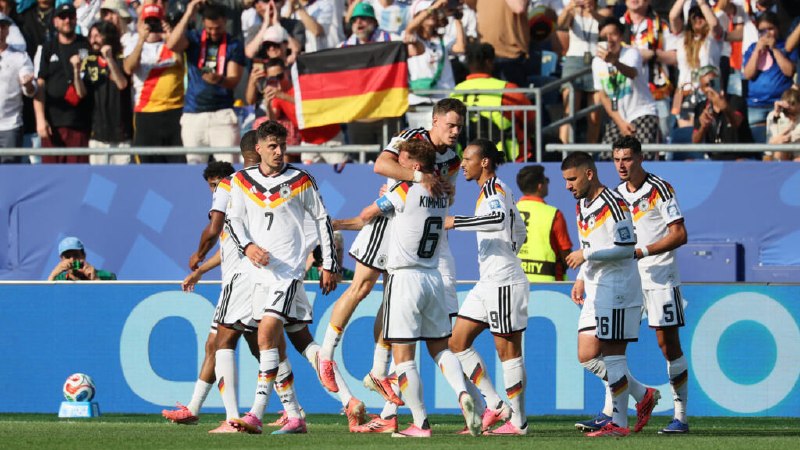
Germany is out of the 2026 World Cup. On 29 June 2026, in Boston, Die Mannschaft fell to Paraguay in a penalty shootout at the first knockout round. The result, confirmed by Deutsche Welle's match report at 23:37 UTC, has the obvious surface reading: a four-time champion humbled, a generation under scrutiny, a coach under pressure. That reading is fine, as far as it goes. It is also the reading that lets the deepest story in the room escape.
The structural story is the 48-team bracket itself. A tournament built to absorb extra participants from every confederation now produces the kind of result that, in a 32-team field, would have been confined to a distant group stage and filed away as an upset. In the 48-team era, it is the first thing the cycle produces. Germany's exit is not a fluke; it is the format working as designed.
What actually happened on the night
Per Deutsche Welle's 23:37 UTC dispatch, Germany lost in dramatic fashion against Paraguay at the first knockout stage in Boston, the match decided by penalties after 120 minutes could not split the teams. Earlier on the same evening, at 23:16 UTC, The Spectator Index's breaking-news wire had flagged the contest going to a shootout; the 23:46 UTC update from the same feed confirmed the outcome: Germany out, Paraguay through.
The on-pitch details beyond the scoreline are thin in the available reporting — the sources do not specify the penalty sequence, the goal scorers in open play, or the attendance figure. What the sources do establish, clearly and consistently, is that Germany, a four-time World Cup winner and one of the two or three historically dominant national sides in the men's game, failed to survive the round of 32.
The counter-narrative worth taking seriously
The comfortable counter-narrative is that Germany underperformed: a transitional squad, a manager still settling on a preferred XI, injuries to established starters, the standard answer that gets handed down whenever a heavyweight exits early. There is usually something to it. National-team football is, by definition, an exercise in stitching together club form into a coherent whole over a compressed calendar, and the seams show.
But Paraguay is not a routine opponent, and the framing of "upset" deserves a second look. Paraguay qualified from South America's famously brutal CONMEBOL qualifying campaign. They arrived at this tournament as a side that had earned its place through ten or more fixtures against Argentina, Brazil, Uruguay and Colombia. To call a CONMEBOL qualifier beating a European heavyweight an upset is, at this point, more reflex than analysis.
The structural frame
Here is the part the post-mortems will underplay. The 48-team World Cup is a political document as much as a sporting one. It is the product of a specific bet by the game's governing body: that broadening access to the finals — more African nations, more Asian slots, more South American representation — would produce a richer tournament and a larger commercial product. The expansion has, in fact, delivered on the commercial promise. It has also redrawn what an early exit looks like.
In a 32-team field, a group-stage elimination of Germany would have been a four-match story: three group games, the knockout that never came, and a flight home. In a 48-team field, the same squad gets a fourth match — a knockout tie — and the chance to lose it from the spot. That is what happened in Boston on 29 June 2026. The early exit is the same; the surface area for it is wider, and the optics for the federations involved are accordingly worse.
The deeper point is that the format now reliably produces "marquee eliminations" in the first knockout round. That is not a bug; it is the geometry. Forty-eight teams, more slots, more variance, more opportunities for a competitive side outside the traditional core to catch a flat favourite at the worst possible moment. The eventual champion will have navigated more knockout football than any previous champion did. The teams that don't navigate it will be talked about as failures, when in many cases they are simply the casualties of a structure designed to produce exactly these results.
Stakes and what to watch next
For the German federation, the practical questions are conventional: squad regeneration, coaching review, qualification pathway for 2030. Those answers can wait a week. The harder question is structural, and it belongs to the confederations and to FIFA: whether the 48-team format, having now produced two cycles' worth of evidence, is delivering the kind of tournament its architects promised — or whether it is mostly delivering more games, more commercial inventory, and a longer list of federations with first-round knockout scars to manage.
For the wider game, the watch-items are specific. How far does Paraguay go? Can a CONMEBOL side other than the traditional three reach the latter rounds, as they periodically threaten to? And does Germany's exit accelerate a conversation about squad-building models — Bundesliga youth pipelines versus the Premier League's gravitational pull on German talent — that has been deferred for a decade? The sources do not yet tell us. They will, soon enough.
How this piece was framed: the wire led on the upset. Monexus treats the result as a legitimate football story and reads the format itself as the under-acknowledged second story inside it.
Wire provenance
This editorial synthesis draws on the following public wire/social posts:
- https://t.me/s/osintlive
- https://t.me/s/osintlive