Hezbollah's red line: what the Lebanon-Israel framework actually changes
Israeli jets hit Siddiqin outside the security zone on the same day Aoun promises 'not an inch' and a former US diplomat calls Trump's Hezbollah-disarmament line 'ridiculous.' The framework is being negotiated while the air campaign keeps running.
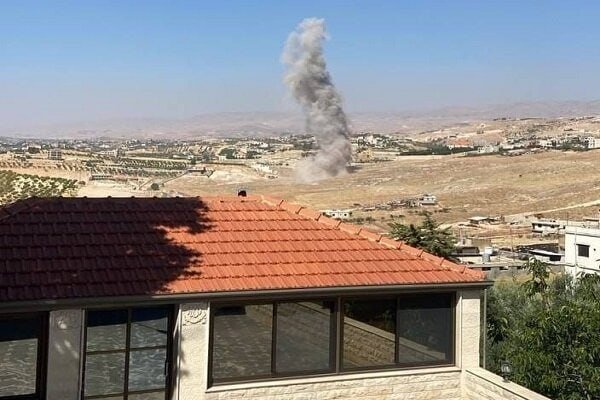
Two Israeli airstrikes hit the town of Siddiqin in southern Lebanon late on 2 July, wounding two Lebanese civilians and leaving secondary explosions visible on open-source footage, according to concurrent reports from war monitors on the ground and regional outlets aligned with the resistance axis (WarMonitors, Al Alam, PressTV, Fars, Tasnim, Al-Mayadeen via Fars). The strikes landed outside the announced security zone, a detail noted by the open-source witness channel Warfield Witnesses, and they landed on the same day that a former senior American diplomat publicly ridiculed the United States' stated disarmament objective for Hezbollah. The geometry is the story: Israeli airpower still operates freely over the Lebanese south, the political track in Beirut is publicly promising not to cede "an inch," and an American-aligned framing of the conflict's endgame is being dismissed, in print, by people who used to carry the brief.
The framework being negotiated is therefore best read as a contested architecture, not a finished diplomatic fact. Lebanese President Joseph Aoun told France 24 on 2 July that Beirut's talks with Israel are "not a betrayal" and that Lebanon will not give up "not an inch" of territory. That statement was made as Israeli jets were again hitting villages in the country's south. If the framework is meant to lock in a cessation of hostilities along with an Israeli withdrawal from positions held since the autumn escalation, then Siddiqin, struck at roughly 22:30 UTC on 2 July, is the empirical test of whether the framework is a constraint on daily operations or merely the wrapper over them.
The red line that has not moved
Hezbollah's stated red line, as conveyed through regional outlets aligned with the resistance axis, is that the movement's disarmament is a non-starter, and that any agreement which crosses that line is illegitimate before it is signed. That position has now been echoed, in unusually blunt terms, by a former American official. Jeffrey Feltman, a veteran American diplomat, told the National newspaper that Donald Trump's public statements about the disarmament of Hezbollah are "ridiculous," according to a 2 July summary carried by Tasnim. The significance is not the insult. It is the venue: a former senior State Department figure, on the record, treating the headline American demand as unserious. For a Lebanese negotiating team that is being told in private that it must secure disarmament commitments in exchange for ceasefire guarantees, the appearance of daylight between the American political messaging and the American diplomatic consensus is not a technicality. It is leverage.
At the same time, the Israeli air campaign in the south continues on a tempo that does not look like winding down. The 2 July strikes on Siddiqin, reported across at least six separate channels including PressTV, Tasnim, Fars, Al Alam, WarMonitors and Warfield Witnesses, injured two civilians and produced visible secondary detonations. Reporting framed the target as outside the security zone that Israel has publicly demarcated for its operations. The pattern, in other words, is the framework being negotiated in Beirut while the operational map on the ground is drawn somewhere else entirely.
What Aoun is buying
President Aoun's France 24 intervention, defending the talks as legitimate and ruling out any territorial concession, is the political move that makes a deal conceivable without collapsing the Lebanese state. Aoun's base includes constituencies that will read any framework as surrender unless the territorial language is explicit. "Not an inch" is the formulation that lets him sit at the table. Whether it lets him sign is a separate question.
Israeli Foreign Minister Gideon Sa'ar, separately on 2 July, characterised Turkish Foreign Minister Hakan Fidan's recent remarks as "an explicit call to destroy Israel," according to Al Alam. That exchange matters because it confirms the regional track is not converging. Ankara is rhetorically aligned with the resistance axis on the question of Israeli operations, Beirut is publicly defending its own negotiating posture, and Jerusalem is publicly treating parts of that regional rhetoric as casus belli. A framework that is supposed to stabilise one bilateral frontier is being negotiated inside a wider diplomatic weather system pulling in the opposite direction.
The Bazan variable
The leverage is not symmetric. Middle East Eye reported on 2 July that the damage to the Bazan refinery in Haifa, Israel's largest, is "much more extensive than what has been announced by the company or the Israeli government," and that repair work will take years. That detail, carried via the Sprinter Press account, recasts the strategic question. If Israeli critical energy infrastructure is genuinely impaired on a multi-year horizon, the cost calculus for sustained aerial operations in the south changes shape. Beirut does not need to win the air war to alter its terms. It needs the other side to feel the bill.
What the framework actually changes, then, depends on which of these facts the text puts in writing. If the document binds daily flight operations to a political clearance mechanism that the Lebanese side can trigger, Siddiqin is the precedent that tests it. If it merely reaffirms the existing ceasefire language while deferring the disarmament question, Siddiqin is the template that continues, and Feltman's "ridiculous" becomes the most honest summary of the American position on offer.
What to watch next
Three dates will clarify which architecture is being built. First, whether the Israeli air campaign inside the announced security zone produces a formal Lebanese complaint through whatever channel the framework creates, or whether the strikes outside the zone, like Siddiqin on 2 July, continue uncounted. Second, whether Feltman's framing is picked up by other former American officials or contradicted by sitting ones; the gap between the two is the working assumption a Lebanese negotiator can either lean on or be told to ignore. Third, whether Aoun's "not an inch" formulation survives the first leak of a draft text, or whether the territorial language is softened in private to a formula that can be sold in Beirut and signed in Washington.
The framework's red lines, on the Lebanese side, are not a mystery. They have been stated on camera by the president, repeated by the movement, and now endorsed, from an unexpected direction, by a former American diplomat. The framework's red lines on the Israeli side are less legible: what is being conceded in the air, on the ground in the south, and at the Bazan refinery is not the same conversation as what is being conceded at the table. Siddiqin, at 22:30 UTC on 2 July, is what the gap looks like in real time.
Sources
- France 24 on Telegram: President Aoun on Lebanon's negotiations with Israel, 2 July 2026. https://t.me/france24_fr
- PressTV on Telegram: Israeli airstrike on Siddiqin, southern Lebanon, 2 July 2026. https://t.me/presstv
- WarMonitors on Telegram: Strike on Siddiqin with secondary explosions, 2 July 2026. https://t.me/WarMonitors
- Warfield Witnesses on Telegram: Strikes outside the security zone, 2 July 2026. https://t.me/wfwitness
- Tasnim on Telegram: Feltman on Trump's Hezbollah disarmament remarks, 2 July 2026. https://t.me/tasnimplus
- Al Alam on Telegram: Sa'ar on Fidan's remarks, 2 July 2026. https://t.me/alalamarabic
- Middle East Eye via Sprinter Press on X: Bazan refinery damage assessment, 2 July 2026. https://x.com/sprinterpress
Desk note: Monexus framed the framework as a contested architecture rather than a settled diplomatic outcome. Hezbollah's veto threat was drawn from regional outlets aligned with the resistance axis and is presented as the movement's stated position, with that sourcing caveat attached. The Feltman line is included because it is an unusual public break in the American consensus on the disarmament ask, and because it directly shapes what a Lebanese negotiator can plausibly claim is on offer.