Israel's Lebanon buffer, the 'framework agreement,' and the disappearing accountability problem
An Israeli minister says southern Lebanon's Shia villages 'had to disappear.' A framework deal may shield the perpetrators. The two stories sit on the same map.
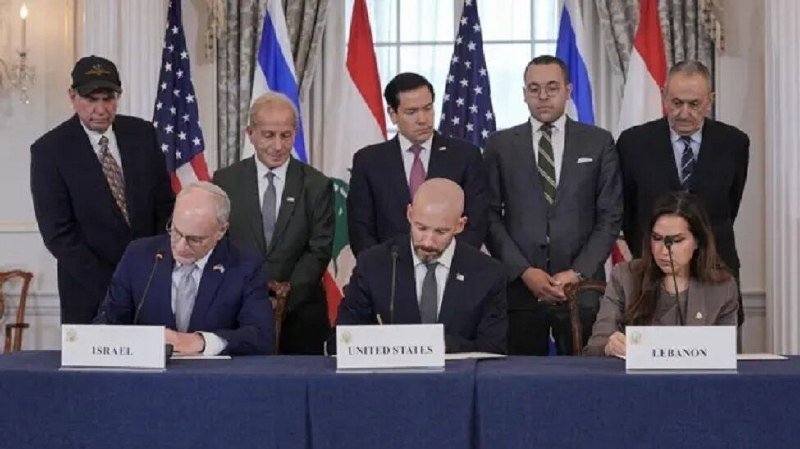
An Israeli minister has said, on the record, that southern Lebanon's Shia villages were always meant to "disappear." On the same day, 30 June 2026, Prime Minister Benjamin Netanyahu toured what Israel is calling a "security zone" inside Lebanese territory. The two items arrived in sequence, and they belong together: the framing and the footnote.
What is being negotiated under the name of a "framework agreement" between Israel and Lebanon is not a routine ceasefire protocol. According to legal experts cited by Middle East Eye on 30 June 2026, a provision inside the draft arrangement could insulate parties — Israeli forces, allied militias, and presumably the Lebanese state — from war-crimes accountability. The mechanism is technical. The consequence is not. It would convert a contested military campaign into a settled administrative fact before any court has examined it.
The framing that came first
The minister's statement — that Shia villages in the south were always meant to be erased — is not a slip. It is the verbal map of a policy that Israeli officials have been describing for months in geographic, rather than legal, language: a buffer cleared of the population from which rocket fire, drone infiltration, and Hezbollah ground activity historically emanated. Israeli security concerns about the southern frontier are real and long-standing. They are also the reason that an entire confessional civilian population has, in the words of a sitting minister, become an object to be made to vanish.
Netanyahu's visit to the declared "security zone" on 30 June 2026, reported by Telegram channel ClashReport, is the physical counterpart to that verbal map. The tour is a signal to the domestic base that the zone is real, Israeli, and intended to persist. A buffer that persists, by definition, is not a temporary security measure. It is a territorial arrangement.
What the "framework agreement" actually does
Legal scholars quoted by Middle East Eye on 30 June 2026 warn that the framework text contains a clause that could foreclose war-crimes prosecutions related to the campaign that produced the buffer. The argument from the critics is narrow and procedural: an agreement that grants immunity, even indirectly, becomes a statute of limitations by other means. Once in force, it pre-empts the international and domestic legal channels — ICC referrals, universal-jurisdiction cases in third states, Lebanese domestic prosecution — that would otherwise have standing to examine conduct during the conflict.
The standard counter from supporters of the framework is that peace and accountability are sequential, not simultaneous: a stable border first, trials later, if at all. The history of postwar settlements offers competing evidence. Some peace agreements — the Lomé Accord of 1999, the 1998 Good Friday Agreement — explicitly reserved the right to prosecute. Others effectively traded justice for closure. There is no abstract reason a framework must do the latter. The choice is the text's.
Why the sequence matters
The order in which the two stories landed on 30 June 2026 is the story. First, a minister on the record explains that a civilian population was always the target. Then, hours later, a draft legal instrument circulates that could foreclose accountability for how that population was treated. Read in either order, the combined effect is the same: declare the population disposable, then lock the declaration into a bilateral architecture.
This is the structural pattern worth naming plainly. A buffer zone is justified as a defensive measure against rocket and drone fire from across the border. A diplomatic instrument that bundles that zone with immunity provisions does not, in fact, defend Israeli civilians from Hezbollah's arsenal — that is done by airpower, ground manoeuvre, and interception. What the instrument defends is the decision-making that produced the buffer: the ministerial authorisation, the operational orders, the displacement, the destruction. The security argument is a present-tense claim. The immunity argument is a permanent one. They are not the same thing wearing the same coat.
The counter-read, and why it does not hold
The strongest counter-position is that a sovereign Lebanese government has every right to negotiate a border arrangement that serves its own stability, and that a Lebanese Shia civilian population cannot be made hostage to a maximalist interpretation of international criminal law. That is a real argument. It rests on a fact often omitted in Western coverage: Lebanon's state is weak, its Shia population has been politically instrumentalised for decades by parties that were, at various points, armed clients of the Islamic Republic, and the southern frontier genuinely has been a launch pad.
None of which, however, discharges the question of conduct during the campaign. A government that negotiates immunity as the price of a buffer is choosing, in writing, not to ask what was done in its name. The Lebanese public, the Shia villages named by the Israeli minister, and the international institutions that have standing under the Rome Statute are not parties to that bargain. The counter-read explains the framework. It does not legitimise the immunity clause. Those are two different judgments.
What remains uncertain
The text of the framework agreement has not been published in full, and Middle East Eye's reporting describes the immunity concern as a worry expressed by legal experts about a "provision within" the draft, not as a confirmed clause. The identities of the parties to the immunity provision — whether it is mutual, asymmetric, or contingent on a future waiver — are not in the public reporting. Netanyahu's visit to the security zone is described by ClashReport, a channel that aggregates field footage, and the tour's specific coordinates and announcements have not been independently verified in the source material available. A deal that disappears accountability is a serious claim. It deserves a verified text, not a paraphrase.
Stakes
If the framework is signed in something close to its current form, the southern Lebanese Shia villages that an Israeli minister says had to disappear will have, in effect, been made to disappear twice: once from the land, and once from the legal record. The first disappearance is contested and arguably defensible on the narrowest security reading. The second is not defensible at all. It is a choice, taken in advance, not to know what was done. The international legal order that emerged from Nuremberg and was rebuilt at Rome depends, in practice, on a much smaller proposition: that some things cannot be agreed away before anyone has looked. If this framework stands, that proposition is what's on the table.
This article was written by Monexus editorial based on wire reporting from Middle East Eye and field material circulated by ClashReport. The two source streams have been kept distinct throughout — policy statements attributed to officials are flagged as such, and operational footage is described as field material rather than confirmed on the record.
Wire provenance
This editorial synthesis draws on the following public wire/social posts:
- https://t.me/ClashReport