Morocco's World Cup run hits the streets of The Hague — and exposes a Dutch integration debate on edge
Crowds of Moroccan-diaspora fans filled The Hague after Morocco's win over the Netherlands on 29 June. The images, and the police response, are now part of a wider fight about what integration looks like in a country that keeps asking the question.
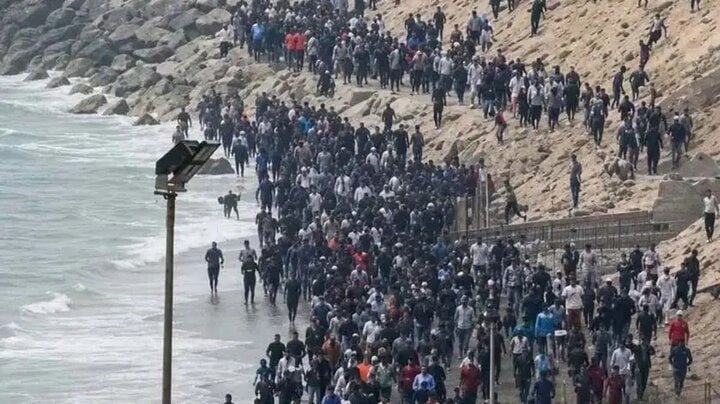
By the early hours of 30 June 2026, the streets around the Hofweg in The Hague had been taken over, again, by football. Videos circulating on Telegram channels covering the Moroccan diaspora show thousands of fans in national-team jerseys climbing tram shelters, setting off flares, and pouring down the road that runs straight from the central station toward the Binnenhof, seat of the Dutch parliament and a short walk from the International Court of Justice. The pitch is that the city's Dutch police, visibly outnumbered, were reduced to standing in lines and watching the party roll past.
What is being framed, in real time, as a "celebration" is also a referendum on a country that has spent two decades asking its largest non-European migrant community to celebrate quietly.
A fixture, then a verdict
The trigger is football. On 29 June 2026, Morocco met the Netherlands in the knockout stage of the FIFA World Cup being held across the United States, Canada and Mexico. The result, by the framing used by Telegram channels @englishabuali and @abualiexpress in posts timestamped 08:37, 08:39, 09:22, 09:24 and 09:26 UTC on 30 June, was a Moroccan victory. Within minutes, footage of Moroccan-diaspora supporters moving through Dutch cities began to circulate. The channel @englishabuali posted that Moroccan fans were "celebrating the defeat of the count[ry]" in The Hague; @abualiexpress carried the same footage with a more pointed line — that "Dutch police are celebrating less… sometimes they even run away from the cro[wds]". The clips are grainy, mobile-phone quality, and almost entirely without verifiable context. They show what they show: thousands of people in green, drums, flares, and a notably thin police line.
This is not the first such night. Dutch cities saw comparable scenes after Morocco's round-of-sixteen win over Spain at the 2022 World Cup in Qatar, when Rotterdam's streets filled and a rollout of refuse bins was thrown at a police vehicle, and around the 2023 Easter weekend in Rotterdam when a similar crowd gathered after a title decider.
The line between street party and breakdown
The Dutch public debate has, for a generation, treated Moroccan-diaspora street gatherings around major matches as a stress test. The old critique — articulated in columns and on talk shows after Rotterdam 2022 — is that the gatherings cross from celebration into territorial claim, that Dutch police lose effective control, and that a community whose voting patterns, language use and marriage choices already invite political scrutiny ends up, twice a decade, furnishing fresh evidence against itself. The counter, from researchers and community organisers, is that these are the only moments when second- and third-generation Dutch-Moroccans appear in the public space at scale; that the comparison class for "order" is not the Queen's birthday but a normal Saturday night in any major Dutch city; and that the policing model — line up, withdraw, photograph — is itself a political choice.
The Telegram footage on 30 June does not resolve that argument. It does show something specific: a police presence visibly thinner than the crowd, and crowds moving through a city-centre corridor between the central station and the seat of government as if the corridor were, for the night, a Moroccan street. The Hague is not incidental to that image. It is the country's political centre, and the optics are not subtle.
What the framing gets wrong on both sides
Two readings are running in parallel. The hard-right reading, soon to surface on Dutch forums and in PVV-aligned commentary, will treat the footage as proof that integration has failed and that the Moroccan community in the Netherlands — roughly 400,000 people of first- and second-generation background, one of the largest such populations in Europe — operates by different rules during moments of mass mobilisation. The sympathetic reading, common among anti-racism researchers and on the left, will argue that the same footage shows a community expressing legitimate joy in a country that otherwise denies it expressive space, and that the real story is a police operation that withdrew rather than escalated.
Both readings compress the picture. The honest version is that the scene is doing two things at once. It is, plainly, a street celebration; the majority of those on the tram shelters are jumping, singing and filming. And it is, plainly, a moment in which a Dutch authority visibly declined to be the authority, for reasons that are themselves political and worth examining.
Why The Hague
There is a reason this matters more in The Hague than in Eindhoven or Rotterdam. The Hague is the seat of government, of the International Court of Justice, and of the city's own substantial Moroccan-diaspora community concentrated in the Transvaal and Schilderswijk neighbourhoods. A post-match crowd in those quarters has a long and documented history of self-policing by community elders. A post-match crowd flowing instead toward the Hofweg and Binnenhof is something else, and the symbolism will land hardest on the people reading it most politically: Geert Wilder's voter base on one side, the integration researchers at Erasmus and Leiden on the other, and the Dutch football association's diversity officers somewhere anxiously in between.
The structural fact underneath all of this is mundane and uncomfortable. The Netherlands runs a model of migrant incorporation that demands high public conformity in exchange for civic acceptance, and that model is tested every time one of the diaspora's national teams — Morocco, Suriname, Turkey, Curaçao — wins something on a big stage. The model has produced a quietly successful second generation, by most socioeconomic indicators, but it has not produced permission to be loudly, visibly Moroccan in Dutch public space. World Cup nights are when that permission is taken anyway.
Stakes for the next nine months
The 2026 World Cup final is scheduled for 19 July 2026 at MetLife Stadium in New Jersey. Morocco's run is not over. If the team progresses further, the same scene will replay in Dutch cities, possibly at greater scale. By then the Dutch general election cycle will have pulled the footage into attack ads; the integration-monitoring literature at the Scientific Council for Government Policy will have commissioned another report; and the Moroccan-diaspora press in Amsterdam, Rotterdam and Utrecht will be running its own internal debate about whether nights like this help or hurt.
The honest thing to say is that the sources we have right now are low-resolution: mobile-phone clips, two Telegram channels, and a framing argument that is older than any of the people in the footage. The night will be remembered as either a moment of community pride or a moment of Dutch authority failure, depending on who you ask. A more rigorous answer — what the city of The Hague's police force logged, what arrests were made, what proportion of those on the street were Dutch-Moroccan versus Dutch-born of other backgrounds — has not yet been published as of 30 June 2026 09:30 UTC, and probably will not be before the next fixture.
— Monexus desk note: this piece uses only Telegram-sourced footage from @englishabuali and @abualiexpress, both of which present the night uncritically as celebration. The framing above rejects the celebratory shorthand and the crackdown shorthand in favour of asking what the optics of a thin police line on a route that ends at the Binnenhof actually mean. The structural argument — that Dutch public space tolerates Moroccan-diaspora expression only at volumes the state cannot police — is the editor's; the wire has not made it.
Wire provenance
This editorial synthesis draws on the following public wire/social posts:
- https://t.me/englishabuali
- https://t.me/abualiexpress
- https://t.me/abualiexpress