Paraguay stun Germany on penalties as Gill's arc from sold boots to last-16 hero completes
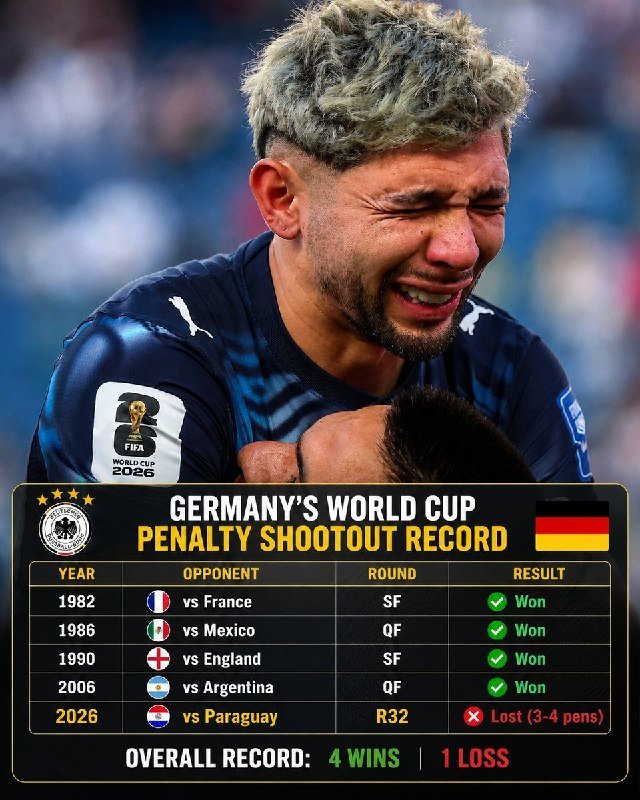
Four-time winners Germany are out in the last 32 after a 1-1 draw and a 4-3 penalty loss to Paraguay — a knockout sealed by the same goalkeeper who sold his kit to feed his family 18 months ago.
Orlando Gill's afternoon, on 30 June 2026, did not start well. The Paraguay goalkeeper was on the wrong end of a VAR intervention in extra time that denied Germany's Jonathan Tah a goal his teammates thought had levelled the tie, and the BBC commentary described the original on-field decision as "terrible". Gill stayed standing. By the end of the night, the same goalkeeper had faced four German penalties and saved enough of them to send a four-time world champion home in the last 32.
Germany, four-time winners of the World Cup, are out of the 2026 tournament after a 1-1 draw with Paraguay that finished 4-3 to the South Americans on penalties. Paraguay advance. The result is a story about officiating, about a side that refuses to outrun its own reputation, and — most of all — about a goalkeeper whose journey to this moment required him to sell the boots that ought to have carried him through it.
How the match broke
The game in the regulation ninety was tight enough that neither side could separate cleanly, and extra time brought the controversy that will dominate German replays for some time. Jonathan Tah, the German defender, had a goal ruled out for a foul by his centre-back partner Waldemar Anton on Gill inside the Paraguay penalty area, with the BBC reporting the call as a "terrible decision" against the Germans. Beyond the framing from one studio, the technical fact is that VAR — not the on-pitch referee — was the one whose call survived.
Penalties followed. Germany took four, Paraguay took five. Paraguay made theirs count by a margin of one. The full sequence of kicks was published in shot-by-shot form by BBC Sport shortly after full time, and German misery is preserved there in clean, slow-motion detail.
Gill's arc, in his own story
The more durable story is personal. Eighteen months before kick-off in this round-of-32 tie, Gill was, by his own account to BBC Sport, on the margins of professional football and improvising to keep a newborn son fed. He sold his kit — the boots, the gloves, the small physical inventory of a career — to support his family after the premature birth of his child. The same hands that held the family's finances together in that period held the line in the shootout in this one.
The arc is the kind of detail international football turns into its own lore. It also makes the tactical point: a goalkeeper who has had to carry that kind of weight off the pitch is rarely fragile on it. Paraguay's coaching staff have, in effect, a player whose concentration is built differently from a goalkeeper whose worst week was a bad training session.
What the German end looks like, and what it does not prove
The VAR call is the headline for the German press, and it is a fair headline. A foul is a foul, and a foul by the partner of the goalscorer in the build-up to a goal does satisfy the technical letter of the law. Whether it satisfies the spirit — whether the contact was enough to nullify a finish — is the kind of judgement the on-pitch referee originally made in Germany's favour, and the kind of judgement VAR is now widely accused of over-reaching on. The Germans have a legitimate grievance. They also lost the lottery of kicks that followed the non-decision, which is the part of the night that is harder to grieve about and easier to fix.
The structural reading is harsher for Germany than for the officials. A side ranked among the favourites to go deep into this tournament has been eliminated at the first knockout round by a nation that did not even qualify for the 2022 World Cup. Order-of-tournament outcomes like this are less common than the betting markets assume, but they are not freak occurrences: eight of the last ten World Cups have seen at least one former champion fail to reach the last eight.
What remains genuinely uncertain
The VAR call will be reviewed under standard processes, but replays do not award goals retrospectively in this tournament. The German federation's response, and whether the German public mood treats this as an officiating outrage or as a structural failure of the squad, will become clearer in the days after the result. Paraguay, for their part, will face either a runner-up from another group in the last 16 — a fixture that, on the evidence of this match, they will not fear — with a goalkeeper whose legend has just begun to compound.
This publication framed the result through the goalkeeper's pre-tournament arc rather than the VAR call, on the view that the officiating moment will resolve itself in procedural review and the personal story will not.