Poland's Two Conditions: Warsaw Holds MiGs and EU Talk Hostage to Bandera and Drone IP
Warsaw has coupled two unrelated files — MiG-29 transfers and EU accession rhetoric — to demands on historical memory and drone technology sharing, hardening the bilateral relationship within a single news cycle.
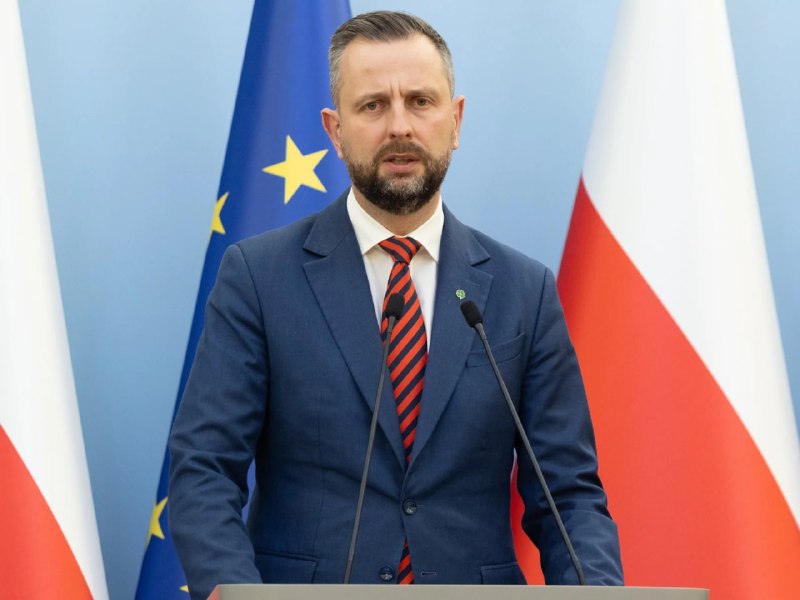
On the morning of 30 June 2026, Polish Defence Minister Władysław Kosiniak-Kamysz made two announcements that, read together, reframe the Polish-Ukrainian relationship in unusually transactional terms. Within hours of each other, Warsaw confirmed it would not deliver MiG-29 fighter jets to Kyiv after Ukraine declined to share drone-production technology, and warned that Ukraine cannot join the European Union "with Stepan Bandera on its banners." The coupling of a hardware transfer, an industrial-policy demand and a historical-memory condition into a single news cycle is not a coincidence; it is a statement about how a frontline NATO state intends to price its support.
The MiG question, on its own, looks like a procurement dispute. Warsaw had proposed "MiGs in exchange" for Ukrainian drone know-how, according to a report circulated by the noel_reports channel at 06:12 UTC on 30 June; Ukraine refused, and the deal is now off the table. The Bandera question, on its own, looks like domestic Polish politics — a coalition partner signalling to voters uneasy about wartime memory politics in western Ukraine. Read together, they suggest a government that has decided bilateral support will be conditional, itemised, and publicly justified.
The MiG-for-drones swap that wasn't
Polish reasoning, as relayed through the Telegram channels noel_reports and uniannet on the morning of 30 June, is procedural rather than punitive: Warsaw asked for technology, did not receive it, and walked away. The framing fits Poland's broader push to deepen its own defence-industrial base rather than act as a transit hub for foreign platforms. The Polish defence ministry has spent the past two years positioning Warsaw as a manufacturing and assembly hub within the European defence market, and a one-sided transfer of combat aircraft without reciprocal industrial access sits awkwardly inside that logic. From Kyiv's side, drone technology is among the few assets Ukraine holds that genuinely shapes the battlefield; surrendering production know-how to a NATO ally, however friendly, is a strategic calculation with costs that extend well beyond the airframes Poland was offering.
There is a counter-read. Some Western commentators, watching the exchange from a distance, will frame Polish behaviour as transactional at a moment when Ukraine can least afford conditional friendship. That reading has a kernel of truth: even allies inside NATO expect each other to absorb costs in the name of collective security, and itemising every transfer undermines the solidarity rhetoric that has defined European support since February 2022. But the alternative — Warsaw quietly handing over aircraft and walking away from the drone question — would have produced an equally loud complaint from Polish voters and from the defence-industry lobby in Lublin and Bydgoszcz. The government chose the louder, more public version.
Bandera, banners, and the politics of accession
The Bandera warning is harder to parse as pure industrial policy. Stepan Bandera, the early-twentieth-century Ukrainian nationalist whose legacy is contested between Kyiv and Warsaw — venerated in parts of western Ukraine, vilified in Poland for the wartime massacres in Volhynia and Eastern Galicia — sits at the centre of a memorial dispute that has flared repeatedly since Russia's full-scale invasion. By tying Bandera imagery to EU accession, Kosiniak-Kamysz is doing something specific: he is telling Kyiv that the political-symbolic terms of integration are not a Ukrainian domestic matter alone. Polish public opinion on the question is not monolithic, but the centre of gravity in Warsaw has long held that unresolved historical disputes with Ukraine are an obstacle to deeper institutional ties.
The structural frame is straightforward. EU accession is a process in which candidate states must demonstrate adherence to a body of norms — rule of law, minority rights, the political conditions attached to membership. Poland, as a state that has spent two decades inside those negotiations on its own behalf, knows the machinery better than most. By speaking publicly about Bandera in the context of accession, Warsaw is signalling that bilateral historical grievances will be raised at the table, not buried in working-group annexes. The framing is blunt, but the underlying claim — that unresolved memory politics complicate the trust required for membership — is one Ukrainian officials have heard before, in private, from German, Israeli, and Baltic counterparts in various registers.
What Warsaw is buying, and what Kyiv is losing
The two announcements land at a moment when Ukraine's external support is structurally constrained. The American pipeline is hostage to a domestic budget cycle in Washington, European ammunition production is still ramping, and Kyiv's battlefield position depends on a small number of suppliers willing to bear political risk. Within that setting, Poland is signalling that it intends to remain a reliable partner — but a partner that prices every transfer. The MiG reversal costs Ukraine a tactical asset it had been quietly hoping to absorb; the Bandera warning costs Ukraine something softer but durable, the assumption that its symbolic vocabulary inside the EU accession process is its own business.
The counter-narrative, more sympathetic to Kyiv, holds that Poland is exploiting Ukrainian dependency to extract concessions it would never have demanded of a stronger negotiating partner, and to settle historical scores that belong in a different forum. There is force in that reading: weaker states absorb the conditions that stronger ones refuse to discuss. But the dominant framing — visible across the Telegram coverage of 30 June — is that Poland is doing what EU accession candidates have always been asked to do: demonstrating, in word and deed, that they have absorbed the political norms of the club they wish to join. The fact that those norms are being itemised more aggressively than usual is itself a signal about how the EU intends to manage the next enlargement round.
The stakes, plain
If the trajectory continues, two things become likely. First, Poland's defence-industrial base becomes more deeply integrated with Ukrainian drone production through some other vehicle — a joint venture, a licensed-assembly arrangement, a Polish-bought tranche of intellectual property — because the strategic logic on the Polish side does not depend on this particular deal collapsing. Second, the Bandera question moves from diplomatic background noise to a recurring item on the EU accession checklist, where it will sit alongside judicial reform, anti-corruption benchmarks, and minority-rights reviews. Neither outcome is catastrophic for either side; both raise the transaction costs of the relationship in ways that will be visible for years.
What remains genuinely uncertain is whether Warsaw coordinated the two announcements within the Polish coalition, or whether they reflect the Defence Minister's personal accumulation of files onto a single press cycle. The Telegram sources cited above do not specify; readers should treat the coherence of the message as a hypothesis worth testing, not as an established fact.
Desk note: Monexus reports this file as a single, coupled Polish policy signal rather than as two unrelated stories, on the ground that Warsaw released both within the same morning news cycle and through overlapping ministerial voice.
Wire provenance
This editorial synthesis draws on the following public wire/social posts:
- https://t.me/ClashReport
- https://t.me/noel_reports
- https://t.me/uniannet