Sentinel revealed: a missile the public wasn't supposed to see
Northrop Grumman's release of imagery of the LGM-35A Sentinel breaks the usual silence around the most sensitive leg of the US nuclear triad — and reopens a debate about cost, deterrence, and what taxpayers are buying.
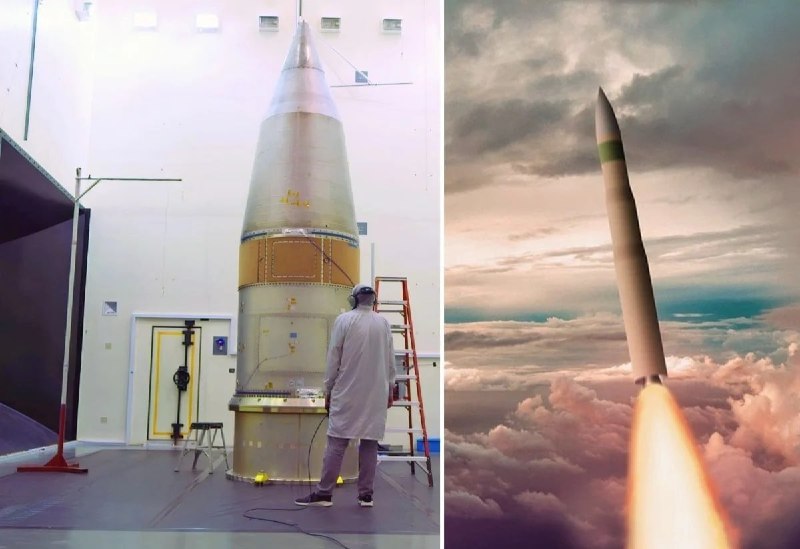
For most of the last half-century, the most dangerous weapons in the American arsenal have been the ones Americans see least. The LGM-30G Minuteman III, the silo-based intercontinental ballistic missile that has stood alert across Montana, North Dakota and Wyoming since the 1970s, has spent its entire service life in grainy test footage and tightly cropped official portraits. On 30 June 2026 that convention broke: Northrop Grumman released photographs of the LGM-35A Sentinel, the missile intended to replace the Minuteman III, and the OSINTdefender channel circulated them within hours to an audience of defence analysts that dwarfs the official press list.
The disclosure is not, in itself, a leak. The Sentinel is a public programme, line-item funded by Congress and reviewed in open hearings. But the visual language matters. The first time a generation sees the weapon intended to ride out a nuclear war is worth pausing on, because what the public is shown shapes what the public is willing to pay for — and what it is willing to ask questions about.
What was actually released
The imagery, distributed by OSINTdefender from the Northrop Grumman disclosure on 30 June 2026, shows the Sentinel's airframe and the first stages of a missile designed to succeed the Minuteman III across a multi-decade service life. The Sentinel programme is the land-based leg of the US strategic triad's replacement, run by the US Air Force and Northrop Grumman as the prime contractor, and structured around three principal components: the missile itself, the launch facilities spread across the northern Great Plains, and the command-and-control infrastructure needed to retarget, test and operate the fleet.
What the photographs confirm, beyond the existence of hardware already in the programme of record, is that the airframe has moved off the page and into something the company is willing to put in front of cameras. That is a small but real shift in the marketing of nuclear modernisation, and it is the opening that the rest of this debate has been waiting for.
The price tag is the story
Inside the Pentagon and on Capitol Hill, the Sentinel is no longer a story about missiles. It is a story about money. The programme has been on the Government Accountability Office's high-risk list and has triggered the kind of unit-cost escalation that, under the Nunn-McCurdy framework, requires the Department of Defense to formally certify the programme back to Congress. Cost growth on the order of tens of billions of dollars over the original baseline has been a recurrent headline; the exact figure, programme officials insist, is a moving target because so much of the work is being done on the silo infrastructure rather than the missile.
That distinction is not a fig leaf. A modern land-based ICBM is, by volume, a civil-engineering project with a rocket on top: new silos, new tunnels, new cabling, new environmental reviews, new contracts with local authorities that have hosted these weapons for two generations. Critics — including some in Congress who otherwise support nuclear modernisation — argue that the infrastructure cost is now dictating the missile's design rather than the other way around. Defenders argue that the alternative is to keep a 1970s system in service past its engineered life, on a hair-trigger alert, while the strategic environment grows less forgiving. Both are coherent positions. Neither is free.
The counter-read: was it ever about missiles?
The deepest critique of the Sentinel is not that it is too expensive but that the mission it is meant to perform is no longer the mission the United States needs. A 2026 strategic environment in which the principal pacing threat is widely understood to be a peer competitor with a maturing triad of its own, and in which non-strategic nuclear systems and cyber capabilities arguably do more day-to-day deterrence work, raises a fair question: do the United States and Russia each need roughly 400 silo-based ICBMs in 2035? Land-based ICBMs are the most destabilising leg of the triad in the technical sense — fixed, easy to target, and historically the first category the two sides have discussed reducing. A programme that adds the Sentinel, a 21st-century Minuteman, locks in a posture the arms-control community has been trying to retire for thirty years.
The rebuttal is that the missile is not just a weapon but a job, a federal budget line, a supply chain and a constituency. It keeps skills alive, sustains a vendor base, and signals to allies in Europe and Asia that the United States intends to remain a full-spectrum nuclear power for the balance of the century. That is a real argument. It is also an argument that has a way of making the next programme equally hard to cancel.
What to watch next
Two near-term tests will determine whether the Sentinel photographs become a turning point or a marketing blip. First, the next round of congressional oversight hearings will show whether the cost problem has stabilised or whether another Nunn-McCurdy breach is on the horizon. Second, the trajectory of the New START follow-on talks — and the parallel debate about placing ICBMs on the negotiating table at all — will determine whether the Sentinel is being built into a steady-state deterrent or into the early stages of a new round of arms control. The pictures are new. The choice is the same one American strategists have been deferring since the Cold War ended: how much is enough, and who decides.
This article is a staff-written opinion piece grounded in open-source reporting and public programme disclosures. Monexus has relied on the OSINTdefender channel for the visual record, and on Congressional Budget Office and Government Accountability Office public reporting for the cost narrative. The view above is editorial; the underlying programme facts are not.
Wire provenance
This editorial synthesis draws on the following public wire/social posts:
- https://t.me/s/OSINTdefender
- https://t.me/s/osintdefender