Anthropic's Claude Sonnet 5 lands as the agentic-AI race tightens pricing
Anthropic's mid-tier flagship arrives on 30 June 2026 with stronger tool-use and lower per-token prices, putting fresh pressure on OpenAI, Google and a crowded field of open-weight challengers.
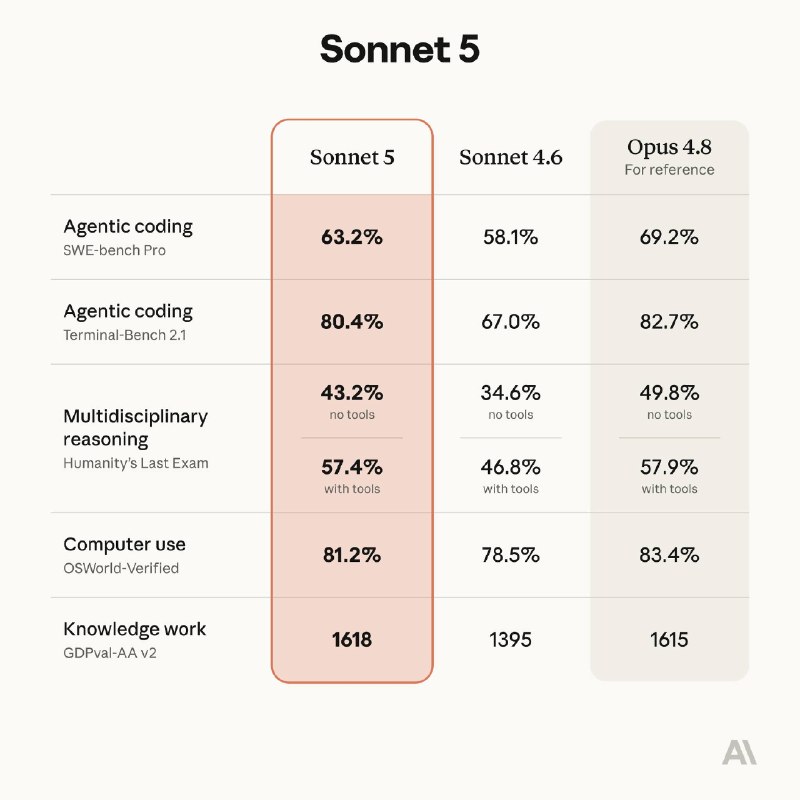
Anthropic unveiled Claude Sonnet 5 on 30 June 2026, framing the release as its most agentic mid-tier model to date — one engineered not just to answer prompts but to plan multi-step work, browse the web, drive a terminal and stitch those tools together without a human hand on every step. The launch lands in the same week that competitors are racing to put cheaper, more autonomous systems in front of enterprise buyers, and the company is explicitly pricing the new model as an alternative to its own flagship, Opus, and to the top tiers at OpenAI and Google.
The release matters less for any single benchmark jump than for what it signals about where the frontier-AI market is heading: the centre of gravity is migrating from "smarter chatbot" to "cheaper worker," and the differentiation among frontier labs is increasingly about how much autonomous task-completion a customer gets per dollar spent. Sonnet 5 is Anthropic's most direct attempt to own that lane.
A mid-tier model with flagship ambitions
Anthropic's marketing of Sonnet 5 leans hard on autonomy. The model can plan a multi-step task, browse the web, use a terminal and "work autonomously on problem"-solving, according to a Telegram summary of the release circulated by the AI research channel AI Post on 30 June 2026 at 19:02 UTC. Polymarket's official account surfaced the announcement the same afternoon at 18:37 UTC, underscoring how quickly prediction-market and trading communities have learned to treat a frontier-lab launch as a market-moving event.
The strategic reading is straightforward. Opus, Anthropic's top-tier model, remains the brand's prestige offering, but every dollar of compute Anthropic burns running Opus for tasks that a smaller model could handle is a dollar not landing in margin. Sonnet 5 is the company's bid to push the bulk of agentic workloads down a price tier — closer to where enterprises actually transact.
The pricing fight is now the product fight
TechCrunch's 30 June 2026 write-up of the launch framed the move as "a cheaper way to run agents," arguing that stronger agentic capabilities, lower pricing and improved safety are intended to position Sonnet 5 as a cheaper alternative to Opus, GPT-5.5 and Gemini Pro. That phrasing captures the structural shift: the agentic question is no longer whether a model can use tools, but how cheaply a thousand tool calls can be made.
This is the part of the release that will draw the closest scrutiny from enterprise buyers. Foundation-model pricing has fallen roughly an order of magnitude over the past two years as labs have chased inference economics; Sonnet 5 sits inside that trend rather than against it. The interesting question is not whether it is cheaper than Opus — almost everything is, eventually — but whether Anthropic has managed to widen the gap between what Sonnet 5 can autonomously complete and what the next pricing tier down, Haiku, can reliably do without supervision.
Safety messaging as competitive positioning
Anthropic has long made safety a marketing pillar rather than a footnote. Sonnet 5's launch leans on "improved safety" as one of three headline attributes alongside agentic capability and price, per the TechCrunch coverage. That is partly substantive — frontier labs have shipped demonstrably better refusal behaviour, jailbreak resistance and constitutional-style training — and partly defensive: every major enterprise procurement now asks for model cards, red-team reports and insurance-friendly safety documentation, and Anthropic is signalling that it has the paperwork.
The safety framing also doubles as a hedge against the open-weight challengers. Chinese-developed models and the Western open-source community have closed capability gaps on several benchmarks in 2025 and 2026; Anthropic's response has been to bundle capability with guardrails and provenance, a package the open-weight releases cannot easily replicate.
What remains uncertain
Three things the launch does not yet settle. First, the real-world economics of long-horizon agentic workloads: token pricing is one thing, but multi-step tasks that browse the web and run terminal commands can balloon into thousands of internal steps, and the unit-economics story depends on whether Sonnet 5's success rate on those chains holds up outside vendor-curated demos. Second, how the model compares head-to-head with GPT-5.5 and Gemini Pro on agentic benchmarks that Anthropic did not itself publish; third-party evaluation will matter more than the launch blog. Third, the regulatory environment. As agentic systems take actions on behalf of users — clicking, transacting, drafting — the legal exposure for the lab shifts in ways current frameworks are still catching up to, and any safety claim is also a liability claim.
For now, the clearest read is that the frontier-AI race has matured into a tier-pricing war with autonomy as the headline metric. Sonnet 5 is Anthropic's bid to win the middle of that market — and to make sure that when an enterprise team picks a model to run an agent, the default answer is not OpenAI.
Desk note: this article leans on the Telegram and X wire traffic from 30 June 2026 plus TechCrunch's same-day write-up rather than reproducing benchmark tables; Monexus treats frontier-lab launch weeks as coverage sprints where the pricing and capability claims travel faster than the independent evaluations that eventually catch up to them.
Wire provenance
This editorial synthesis draws on the following public wire/social posts:
- https://t.me/aipost
- https://en.wikipedia.org/wiki/Anthropic
- https://en.wikipedia.org/wiki/Claude_(language_model)