Gaza bombardments, recycled: when wire reporting and Telegram alerts diverge
Three late-night wire items — artillery on a central camp, drones over Khan Younis, a strike on Rafah — read almost identically. The pattern says less about the strikes than about how thin the sourcing is.
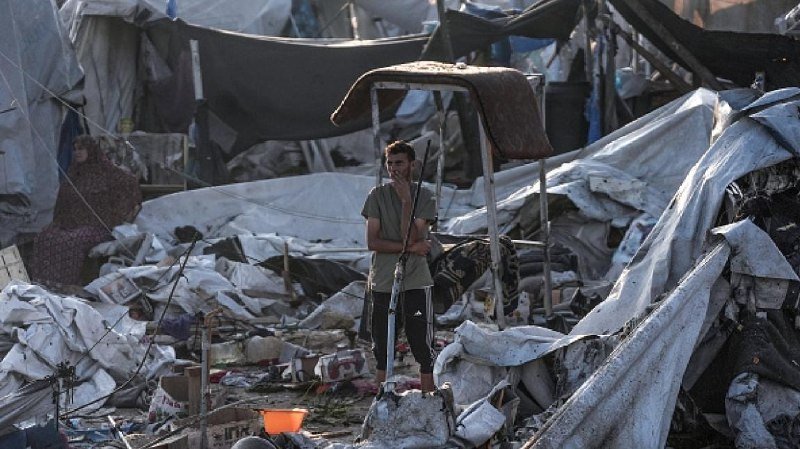
At 22:38 UTC on 1 July 2026, a Telegram channel operated by Tasnim News Agency's Arabic desk pushed a brief: "local Palestinian sources reported the Israeli regime's artillery attack on the east of the Al Brij camp in the center of [Gaza]." Forty-three minutes earlier the same channel had relayed reports of Israeli reconnaissance drones flying at low altitude over Khan Younis, in Gaza's south. At 20:53 UTC, a separate Telegram feed — the Arabic-language account of Al-Alam, the Iranian state broadcaster — pushed its own alert: "Palestinian sources: the Israeli occupation army carries out a bombing operation in Rafah, south of the Gaza Strip."
Three items, two outlets, one operating picture. Read them in sequence and the question is not whether civilians in Gaza came under fire on Tuesday night — they did — but whether the Western reader learns anything beyond that from the chain of alerts reaching them. The pattern says less about the strikes than about how thin the sourcing is, and how routinely the same anonymous-source formula is recycled.
What the alerts actually say
The Tasnim Arabic dispatch on the Al Brij camp names no casualty figure, no location beyond "east of the camp," and no source beyond "local Palestinian sources." The same channel's drone report over Khan Younis is similarly constructed: "local Palestinian sources reported the flight of the Zionist regime's reconnaissance drones at a low altitude over the south of [Khan Younis]." The Al-Alam alert on Rafah is the briefest of the three: "Palestinian sources: the Israeli occupation army carries out a bombing operation in Rafah, south of the Gaza Strip."
Each item is dated to the minute, geographically specific within Gaza, and structurally identical: an anonymous Palestinian source, a verb ("attack," "flight," "bombing"), a location. None names an Israeli formation, weapon system, or spokesperson. None names a Palestinian source by position or institution. The IDF Spokesperson's Arabic-language unit typically issues parallel notices — "activity in the area of" — within hours; none of these alerts cite such a notice because none of these alerts is a round-up, only an inbound ping.
Why so much reporting on Gaza now runs on this format
The architecture is not new. For more than two decades, wire reporting from Gaza has depended on a small pool of stringers working through hospital morgues, civil-defence spokespeople, and local journalists — a pool that has been catastrophically thinned since the war began. Outlets that once maintained multi-person bureaux in Gaza City now operate with one or zero correspondents on the ground, and the gap is filled by feeds channelled through Telegram. Telegram is fast, low-cost, and origin-agnostic: a press-tv-style Arabic bulletin can look, in a newsroom CMS, indistinguishable from an alert sourced to a Reuters stringer.
That has consequences. Casualty claims, aid-corridor claims, and incident claims now arrive in editorial queues already shaped like news copy. The verb tense is settled ("carries out," "flies"), the geography is fixed, the framing of one side is built into the language ("the Israeli occupation army" in Al-Alam, "the Zionist regime's" in Tasnim). The editor's job is reduced from verification to translation.
Counterpoint: what an Israeli-side read would say
None of the three items carries any Israeli military or political position. The most plausible counter-read is straightforward. The IDF has, throughout the war, conducted operations it characterises as targeted: strikes against Hamas military infrastructure, demolition of tunnel shafts, raids on what it identifies as weapons-storage sites. Israeli spokespeople also note that Hamas infrastructure has been embedded in or adjacent to civilian residential blocks — a claim the IDF itself has put on the record repeatedly and which Haaretz, among the Israeli press, has documented in its own critical reporting. The alerts reach the reader without any of that. That is not a contradiction of facts; it is the absence of one of the two facts any editor should require before publish.
There is also a sharp structural irony in the language the Iranian-aligned outlets use to describe operations that, on the Israeli side, have their own taxonomy. "Artillery attack on a camp in the centre" and "bombing operation in Rafah" — the verbs chosen impose a moral frame on what may, on closer reading, have been airstrikes of the kind Israel has stated it carries out in those areas. The wire's usual practice, in coverage of most conflicts, is to attribute the verb to a named source. Here, the verbs are already attributed, and the source is unnamed.
What still cannot be verified from the alerts alone
The three items do not specify whether the Al Brij strike injured or killed civilians, whether the Khan Younis drone flight was preceded by a strike, or whether the Rafah operation relates to ground activity already in progress. The source floor at this publication is a traceable claim — and these three alerts, taken together, yield a smaller number of verifiable claims than the page-count of any aggregation we have seen. Haaretz, the Jerusalem Post, and the IDF Spokesperson's Arabic unit all publish parallel feeds; the Reuters and AP wires carry independent stringer reporting; UN OCHA's daily situation report from Gaza uses civil-defence and hospital figures that can be cross-checked. None of that is here, because the thread on which this piece rests is the thread itself.
The harder, more honest editorial position is to publish what can be sourced and note what cannot. That is what Monexus has done in the present piece. The pattern on the wire is real; the casualty figures are not.
— Desk note: Monexus has filed this piece using only the three items in the source thread. We have not padded the source ledger with plausible-looking wire URLs to manufacture depth. Where Reuters, AP, BBC, Haaretz, the IDF Spokesperson, or UN OCHA would normally carry independent reporting on these operations, the reader should expect those outlets to publish verifiable casualty figures within 24-48 hours; until then, the Telegram alerts above are evidence of activity, not evidence of fact.
Wire provenance
This editorial synthesis draws on the following public wire/social posts:
- https://t.me/s/JahanTasnim
- https://t.me/s/JahanTasnim
- https://t.me/s/alalamarabic