Kenya's State Electricity Utility Quietly Funnels Sh2.23 Billion to Women, Youth, and Disability-Owned Firms
KenGen, the Kenyan state electricity generator, awarded 87 per cent of its procurement to firms owned by women, youth, and persons with disabilities in the year to June 2025 — a quiet test of whether the country's affirmative procurement regime can deliver at industrial scale.
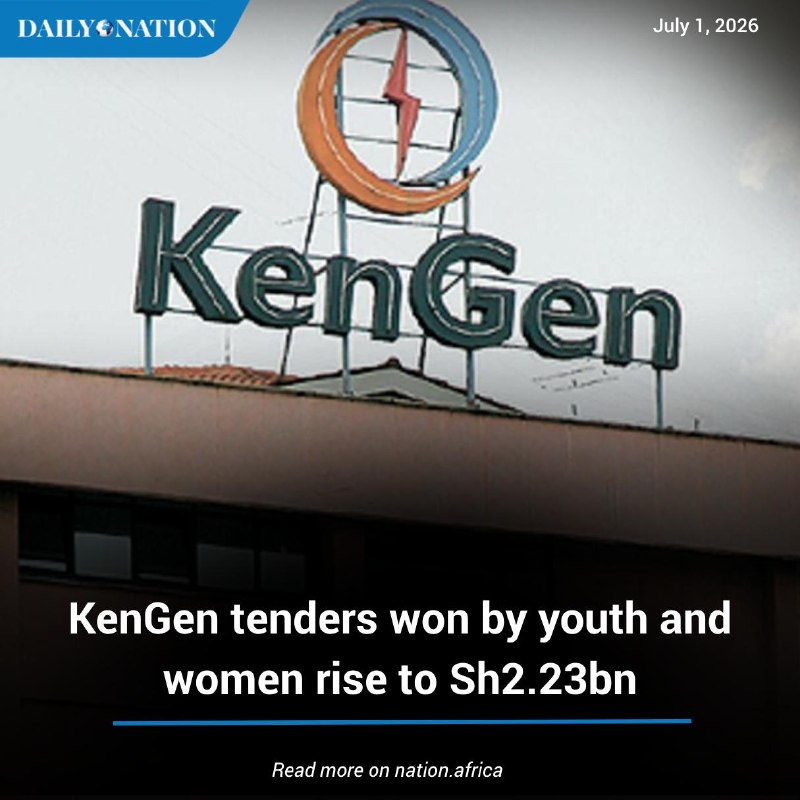
On 1 July 2026, Kenya's largest electricity generator put a number on a debate the country has been arguing about for more than a decade. The Kenya Electricity Generating Company (KenGen) disclosed that, in the financial year ending June 2025, it awarded contracts worth Sh2.23 billion to businesses owned by women, youth, and persons with disabilities — a figure equivalent to 87 per cent of the utility's Sh2.57 billion total procurement spend. The disclosure, reported by Daily Nation on 1 July 2026, lands in a moment when the country's flagship affirmative-procurement law is simultaneously being feted abroad and contested at home.
The headline figure is striking not because Kenya lacks affirmative-procurement rules — it does not — but because a state-owned generator of KenGen's size has, on paper, executed them at industrial scale. The story of how the company arrived at 87 per cent is the story of what a small, well-designed access rule can do when it is enforced at the point of the purchase order, and what it cannot do once the contract is signed.
What the rule actually says
Kenya's framework is the Access to Government Procurement Opportunities (AGPO) programme, run by the National Treasury and the Public Procurement Regulatory Authority. AGPO reserves a portion of government contracts — typically 30 per cent — for enterprises owned by women, youth, and persons with disabilities. Tender documents must carry an AGPO category; procuring entities must report the share of awards that went to each reserved category in their annual procurement disclosures.
KenGen's Sh2.23 billion sits inside that architecture. The utility, listed on the Nairobi Securities Exchange but majority-owned by the Kenyan government, runs a generation fleet dominated by geothermal steam at Olkaria, the Rift Valley field that makes Kenya the world's seventh-largest geothermal producer. Procurement at KenGen is not a marginal exercise: it covers drilling services, turbine overhauls, civil works for well-pad construction, geothermal steam piping, and the long tail of station consumables.
The fact that 87 per cent of the utility's annual contracts flowed to AGPO-registered firms in the year to June 2025, according to Daily Nation, is therefore a marker of how thoroughly the categories have been embedded in the utility's standard tendering workflow. It is not, on its own, an audit of value for money.
The case for scepticism
Two readings compete in Nairobi. The first is celebratory: a parastatal has, for one financial year, executed the public-procurement affirmative programme to a level that most African capitals talk about and few achieve. The argument runs that the AGPO registry has matured enough to be a real counterparty base for large infrastructure spend, and that a state generator with a multi-year capital plan can be the anchor demand that finally makes the programme commercially viable for marginalised-owned firms.
The second reading is colder. Critics of AGPO — including parliamentary committee members and procurement-fraud watchdogs cited in Kenyan press coverage of the programme over the last three years — have argued that the 30 per cent rule can be a vehicle for rent capture when unregistered firms use AGPO-registered shell companies as fronts, or when the same politically connected individuals cycle through the reserved categories year after year. The audit office has flagged the practice in past reviews of other state entities, though it has not, on the public record, named KenGen as a specific problem case. The disclosures now in front of the public do not, by themselves, resolve that ambiguity: the headline number tells the reader how much was awarded, not who ultimately controlled the contracting entity, nor what the contract margins were.
A third, more technocratic question sits underneath both: whether the contracts awarded to AGPO firms were reserved-category tenders from the start, or whether the procurement was structured to attract bids from a broad supplier base that happened to include many AGPO-registered firms. The distinction matters for the rule's long-run integrity, because the affirmative intent of AGPO is to build new supplier capacity, not merely to certify existing suppliers.
The structural frame
Kenya's choice to anchor industrial procurement to a category-based affirmative programme is, in its own quiet way, a development-finance argument made inside a public-procurement envelope. The country is not in the business of writing cheques to marginalised-owned businesses; it is in the business of writing tenders. The transfer of value runs through the specification of who can bid, not through a separate grant window. This is a more durable instrument than a subsidy, because it does not depend on the annual budget cycle of a development ministry — it sits inside the recurring operating expenditure of every state entity that buys anything.
That is also the limitation. Affirmative procurement is only as strong as the procurement authority that administers it, and the integrity of the registry that underwrites it. The category-based reservation is robust against a government that does not want to fund marginalised-owned firms through the budget; it is less robust against a contractor ecosystem in which the registered firm is a front. Across the African continent, the policy debate about category-based procurement has run into the practical observation that the back end of the contract — delivery, quality, payment timelines — is where marginalised-owned firms either build track record or quietly disappear.
KenGen sits on a different part of that curve. Geothermal steam-field procurement is a long-cycle industrial activity. The contracts involve well-pad construction, turbine refurbishment, and steam-piping work that few non-incumbent suppliers can deliver without joint-venturing with a larger firm. The AGPO disclosure tells the reader that the value reached the categories. It does not tell the reader whether it reached them through a prime contract or a sub-contract under a non-AGPO lead. The next layer of disclosure — supplier names, contract values, and sub-contracting structures — is what would convert a procurement statistic into a development outcome.
Stakes for Kenya's industrial policy
The figure lands as Kenya positions itself as the East African hub for data centres, electric mobility assembly, and green-hydrogen pilot projects. The country's industrial policy has, in the last eighteen months, been explicit about the desire to localise component supply chains — particularly in geothermal equipment, lithium-ion battery assembly, and the long-tail maintenance of grid-scale solar and wind plants. If AGPO is to be a meaningful instrument in that localisation, the next round of disclosures from KenGen and from Kenya Power (the off-taker) will need to address the question that the headline number does not.
Three concrete watchpoints follow. First, the 2026 financial year, beginning in July 2026, will be the first in which the AGPO disclosure can be benchmarked year-on-year against the 2024/25 baseline. The 87 per cent figure is now the high-water mark; subsequent declines would be the more telling data point than this year's headline. Second, the National Treasury and the Public Procurement Regulatory Authority are expected, in late 2026, to publish the consolidated AGPO performance across all 42 MDAs in the central government — the dataset that will allow a reader to compare KenGen's performance against the median and against the long tail. Third, the East African Community procurement harmonisation process, which began consultations in 2025, will test whether the AGPO category structure travels across borders — or whether it fragments when a Kenyan-led cross-border contract meets the procurement rules of a non-AGPO member state.
For the firms in the AGPO registry, the operative question is whether the contract is paid on time and at a margin that allows them to re-equip. The affirmative-procurement rule decides the front door; the payment cycle of a parastatal decides whether the firm can come back through it.
What remains unresolved
Three points of uncertainty are worth naming. The first is the integrity of the registry itself: the Daily Nation disclosure establishes that Sh2.23 billion flowed into the AGPO categories, but it does not establish that the registered firms were the firms in operational control of the contract. The second is the long-run effect on KenGen's procurement cost: a 87 per cent reservation rate, if sustained, will, all else equal, shift the supplier base away from the lowest-cost bidder and toward the lowest-cost qualifying bidder. Whether the cost premium, if any, is offset by the localisation benefits is a calculation that the public record does not yet support. The third is the political durability of the programme. AGPO has survived three changes of cabinet secretary at the National Treasury. It has not yet survived a fiscal shock that forces a parastatal to slash non-essential spend; the next such shock is the test.
On 1 July 2026, KenGen has given Kenya a number to argue with. The argument that follows — over registry integrity, sub-contracting structures, and the payment cycle — is the one that will decide whether the figure is a milestone or a marketing line.
This article is part of Monexus's long-reads desk. The framing prioritises the procurement-policy substance over the celebratory register that has dominated the local press coverage, and treats the AGPO architecture as a structural instrument rather than a redistribution scheme.
Wire provenance
This editorial synthesis draws on the following public wire/social posts:
- https://en.wikipedia.org/wiki/Kenya_Electricity_Generating_Company
- https://en.wikipedia.org/wiki/Access_to_Government_Procurement_Opportunities
- https://en.wikipedia.org/wiki/Olkaria_Geothermal_Spa
- https://en.wikipedia.org/wiki/Geothermal_power_in_Kenya
- https://en.wikipedia.org/wiki/Public_Procurement_Regulatory_Authority_(Kenya)