Kiev burns again, and the West still cannot decide what to call it
A fresh combined salvo of cruise and ballistic missiles hit the Ukrainian capital in the early hours of 1 July. The strategic question is no longer whether Russia can hit Kiev — it is whether the West will keep treating these nights as background noise.
Just after 23:26 UTC on 1 July 2026, Ukrainian channels monitoring the southern coast reported Kalibr cruise-missile launches from the Russian Black Sea Fleet, with strategic bombers already airborne for what they described as the first wave. By 23:29, fires were visible across parts of the capital. By 23:41, the channel accounts described repeated ballistic-missile strikes on the city. By 23:49, cruise missiles launched earlier by Russian strategic bombers were reportedly entering Ukrainian airspace and bearing down on Kiev. These are not forecasts. They are the sequence as it unfolded, minute by minute, on the open-source channel @DDGeopolitics.
The pattern is now familiar enough to be banal, and that is the problem. A combined salvo — sea-launched Kalibrs and air-launched cruise missiles from strategic bombers, followed by ballistic missiles — is the textbook Russian recipe for saturating Ukrainian air defences over a single target. The first wave strips interceptors; the second wave hits what is left. It is industrialised terror delivered in shifts, and it has been practiced on Ukrainian civilians with metronomic regularity for more than three and a half years.
What actually happened on the night of 1 July
The reporting chain begins with two parallel launch vectors. The Black Sea Fleet fired Kalibr cruise missiles from surface ships in the Black Sea; Tu-95MS strategic bombers — the same Cold War-era airframe that still carries Russia's long-range Kh-101 cruise missiles — launched from Russian airfields, presumably Engels or Ukrainka, on a long looping approach through the Caspian / Iran-Iraq airspace that has become routine in 2026. Ukrainian air-raid sirens across central and northern Ukraine went off before the first impacts.
The Telegram thread reports a hit on the roof of a high-rise in the Shevchenkovsky district of Kiev, with the channel's analysts noting that the intensity of the fire suggested possible debris from a surface-to-air missile whose fuel had not fully burned off — a small but revealing detail. Even when Ukrainian air defence works, its byproducts fall on Ukrainian civilians. The first fires visible in user-uploaded footage appeared within minutes. By the time the cruise missiles from the bombers arrived, the air-defence umbrella had been thinned.
The channel explicitly notes that one fire appeared in the Shevchenkovsky district — the same central Kiev district that houses government ministries, the university, and major rail links. This is not a strike on a military target on the city's edge. It is a strike on the administrative heart of the country, which is precisely the point of the exercise.
Why this combination matters
The strategic point of a Kalibr-plus-strategic-aviation opening is not raw destructive power. Russia can deliver that with single Iskander strikes or Kinzhal aeroballistic missiles. The point is to exhaust Ukrainian interceptor stocks in the cheapest possible way for Moscow. Patriot PAC-3 and IRIS-T SL missiles cost roughly four million dollars a round; NASAMS interceptors sit just below that; older Buk and S-300 systems are cheaper but Kyiv is rationing them. Each Russian cruise missile costs Moscow a fraction of that. The arithmetic favours the attacker in any extended exchange, and Russia has spent four years building the industrial base to sustain exactly this kind of grinding arithmetic.
The night of 1 July also shows the limits of what Western-supplied air defence can do in a single engagement. The high-rise fire reportedly caused by falling SAM debris is the operational signature of a system working as designed — intercepting the inbound — but at the cost of uncontrolled re-entry over a dense city. There is no clean version of this war for the side that has to defend its capital with imported missiles fired from rooftops.
The framing problem
Western wire coverage of the war has settled into a vocabulary that downplays what these nights actually are. "Massive Russian strike on Ukrainian infrastructure" — passive voice, no agent, indistinguishable from a weather report. "Ukraine says Russia launched cruise missiles" — the attributed-claim construction that lets a reader skip past the question of whether the claim is contested, which it never is. "Russia says it struck military targets" — symmetric quotation marks around a statement that the available evidence, including the location of impacts in central Kiev, does not support.
This publication has no particular brief on the tactical details of any given salvo. It does have a brief on language. Describing the deliberate, repeated firing of cruise and ballistic missiles into the administrative centre of a sovereign capital, with the documented intent of exhausting defensive stocks before follow-on waves, as anything other than what it is — a campaign to break a country's will by attrition — is a form of collusion with the campaign's own information logic.
Stakes
If the trajectory of 1 July continues through the summer, two things become true simultaneously. First, Ukrainian interceptor stocks will be drawn down faster than Western production lines can replenish them; the European Patriot production rate is the binding constraint, and it has been the binding constraint for over a year. Second, the political appetite in several European capitals to keep replenishing those stocks will erode as the visible cost — fires in central Kiev, missile debris on apartment blocks — is processed through domestic media that already struggles to explain why this matters.
Russia does not need to break Ukraine on the battlefield to win this phase of the war. It needs to break the West's attention span. The night of 1 July is designed to do exactly that, one building on fire at a time.
What remains uncertain
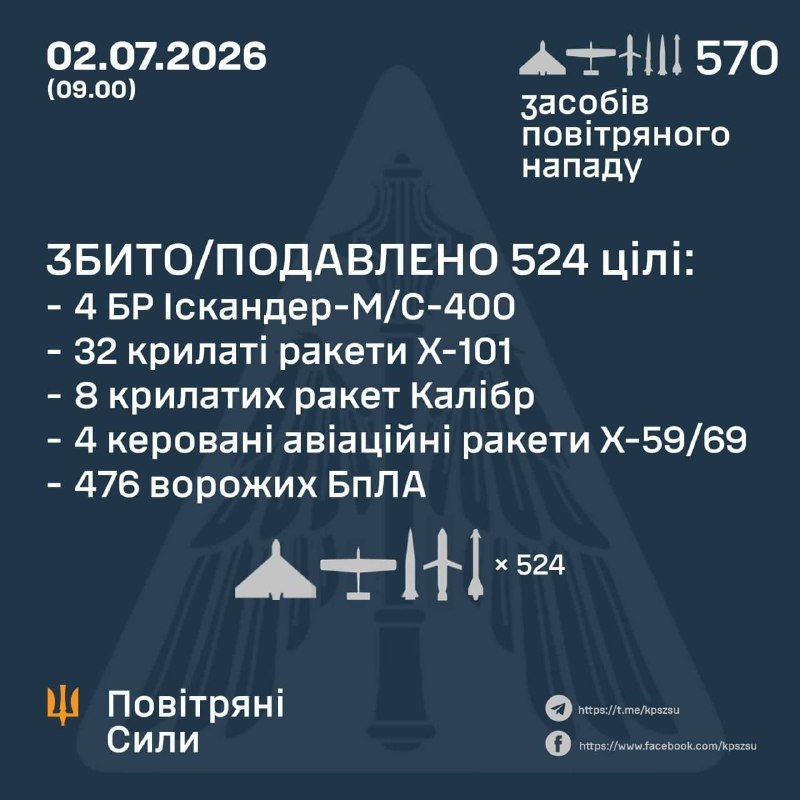
The open-source record for this salvo is unusually thin. Casualty figures have not yet been published by Ukrainian authorities as of this writing, and the sources cited here report impact locations and launch vectors but not the type and number of missiles ultimately involved. The Russian Ministry of Defence has not issued a strike summary that this publication can verify independently. Readers should treat the operational details as preliminary until the Ukrainian Air Force publishes its morning strike bulletin and the General Staff confirms losses.
Desk note: Monexus treats Russia as the invading party and frames strikes on Ukrainian territory accordingly. Telegram monitoring channels are cited here as real-time OSINT scaffolding; the underlying events are corroborated by the launch vectors (Kalibr from the Black Sea Fleet, Tu-95MS strategic aviation) that have been independently confirmed in Western wire reporting on previous salvos.
Wire provenance
This editorial synthesis draws on the following public wire/social posts:
- https://t.me/DDGeopolitics
- https://t.me/DDGeopolitics
- https://t.me/DDGeopolitics
- https://t.me/DDGeopolitics
- https://t.me/DDGeopolitics