Kyiv under fire: what four missiles over Brovary tells us about the shape of this war
Four missiles over Brovary, a fighter outbound from Kyiv, and an air-raid picture still being drawn. The night's arithmetic is thin — but the trajectory it sits inside is not.
At roughly 22:59 UTC on 1 July 2026, the Telegram channel AMK Mapping posted a terse update: four missiles inbound toward Brovary, then Kyiv, traveling at what it described as 11,000 km/h. Half an hour earlier, the channel war_monitor had reported a fighter jet leaving Kyiv in the direction of Brovary. Read together, the two messages sketch a familiar scene — a Ukrainian capital under bombardment, an interceptor sortie in the air, and the city's defenders working through another night.
The arithmetic is thin. Telegram channels that track missile trajectories are useful precisely because they publish in real time, but they are not primary sources — they aggregate radar data, eyewitness reports, and official Ukrainian air-force readouts, and they routinely publish before those readouts are confirmed. What the night does confirm is that the pattern documented since the full-scale invasion began has not changed: missiles on Kyiv, sorties in defence, and the public accounting left to come.
What the night tells us
Four missiles at hypersonic-class speed, according to the tracker, are not a saturation strike. The barrages that have flattened apartment blocks in the capital in previous waves ran into the dozens and used a mix of cruise and ballistic profiles designed to overwhelm Ukrainian Patriot and S-300 batteries. A four-missile package suggests something different — a probing salvo, a test of air-defence coverage over the northern approaches, or a strike aimed at a specific target the routing toward Brovary implies.
The outbound fighter is the second clue. Ukrainian air-defence doctrine has matured visibly since 2022: MiG-29s and F-16s have been used both to intercept cruise missiles and to suppress Russian launch aircraft operating over the Black Sea. A single jet heading north toward Brovary does not on its own confirm an interception, but it does confirm that the Ukrainian air force is still flying intercept missions against incoming fire over the capital's airspace. That is the operationally significant fact — not the count of the salvo, but the continued willingness to fly.
What we do not yet know
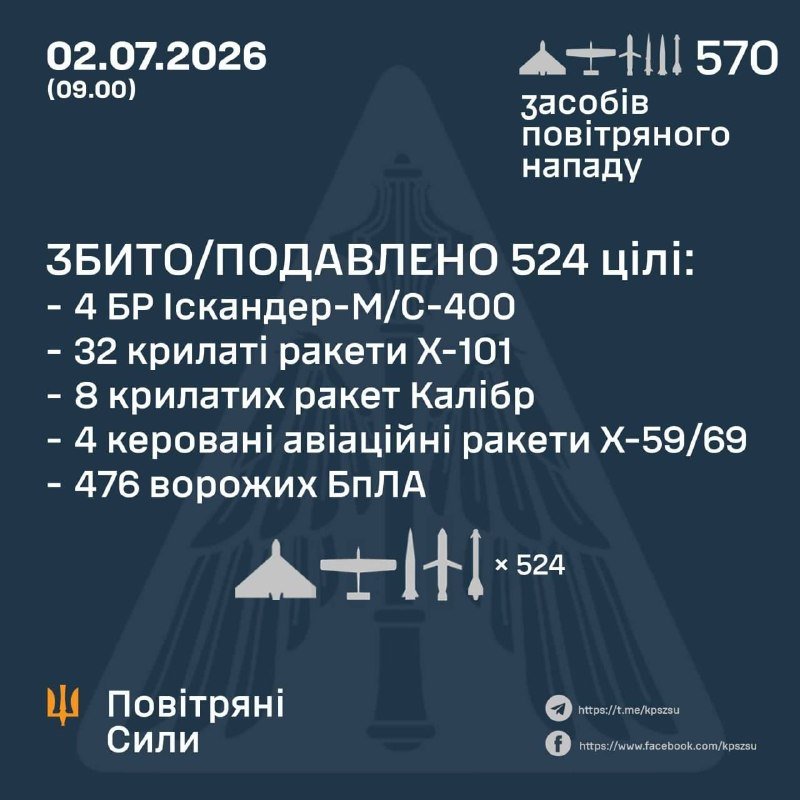
The sources do not specify what was hit, what was intercepted, or whether the four-missile package reached its aim point. The Ukrainian air force publishes its own evening tallies; the pattern in past waves has been a morning summary that lists launches, intercepts, and falling debris — debris that, in Kyiv, has done as much structural damage as direct hits. Until that summary lands, the four missiles in AMK Mapping's post are a trajectory claim, not a damage assessment. The Cradle and other outlets tracking the war have noted in past strikes that Telegram trackers regularly publish counts before Kyiv's defenders confirm them, and the gap between the two has, on multiple occasions, been wide.
We also do not know the airframe of the outbound jet. war_monitor did not identify it. Russian milblogger channels, which sometimes comment on Ukrainian sorties in real time, were not included in the thread context for this piece; their read of the same night's events would normally be the first counter-claim material any responsible wire desk reaches for. The structural pattern is that those channels tend to overstate Russian intercepts and understate Ukrainian successes, but they are not always wrong.
What the trajectory sits inside
This is not a stand-alone incident. It is the latest entry in a campaign that has, by any honest accounting, run for more than four years and that has used the Ukrainian capital itself as a recurring target. The political logic is not new: Kyiv is the symbolic centre of Ukrainian statehood, and strikes on it are designed to communicate that no Ukrainian city is outside range. The military logic has shifted over the course of the war — early barrages aimed at infrastructure, later waves aimed at energy, more recent packages aimed at defence-industrial sites — but the signalling function has not.
That signalling function is what the Western wire cycle tends to underplay. Headlines tend to read "Russia strikes Kyiv" and stop. The structural fact underneath is that the strikes have continued despite successive rounds of sanctions, despite the diplomatic openings in 2025, and despite the increasingly explicit Western supply of long-range fires and air-defence interceptors to Ukraine. Whatever the barrages are doing, they are not functioning as a coercive instrument in any conventional sense. They are functioning as a steady-state posture.
The stakes of the steady state
If the four-missile night of 1 July is read as a probing salvo rather than a strategic escalation, the implication is uncomfortable for the Western policy debate: the war is settling into a rhythm that sanctions and arms deliveries have not been able to break, and the rhythm is most visible in the airspace over Kyiv. Ukrainian defenders continue to fly intercepts, Ukrainian civilians continue to take shelter, and Russian launch crews continue to fire. That is not stalemate in the Clausewitzian sense — there is movement on the ground and in the diplomatic track — but in the air over the capital, it is the closest the war comes to stasis.
For Kyiv, the stakes are direct: continued damage, continued loss of life, continued pressure on an air-defence budget that depends on Western resupply. For Moscow, the stakes are reputational as much as operational: every salvo that fails to break Ukrainian morale is, in the framing of the Russian defence ministry, a success of persistence. For Western capitals, the night is a reminder that the cost of support is not abstract — it is paid in interceptors spent and patience tested, and it is paid in a city that takes the hit first.
The sources do not yet confirm what was lost or saved in the night of 1 July. They confirm that the night's arithmetic — four missiles, one jet outbound, and a city still under fire — is the arithmetic this war keeps producing.
Monexus framed this piece around the steady-state character of the campaign over Kyiv, rather than the strike-by-strike drama, on the view that the pattern matters more than the count.
Wire provenance
This editorial synthesis draws on the following public wire/social posts:
- https://t.me/AMK_Mapping
- https://t.me/war_monitor