Another Night, Another Barrage: What Kyiv's Drone Wave Tells Us About the Stalemate
Moscow's renewed overnight strikes on Kyiv, met by sheltering civilians and a familiar round of Telegram footage, expose the gap between Western fatigue rhetoric and the daily reality of an invaded capital.
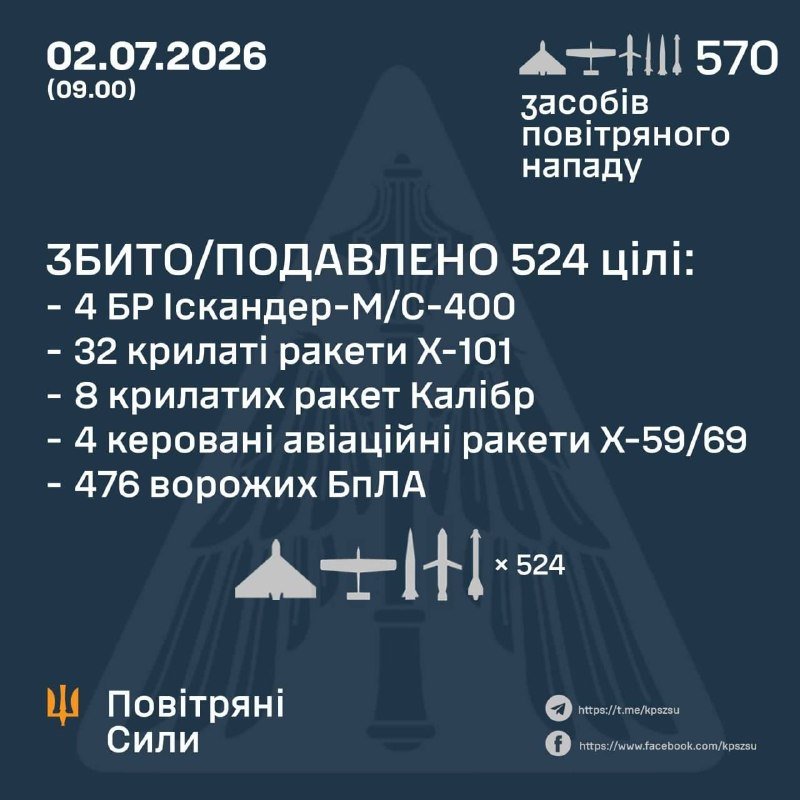
The first reports began trickling through Telegram channels just before midnight Kyiv time on 1 July 2026: explosions across the capital, footage of a residential building on fire after what the open-source monitor OSINTdefender described as an impact from Russian fires, and renewed advisories urging residents into the metro. By 23:48 UTC the picture had hardened into a familiar shape — apartment blocks burning, drones and ballistic missiles reported inbound, and a city that has long since learned the choreography of sheltering in its own subway system.
This is not new. The pattern is now almost four years old: Moscow's air campaign against Ukrainian cities, refreshed each season with whatever combination of Shahed-type one-way attack drones, cruise missiles, and ballistic missiles the Russian defence ministry can muster. The novelty each night is geographic — which district, which block, which thermal power substation. The structural fact underneath — that an invading power continues to pound the capital of the country it invaded — gets steadily less airtime in Western commentary.
The frame the West reaches for
Western coverage of these nights has settled into a tired script. A strike hits, casualty figures are reported, a Western capital issues a statement reaffirming "support for as long as it takes," and within forty-eight hours the cycle has rotated to the next story. The Russian framing — circulated through TASS, RIA, and the Telegram milblogger ecosystem — frames the same strikes as retaliation, targeting military-industrial sites and decision-makers. Both framings are partial.
What gets lost in the churn is the daily texture the OSINTdefender footage actually shows: civilians filing into metro stations in the middle of the night, apartment buildings that were homes an hour earlier catching fire, the cumulative weight of a campaign designed less to break Ukrainian resolve than to exhaust it. The structural logic is siege warfare executed at the speed of cheap airframes.
What the dominant narrative misses
The Western commentary class has its own version of fatigue, and it is increasingly visible in the subtext of European coverage. The implicit message: Kyiv has held heroically, the front line is roughly where it was, and donor publics are running out of patience. The accompanying policy reflex is to push Kyiv toward negotiation on terms that, in practice, would ratify the invasion.
That framing deserves to be named and challenged. Ukraine is the invaded party under established international law. The relevant baseline is not the patience of a Western voter who last saw Kyiv on a screen in 2022; it is the Ukrainian family in the burning apartment block in OSINTdefender's frame. From that baseline, the conversation about who should be tired, and on whose behalf, sounds different.
There is also a quieter assumption in some Western analytical writing — that these strikes are essentially performative, that they consume Russian stockpiles faster than they impose Ukrainian costs, and that the air campaign is therefore a sign of Moscow's weakness. There is real evidence for that read: Russian missile production has struggled to keep pace with expenditure, and Iranian and North Korean supply lines have become structurally important. But "Moscow is wasting ordnance" and "Kyiv is safe" are not the same sentence, and residents taking shelter in the metro on 1 July 2026 are evidence for the second proposition only if you are not one of them.
The structural fact underneath
What this latest barrage illustrates, more than any individual casualty, is the persistence of a particular kind of war. Russia has not generated the air superiority required to make these strikes decisive; Ukraine's air defences, layered with Western-supplied systems and increasingly with domestically produced interceptors, have kept the per-strike casualty rate far below what Moscow's planners likely hoped for. The war in the air has settled into an industrial grind — Russia builds and buys drones, Ukraine shoots them down or endures them, and the civilian cost is distributed across whichever neighbourhood happens to be under the flight path on a given night.
This is not the air campaign Moscow launched in February 2022. It is a degraded, attritional substitute, and reading it as a sign of imminent Russian breakthrough or imminent Russian collapse both flatter the available evidence. The honest read is duller and harder to fund: the war has become a long siege, and sieges are decided by logistics, by industrial depth, and by the willingness of the attacked population to keep sheltering in the metro until the shooting stops.
What remains genuinely contested
The sources do not yet agree on the scale of damage from the 1 July wave. OSINTdefender's thread shows one apartment building ablaze and frames the night as a combined drone and ballistic-missile barrage; BRICS News reports multiple explosions across the capital but does not provide casualty figures or strike locations. Independent Ukrainian outlets — Kyiv Post, Ukrainska Pravda, Suspilne — will, as usual, carry the corroborated counts once air-raid alerts lift and municipal services publish assessments. Until then, the Telegram footage is best read as evidence of renewed strikes on a residential capital, not as a final ledger of damage.
What is not contested, and what matters most, is that an invaded country's civilians are again sheltering in a subway system while missiles land above them. Whatever the Western frame of the week says about the war's trajectory, that fact is the floor underneath it.
This publication treats Russian strikes on Ukrainian cities as strikes on the cities of an invaded country, and leads with Ukrainian and Western-wire sourcing rather than Russian-state framings of the same events.
Wire provenance
This editorial synthesis draws on the following public wire/social posts:
- https://twitter.com/sentdefender/status/2
- https://twitter.com/sentdefender/status/2