Kyiv under bombardment: what the overnight missile salvo tells us about Russia's air campaign
Multiple waves of Kalibr, Iskander and Zircon missiles hit Kyiv in a single night. The pattern — not just the payload — is the story.
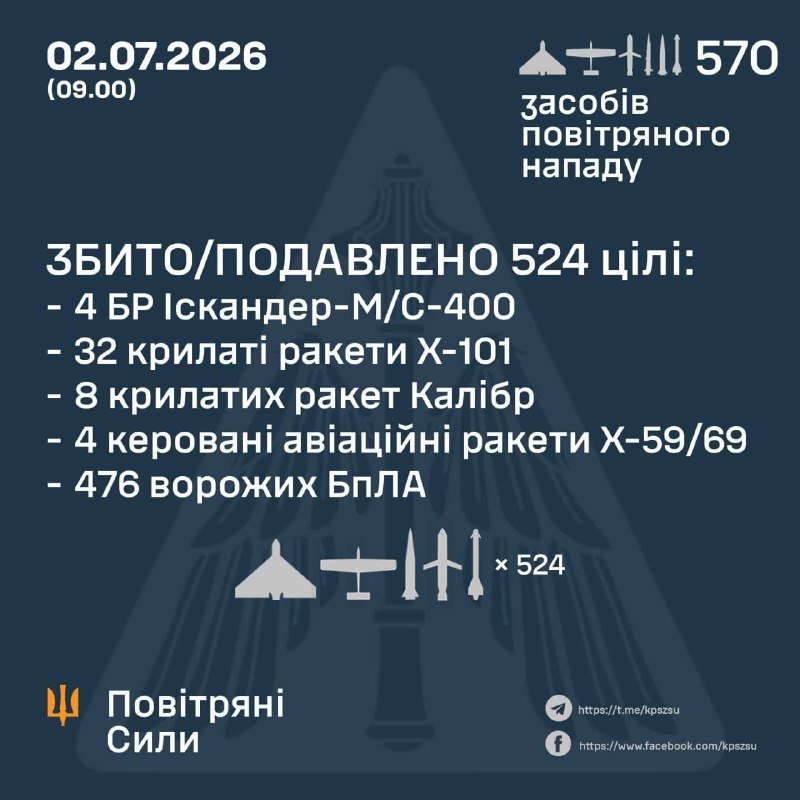
At 22:58 UTC on 1 July 2026, Telegram channel DDGeopolitics reported Iskander and Zircon strikes on Kyiv. By 23:12 UTC, Ukrainian channels cited by the same feed were tracking Kalibr cruise-missile launches from Russia's Black Sea Fleet, with strategic aviation reportedly executing the first wave. By 23:29 UTC, fires were burning in the capital. By 23:32 UTC, the channel was logging repeated ballistic-missile strikes on the city. By 23:33 UTC, a parallel channel, @intelslava, was carrying a one-line flash: a violent explosion in Kyiv. In roughly half an hour, a routine Russian air operation had become a citywide bombardment.
What the timeline actually shows
Read in sequence, the reports describe a layered attack — not a single volley but a sequence of distinct systems arriving in waves. Kalibr sea-launched cruise missiles from the Black Sea Fleet, then air-launched cruise missiles from strategic bombers, then short-range ballistic systems — Iskander and Zircon — striking inside the capital. Each system has a different flight profile, a different radar cross-section and a different interception problem for Ukrainian air-defence crews. The choreography matters: sequencing the launches forces defenders to engage multiple salvos in parallel, exhausting magazine capacity and creating windows for follow-on strikes to reach targets.
The fires captured on the ground at 23:29 UTC are consistent with that sequencing — multiple impact points, not a single strike site. Ukrainian official channels have not yet published a consolidated damage assessment in the material available to Monexus, and the casualty toll is unconfirmed at time of writing.
The structural frame: an attritional air campaign, not a single dramatic raid
What makes this night worth analysing is not the size of the salvo but the recurrence. Theatre-wide missile strikes on Ukrainian cities have become a near-weekly feature of the war. The doctrine is attritional: hit civilian energy and transport infrastructure, force air-defence expenditure, deplete interceptor stocks, and periodically target residential districts to maintain pressure on public morale. Each individual strike is also a consumption event for Russia — Kalibr and Zircon are expensive systems — which is why the targeting emphasis has shifted toward ballistic systems and Shahed-type one-way attack drones in recent months.
For Kyiv, the practical meaning is that the capital is no longer a sanctuary behind forward air-defence belts. Iskander and Zircon are short-range systems launched from Russian-controlled airspace over the Black Sea and Crimea; flight times are measured in minutes, leaving defenders almost no decision window. The Ukrainian air force's job is not to prevent launch but to intercept inbound — a fundamentally harder problem.
What is contested in the reporting
The Telegram feeds that carried this overnight account are open-source intelligence channels aggregating Ukrainian and Russian military reporting in real time. They are fast, often first, and frequently wrong on details that matter. Specific casualty figures, the number of missiles actually launched, and the proportion intercepted should all be treated as preliminary until corroborated by the Ukrainian Air Force, the General Staff, or wire services on the ground. Russian state media's framing of such strikes — typically describing them as retaliation for Ukrainian strikes on Russian territory — is also moving in the background and should be weighed as counter-claim, not as factual record. The basic geography, however, is unambiguous: missiles struck Kyiv overnight, fires burned, and the attack followed a layered pattern visible across multiple independent channels.
Stakes
The immediate stakes are Ukrainian. Every missile that reaches its target is a defensive failure; every successful interception preserves interceptor stocks the country cannot easily replace. The medium-term stakes are strategic: each successive salvo accelerates the depletion of Western-supplied air-defence ammunition and lengthens the case for either deeper strikes on Russian launch infrastructure or accelerated delivery of additional interceptors. The longer-term stakes concern the war's centre of gravity. As long as Russia can sustain theatre-wide strikes against the capital, Kyiv's diplomatic leverage rests on continued Western air-defence supply — leverage that is itself contingent on political conditions in donor capitals. The pattern on the night of 1 July is, in that sense, a reminder: the air war is not a backdrop to the ground war. It is the war.
This piece relies on open-source Telegram channels for real-time strike reporting and will be updated as official Ukrainian assessments and wire-service confirmation become available.
Wire provenance
This editorial synthesis draws on the following public wire/social posts:
- https://t.me/DDGeopolitics
- https://t.me/DDGeopolitics
- https://t.me/DDGeopolitics
- https://t.me/DDGeopolitics
- https://t.me/intelslava