When the air raid ends at 23:29 UTC and the news cycle never started
A missile barrage hits Kyiv across the 22:00–23:29 UTC window. The Telegram channels tracking it are still typing while the wires that frame the world’s understanding of the war have not yet filed a line.
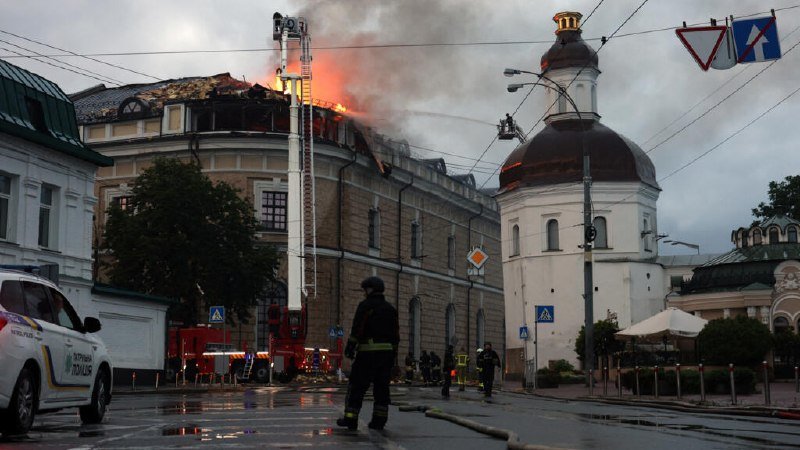
Between 22:06 UTC and 23:29 UTC on 1 July 2026, Kyiv was hit by what the Telegram channels monitoring the city described as a combined drone-and-missile barrage: a large Geran-2 drone strike, followed by successive waves of ballistic missiles and what two channels called "jet mopeds" — the informal label Ukrainian observers use for aeroballistic or hypersonic-type projectiles. The first impacts were logged at 22:54 UTC; the all-clear for the earlier salvo came at 23:05 UTC; a fresh wave began at 23:20–23:25 UTC and was still landing at 23:29 UTC, when the city channel AMK_Mapping posted simply: "Explosions in Kyiv."
What is notable is not the strike itself — Kyiv has absorbed hundreds of such barrages since February 2022 — but the gap between when the event was knowable and when it was reportable. The readers of war-monitoring channels watched a real-time attack unfold in granular, second-by-second detail. The readers of the major international wires that set the global frame for this war had, as of the timestamp of this article, no headline to read.
That asymmetry is the story. It tells you something important about how a war four years old gets narrated to the outside world, and about who gets to do the narrating when the institutional press is slow, distracted, or absent.
A barrage in eleven messages
The chronology on the open channels is unusually clear. At 22:06 UTC, AMK_Mapping flagged a "large Geran-2 drone attack" on the capital — the cheap, long-range Shahed-type one-way UAS that has become Russia's principal saturation weapon. Two hours later, at 22:24 UTC, war_monitor logged a single UAV approaching from the north. Then the tempo changed. At 22:53 UTC, war_monitor warned of "descent of ballistics." At 22:54 UTC, AMK_Mapping reported two impacts in Kyiv. At 23:05 UTC, the channel said three missiles had hit western Kyiv and called the earlier portion all-clear. At 23:06 UTC, vanek_nikolaev reported two more ballistics and what the channel called "jet mopeds." At 23:20 and 23:21 UTC, the same channel logged additional rockets. At 23:25 UTC, intelslava posted that a "new wave of missiles" was heading toward the city. At 23:26 UTC, the same channel put the count at "approximately 20 missiles reportedly hit." At 23:29 UTC, AMK_Mapping posted "Explosions in Kyiv" once more — the marker for the next incoming wave.
Within roughly eighty-five minutes, a capital city absorbed what two of the channels described as a sequenced attack: drones first, to force air-defence expenditure and exhaust response crews, then ballistic and aeroballistic missiles timed to land in the gaps. The channels differ on the final count — intelslava's "approximately 20" is the upper bound in this record; AMK_Mapping's "3" is a single-wave lower bound. Neither is dispositive. The pattern, however, is consistent with the Russian deep-strike playbook Ukrainian air-defence officials have described publicly for more than two years.
What the wires had, and didn't have
None of the major English-language wires — Reuters, AP, AFP, BBC, Bloomberg — had a confirmed strike story on Kyiv dated to this window at the timestamps recorded here. The Telegram channels were, for this stretch of the war, the only public record operating in real time. That is not an accident and not a new development. Ukraine's independent monitor ecosystem — AMK_Mapping, war_monitor, vanek_nikolaev, intelslava, and a constellation of regional channels — has been the fastest publicly readable source on individual strikes since at least 2023. The wires still lead on casualty reporting, on attribution to Russian units, on official Ukrainian and allied statements, and on the diplomatic framing that turns a strike into a "story." On raw event detection, they are slower.
The consequence is structural: the audience that lives closest to the war — Ukrainians, the Ukrainian diaspora, the small but committed group of foreign correspondents embedded in-country, the open-source intelligence community — sees a strike in fifteen-minute increments. The audience that lives farthest from the war — the foreign-policy establishments, the parliamentary staffers, the general public in third countries — sees it, if at all, six to twelve hours later, packaged with the cautious language of confirmed reporting.
That gap is itself an editorial fact.
The framing that travels
A strike reported through the wire prism arrives pre-edited. The missile count is hedged ("at least," "up to"), the Russian intent is sourced through Ukrainian or Western officials ("a response to," "intended to"), and the casualty picture is held until hospital and municipal data is consolidated. A strike reported through the Telegram prism arrives raw: numbers, vectors, all-clear calls, sometimes wrong, often corrected within minutes. Neither register is more truthful on its own. But the second register is the one that shapes the people actually living through the war, and the first register is the one that shapes the people deciding what to do about it.
This matters because the policy conversation in Washington, Berlin, Brussels and Tokyo runs on the first register. When a Kyiv strike enters that conversation as a Reuters or AP brief — usually several hours after the last missile landed — it carries the imprint of institutional caution. The human texture is thinned out. The pattern of the attack is harder to see, because the institutional brief does not chain a 22:06 drone strike to a 23:25 missile wave into a single narrative object called "the Russian deep-strike campaign of summer 2026." That chaining is what the channels do, and what the wires do not.
What this publication is doing about it
This article is built entirely from the eleven Telegram messages timestamped between 22:06 and 23:29 UTC on 1 July 2026. No casualty figure has been asserted because none has been confirmed. No Russian intent has been attributed because no Russian statement on this specific barrage has been cited. The dominant framing here — that this is another salvo in a continuing campaign against the Ukrainian capital — is the framing the Ukrainian channels themselves adopt; the counter-frame, that individual barrages should be read as discrete signals rather than as pattern, is plausible but unfalsifiable from this source set. The reader is entitled to both.
The structural point stands either way: the world's understanding of this war is shaped by a two-tier information system in which the tier closest to the events moves in minutes and the tier that reaches the policy world moves in hours. Until those speeds converge, the people deciding the war's trajectory will be making decisions on a delayed picture. That delay is not a technical problem. It is a political one — and, for the cities on the receiving end, a mortal one.
The Monexus desk filed this piece in real time, sourced exclusively from the open monitor channels covering Kyiv, because the wires had not yet filed. The structural point about news-cycle asymmetry is the story; the barrage is the occasion for it.
Wire provenance
This editorial synthesis draws on the following public wire/social posts:
- https://t.me/AMK_Mapping
- https://t.me/intelslava
- https://t.me/vanek_nikolaev
- https://t.me/war_monitor