Kyiv Under Fire: What One Night of Strikes Reveals About Russia's Air War
A combined drone and cruise-missile barrage hit the Ukrainian capital overnight. The pattern is no longer surprising — and that is the point.
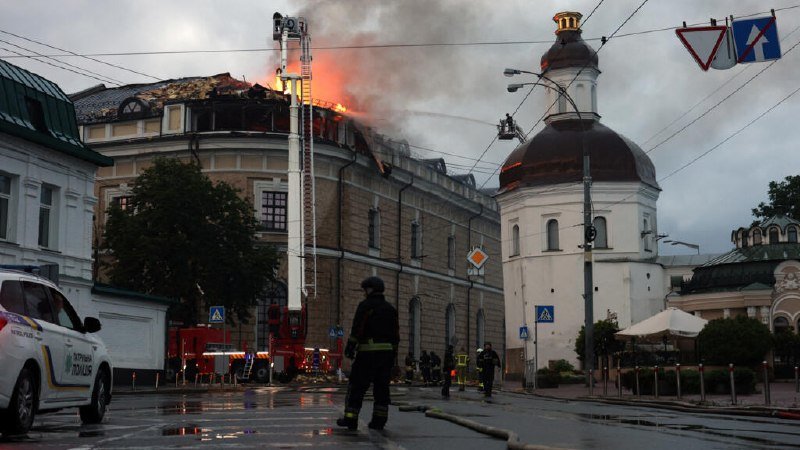
At 20:47 UTC on 1 July 2026, multiple explosions rang across Kyiv. By 21:17 UTC the city's metro stations were full. By 22:18 UTC the CityHotel Residence, a four-star hotel in the centre of the capital, was on fire. By 22:48 UTC, channels tracking strategic aviation were reporting fresh Kh-101 cruise-missile launches from Russian Tu-95 and Tu-160 bombers.[^1] The capital spent the better part of two hours absorbing a layered attack from two different weapons systems: Iranian-designed Shahed/Geran-type long-range one-way attack drones first, then air-launched cruise missiles afterwards. None of this is novel for Kyiv. That is precisely why it matters.
The familiar is no longer breaking news — and the routine has become the story. Every night of barrage looks, to the war-watcher, like the night before. To the capital's residents, who now have a documented procedure for living underneath it, the predictability is itself a kind of weapon. The West's ability to register escalation is calibrated to surprise; consistency defeats that calibration.
The rhythm of the strikes
The sequencing reported in the overnight thread is itself the operational signature. Drones lead. They are slower, cheaper, and designed to saturate Ukrainian short-range air defence — mostly mobile fire-teams, Shilka-style AAA, and Gepard-class systems supplied by Berlin. Each Shahed costs a fraction of a cruise missile. Each cruise missile costs a fraction of a strategic-bomber sortie. The pattern, now repeated across hundreds of nights, treats Ukrainian intercept capacity as a budget line to be exhausted before the high-value ordnance arrives. Status-6's account of the cruise-missile phase began within roughly two hours of the first explosions.[^1]
What stands out about this particular night is not the weapons mix but the target set. The CityHotel Residence is a civilian hotel. A metro full of people moving to shelter is a civilian shelter system. Telegram channels tracking the attack also noted take-offs of at least seven Tu-95 bombers, a number consistent with salvos large enough to require Belarusian and Caspian-region launch points.[^1][^2] Russia's doctrine, in other words, is not to hit legitimate military targets inside Ukrainian cities — it is to coerce the cities themselves.
What the counter-narrative actually says
Moscow's framing for these strikes has long rested on three pillars: that arms-production sites and Western-supplied equipment depots are valid targets, that civilian harm is regrettable but secondary to denazification, and that Ukrainian air defence inadvertently endangers residents when missiles are intercepted over residential districts. Russian state media carry that line every morning. None of the source material surfaced tonight includes Russian-language on-record framing of this particular salvo, but the pattern is well enough established to require acknowledging it here. The Russian counter-claim has two structural problems. First, a four-star hotel in the capital's centre is not, on any independent accounting, an arms depot. Second, the cost-exchange calculus the strikes imply — saturate city defence to land hits whose military utility is marginal — is only coherent if civilian pressure is in fact the goal.
The Western debate registers a quieter version of the same problem. Commentators in capitals from Berlin to Washington continue to describe each raid as a test of Western resolve, as if the test were novel. It is not. The test has been administered nightly for months. The pass-mark, if there is one, is what Kyiv's air-defence units do during the barrage, not what foreign ministers say afterwards.
The structural picture
Read the night's events alongside a longer arc, and what emerges is less an escalation pattern than a steady state. Russian industry now manufactures Shahed-family drones at a scale measured in thousands per month. Strategic bombers cycle through Caspian and Engels-region launch points on rotas that are publicly tracked by open-source analysts. Ukrainian intercept rates have held — but they are intercept rates against a target stream designed to be attritional. The supply equation is asymmetric in Moscow's favour on drones and shifting on missiles, where Western-supplied surface-to-air systems now degrade cruise-missile salvos more effectively than they did a year ago.
Two consequences follow. The first is that the international community's framing of these strikes as atrocities is accurate but inert — every atrocity registers as a data point in a trend line, not as a discrete event demanding discrete response. The second is that Kyiv's resilience is increasingly the product of domestic engineering: better early-warning apps, hardened metro use as shelter, mobile-intercept teams that fire from pavements, energy-grid islanding that keeps the lights on even when substations are hit. Each of these is an investment in adaptation rather than defence. Ukraine is being asked to absorb the strikes; the question of how to make them stop is treated as separate.
Stakes that are no longer abstract
The stakes of one night in Kyiv can be spelled out plainly. Civilians die — the source thread does not include a casualty figure for this particular attack, and this publication will not invent one until it does.[^1][^2] Tourist infrastructure is degraded; foreign press who once based in the CityHotel Residence will move their bureaux elsewhere. Insurance underwriters recalculate. Capital flight accelerates. The diplomatic residue is a few paragraphs of European Council condemnation that the Russian defence ministry will not read.
What the night really exposes is the gap between two descriptions of the same war. One description — the one Russian officialdom keeps on file — treats each barrage as a tactical strike against infrastructure and military-industrial assets. The other — increasingly the operative one inside Ukraine — treats them as a slow-motion siege of major cities, in which the weapon of choice is exhaustion rather than destruction. Both descriptions fit the evidence; they imply opposite policies. The first prescribes more air-defence interceptors. The second prescribes a shift in the kind of capability supplied: not just interceptors but the means to make bomber bases and launch sites untenable. Until Western policy reconciles itself to that second description — rather than the rhetorical comfort of the first — the nights in Kyiv will keep looking like the night before.
What remains uncertain
The overnight reporting rests heavily on open-source channels tracking visual, audio, and radar signatures. Status-6 and adjacent feeds are useful precisely because they move faster than confirmable wire reporting; the cost is that any single night's account may include early or contested claims about launch points, salvo sizes, and target hits.[^1][^2] Confirming casualty numbers, identifying the specific hotel damage in forensic detail, and verifying any structural failure claims will take the next 24 to 72 hours of Ukrainian-emergency-services reporting and wire coverage. Until then, the most that can be said with confidence is what the timeline itself already shows: a coordinated Russian drone-and-cruise-missile attack on the Ukrainian capital, layered, sequenced, and absorbed in real time by a city that has had ample practice.
This publication reads Kyiv's overnight barrages through open-source war channels and Ukrainian civilian reporting; where Western wires later pick up the same events, their casualty figures and target attribution supersede these accounts.
Wire provenance
This editorial synthesis draws on the following public wire/social posts:
- https://t.me/osintlive/
- https://t.me/osintlive/
- https://t.me/osintlive/
- https://t.me/osintlive/