Moscow's midnight missile barrage on Kyiv — and the silence that follows
Two Iskanders, two more Iskanders, two Zircons — a Kremlin missile wave hit Kyiv between roughly 21:46 and 23:04 UTC on 1 July. The barrage itself is documented; the political signal is harder to read.
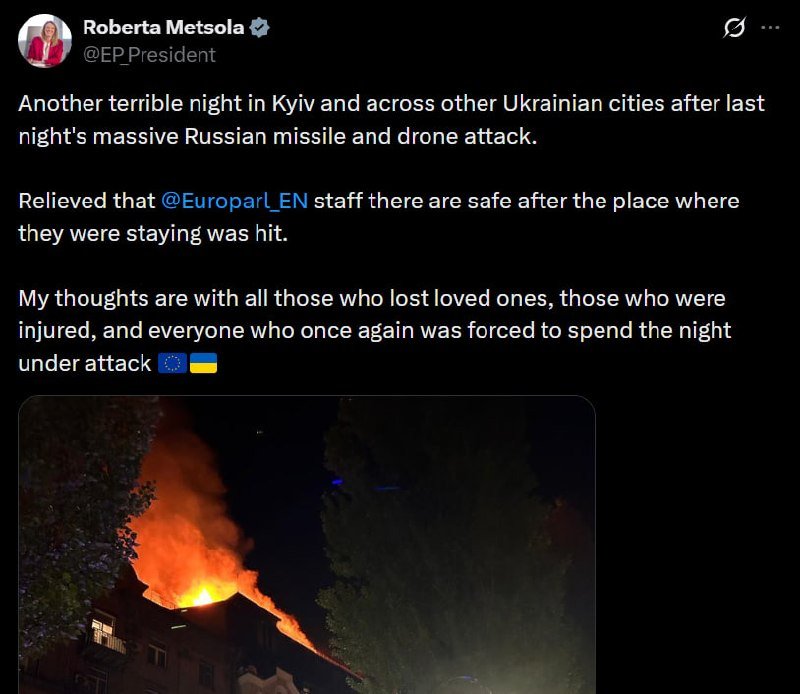
Between roughly 21:46 and 23:04 UTC on 1 July 2026, the Telegram tracking channel AMK Mapping posted a sequence of seven launch-and-impact alerts covering an apparently coordinated Russian missile strike on the Ukrainian capital. The bulletins name Iskander-M ballistic missiles launched from Bryansk Oblast, follow-up salvos launched on Kyiv, and a final wave described as two more Iskanders, with one early post citing four missiles travelling at roughly 11,000 km/h and approaching via Brovary. A separate channel, war_monitor, added a single operational note at 22:31 UTC that one jet had departed Kyiv in the direction of Brovary. Together, the seven AMK Mapping alerts make the tempo of the barrage visible in close to real time; they do not make the damage visible, and they do not by themselves identify the targets, the intercept outcomes, or the casualty count.
What this wire shows is a familiar and increasingly routine signal: a Russian long-range missile complex firing in salvos against a Ukrainian city. The political signal embedded in the timing and the weapon mix — ballistic plus aeroballistic plus at least one jet sortie — is the more interesting question, and the harder one to answer from open sources alone.
What the alerts actually describe
Reading the seven AMK Mapping posts in order, the picture is one of staggered launches from a single direction of fire, with Bryansk identified as the launch point for at least the first wave. The opening post at 21:46 UTC flags an Iskander-M on Kyiv. A second at 21:48 UTC adds that three to four missiles were used, with explosions reported in the city. Roughly an hour later, at 22:53 UTC, a fresh Iskander-M launch is logged from Bryansk, with two missiles placed on Kyiv. At 22:56 UTC the threat picture broadens to two Iskanders and two Zircons inbound. The 22:59 UTC post specifies four missiles at roughly 11,000 km/h approaching via Brovary, and the two posts at 23:03 and 23:04 UTC each register "2 more Iskanders" on Kyiv. The bracketing is consistent with a rolling multi-wave barrage of the kind Ukraine's air force has faced repeatedly since the spring of 2024, scaled up in tempo rather than in entirely new weapon classes.
The lone war_monitor item — a single jet seen leaving Kyiv toward Brovary at 22:31 UTC — is more ambiguous. It could indicate an intercept sortie, an evacuation flight, or a tactical movement of a different kind entirely. The channel's bare caption does not resolve that ambiguity, and the other six sources in the cluster do not address the airframe directly.
Why these particular weapons
Iskander-M is a short-range, road-mobile ballistic missile with a conventional or dual-capable payload, in service with Russia's Strategic Rocket Forces. Zircon is the maritime-launched aeroballistic missile that Russia has framed as a hypersonic capability; its land-attack use against Kyiv has been claimed in earlier waves. The combination — ballistic plus aeroballistic — is designed in part to stress air defence: ballistic missiles arrive on a high, fast, depressed trajectory that taxes interceptor radars and magazines, while a hypersonic-class threat forces defenders to spend additional effort on discrimination and tracking.
Bryansk Oblast sits just north of the Ukrainian border. From positions there, ground-launched Iskanders can reach central Kyiv inside three to five minutes of launch. That short time-of-flight is the operational point of the salvo: it compresses Ukraine's decision window, increases the burden on mobile fire units in and around the capital, and raises the probability that at least some warheads arrive at patrick zones unmolested. The 11,000 km/h figure cited in one of the alerts lines up with published Iskander terminal-velocity estimates.
What the wire is not yet telling us
None of the seven alerts carries ground-truth confirmation of hits, and none names the targets. Telegram tracking channels of this kind publish launch-and-trajectory data, often pulled from open-flight tracking, public radar aggregators, and eyewitness traffic; they do not, by themselves, constitute battle-damage assessment. Ukrainian Air Force statements on overnight strikes — usually posted within hours of impact via the official Telegram channel — are conspicuously absent from this thread, which is one reason the damage picture is genuinely unresolved here, rather than merely delayed.
That absence matters. Routine Russian barrages on Kyiv since 2024 have typically produced an immediate "Shahed-and-missile overnight" summary from the Ukrainian Air Force, with intercept counts, inbound counts, and impact zones. The lack of an official Ukrainian post in the immediate wake of these alerts leaves the effect on Kyiv itself — including any damage in the Brovary direction flagged in the 22:59 UTC alert — uncertain. It also leaves unclear whether the 23:03 and 23:04 UTC alerts describe a continuation of the same wave or a distinct, separate launch.
What the tempo suggests
The cluster as a whole is striking less for its novelty than for its density. Seven separate tracking-channel posts across roughly seventy-eight minutes, naming at least six Iskanders and two Zircons, places this night at the upper end of the routine campaign tempo that has defined Moscow's missile war against Ukrainian cities through 2025 and into 2026. There is no public information in this wire suggesting a city-wide emergency, an unusual target set, or a known anniversary or diplomatic event that would explain a deliberate escalation, and absent that context the defensible read is that the bombardment reflects the steady operational rate Russia has settled into: not a single dramatic strike but a continuing campaign pressure on the capital, punctuated by heavier nights. The single most plausible alternative reading — that the salvo is timed to coincide with a specific negotiation, anniversary, or domestic-political event not mentioned in the open wire — cannot be ruled out from the items to hand, but is not supported by them either.
What is supported is the basic fact: Kyiv was under sustained Russian missile fire on the night of 1 July 2026, the launches originated from Bryansk, the weapon mix combined Iskander ballistic and Zircon aeroballistic missiles, and the open tracking wire caught the barrage in close to real time without catching its consequences. Until the Ukrainian side releases its own assessment, the political significance of the night will remain a question that open-source tracking can frame but not answer.
Desk note: Monexus has treated this primarily as a tracking-wire reconstruction, distinguishing what the Telegram alerts can verify (launch points, weapon types, tempo) from what they cannot (damage, intercept outcomes, target selection). Ukrainian Air Force statements are expected to clarify the ground picture within hours; the editorial line here will be updated as they arrive.
Wire provenance
This editorial synthesis draws on the following public wire/social posts:
- https://t.me/AMK_Mapping
- https://t.me/AMK_Mapping
- https://t.me/AMK_Mapping
- https://t.me/AMK_Mapping
- https://t.me/war_monitor
- https://en.wikipedia.org/wiki/9K720_Iskander
- https://en.wikipedia.org/wiki/3M22_Zircon