Russia's Drone Tempo Has Quietly Reached Industrial Scale
Four Telegram dispatches in roughly ninety minutes describe Geran-2 strikes on Zaporizhzhia and Chernihiv. The pattern is the story — Russia is now running long-range drone attacks on a near-continuous tempo, and Ukraine's air-defence burden has become a permanent feature of the war.
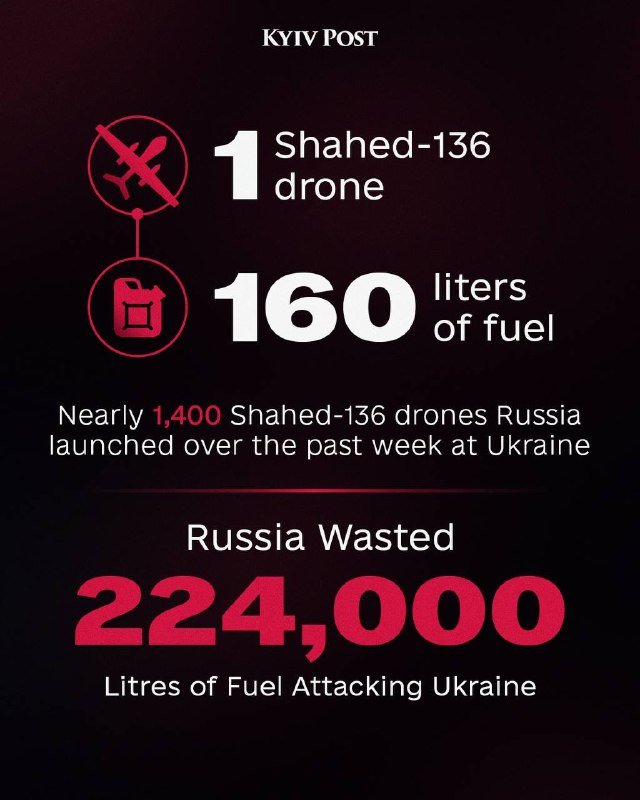
At 21:10 UTC on 1 July 2026, an explosion was reported in Zaporizhzhia City — the latest of at least four Geran-2 drone strikes tracked across roughly ninety minutes that evening, according to the open-source channel AMK Mapping. Subsequent posts at 22:02 UTC and 22:49 UTC recorded further Geran-2 strikes on Zaporizhzhia, with a fourth at 22:48 UTC near Chernihiv City, several hundred kilometres to the north. No drone hit the same city twice; the cadence itself is the news.
For thirty months the dominant frame around Russia's long-range strike campaign has been a count — how many Shahed-type drones were launched overnight, how many were shot down, what percentage reached their target. That frame is now obsolete. What the AMK Mapping thread from 1 July shows is a tempo that no longer behaves like a strike package. It behaves like a production line.
From salvos to a continuous drip
The early months of the Shahed-136 / Geran-2 campaign, beginning in autumn 2022, were characterised by discrete waves — fifty drones, one hundred drones, occasionally more, launched in coordinated packages against the Ukrainian grid as autumn and winter approached. Reporting at the time, including from Reuters and the Institute for the Study of War, treated each wave as a discrete event with a discernible tactical logic.
The 1 July sequence does not read that way. Two strikes on Zaporizhzhia and one on Chernihiv inside ninety minutes is not a package; it is a baseline. The structural implication is that Russia has built, or bought, enough airframes and enough launch capacity to treat long-range drone strikes as a standing tool rather than a once-a-season escalation. The factory in Yelabuga that the Wall Street Journal first identified in 2023 as a domestic assembly site for the Geran-2 is, by all available evidence, still running.
The defence burden becomes permanent
For Ukraine the arithmetic is unforgiving. Each Geran-2 costs a fraction of a Patriot interceptor or even a Gepard round; every drone that gets through can damage substations, residential blocks, and rail nodes. When the incoming tempo rises from one wave a week to multiple waves a day, the question stops being "did Ukrainian air defence hold?" and becomes "how long can Ukrainian air defence hold before magazine depth becomes the binding constraint?"
Western patrons have so far preferred to read this as a logistics problem solvable with more deliveries. That is probably true on a six-month horizon. It is much less obviously true on a thirty-month horizon if Russian production continues to scale in parallel.
What the wires are not yet calling it
Most coverage of the long-range strike campaign still reaches for the word "salvo" — a military term that implies a deliberate, bounded action. The 1 July thread suggests the word no longer fits. What we are watching is the industrialisation of attritional bombardment by a state that has decided the unit cost of one Iranian-designed airframe is acceptable exchange for one Ukrainian transformer substation, one apartment block, one rail switch.
The reasonable counter-reading is that the AMK Mapping thread captures an unusually active ninety minutes and that the longer-run cadence is in fact steadier than these four posts suggest. Open-source channels routinely over-report active nights and under-report quiet ones. Until an independent ledger exists that aggregates daily Geran-2 launches across the whole country, claims about "industrial tempo" remain inferential. Monexus flags that uncertainty.
Stakes
If the trajectory continues, the diplomatic conversation inside NATO will shift from how many air-defence systems to send to whether to underwrite Ukrainian domestic production of interceptor drones at the scale the war now requires. The war's economic geometry has changed; the policy vocabulary has not caught up. That gap is, for now, the most consequential single fact about the Russian drone campaign.
— Monexus framed this around tempo rather than around individual explosions because the four Telegram dispatches in ninety minutes do not justify separate incident pieces; the cadence itself is the news the wires have not yet named.
Wire provenance
This editorial synthesis draws on the following public wire/social posts:
- https://t.me/AMK_Mapping
- https://t.me/AMK_Mapping/1
- https://t.me/AMK_MAPPING
- https://t.me/AMK_MAPPING