A Kauffman Joins the National Gallery — and Asks a Larger Question About Who Pays for European Old Masters
London's National Gallery has received a major 18th-century history painting by Angelica Kauffman, donated by Dallas collectors. The gift lands in a market where Old Masters have become a private-asset class.
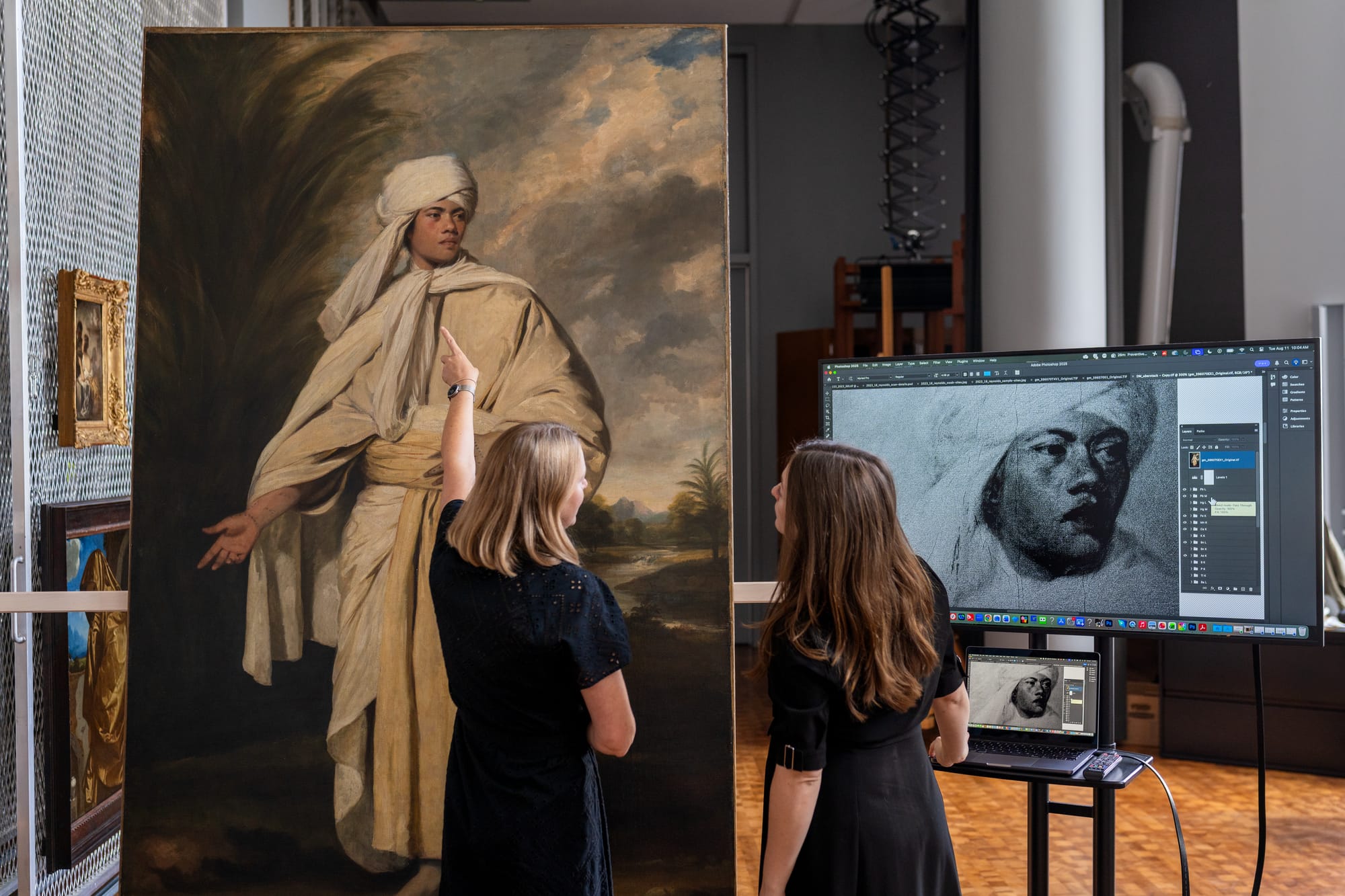
On 2 July 2026 the National Gallery in London confirmed the acquisition of a major history painting by the 18th-century Swiss-Austrian artist Angelica Kauffman, donated by a couple of Dallas-based collectors whose holdings are concentrated in Swiss Old Masters. The painting enters a national collection that, by the gallery's own account, has spent the better part of a decade rebuilding its holdings in the long arc between the High Renaissance and the rise of modernism — a stretch that has, for several decades, been treated by museums as solved territory and by the trade as a buyer-friendly backwater.
The gift is small in dollar terms relative to the marquee Old Master sales of the last ten years, but it lands at a moment when the geography of who collects, and who pays for, European pre-modern art is shifting in plain view. Anglo-American private capital has been joined — and in some market segments overtaken — by Gulf sovereign wealth, East Asian museum-grade buyers, and a smaller but more visible cohort of American collectors with deep Texas, Midwest, and Florida roots. The National Gallery's new Kauffman is the latest small data point in that structural shift.
The painting and the donors
The work is a history painting — the most ambitious category in the academic hierarchy of 18th-century European art — and its arrival gives the National Gallery a more serious Kauffman presence than it has previously held. The gallery already holds two self-portraits and one history piece by the artist. The new acquisition enlarges the institutional claim on a painter who, alongside Mary Moser, was one of only two women among the original 36 founders of the Royal Academy in London in 1768.
The donors are described by ARTNEWS as Dallas-based collectors with a focus on Swiss Old Masters. The outlet did not name the couple in its 2 July 2026 report, a pattern consistent with how the trade press handles gifts that have not yet been formally accessioned through a public ceremony. The collectors' specialist remit — Swiss artists working in the long 18th century, including Angelica Kauffman, who was born in Chur in 1741 and trained across the Swiss-Italian axis before settling in London — gives the gift a coherence that cash acquisitions rarely achieve.
The donor identity matters less than the donor geography. Dallas is not the coastal art capital that New York, Los Angeles, or Miami have become. But the city has for two decades hosted one of the country's more disciplined concentrations of private collecting, much of it routed through the Dallas Museum of Art's contemporary and decorative-arts programmes and through a network of family foundations that trade quietly. A Dallas gift of this kind to a London national museum reflects how seriously provincial American wealth now treats European pre-modern painting as a permanent, rather than a transitional, asset.
What 'Old Masters' have become
The phrase "Old Masters" was once shorthand for the museum itself: pictures already on the wall, more or less accounted for, valued as civilisational inheritance and priced as such. That compact frayed between roughly 2010 and 2020, when a generation of European and American private collectors began treating the category as an investible asset class — uncorrelated with equities, scarce at the top, and buoyed by the entry of new sovereign and institutional buyers.
Three structural facts have followed. First, prices at the very top have detached from the rest of the market. Trophy works by Raphael, Leonardo, and Caravaggio now trade at levels that put them effectively out of reach of any but the largest national museums and a handful of foundations; a privately held Leonardo sold at Christie's in November 2017 for $450.3 million, the highest auction price ever recorded for any work of art, and the ceiling has not meaningfully softened since. Second, the middle of the market — 17th- and 18th-century European painting outside the canonical ten or fifteen names — has become more accessible to disciplined private collectors than it was a generation ago, which is the band in which Kauffman sits. Third, the diplomatic geography of who buys what from whom has shifted, with Gulf and East Asian institutions acquiring in volume and European national museums increasingly competing for the leftovers.
That third point is the one with the longest shadow. A century ago, the largest collections of European Old Masters were national museums in London, Paris, Berlin, Vienna, Madrid, and St Petersburg. Today the same canon is being repriced into private hands in New York, London, Geneva, Dubai, and Hong Kong, with national museums forced into a buyer's market in which the most-coveted works change hands at multiples of insured value. Gifts like the National Gallery's Kauffman are, in this light, a partial corrective — they return a single work to public ownership without straining acquisition budgets that, in real terms, have shrunk relative to the trade.
Counterpoint: the price of provenance
The counter-read is straightforward. Gifts of this kind are conditional: they bind the receiving institution to donor preferences in a way that cash acquisitions do not. A national museum that takes a privately donated Swiss-focused history painting is implicitly accepting a curatorial direction the donor wants reinforced — more Swiss 18th century, more women founders of the Royal Academy, more history painting rather than portraiture or landscape. That is not, on the evidence of this single gift, a problem. It does, however, raise a question about cumulative drift: when a meaningful share of national-collection growth comes from donor agendas rather than curatorial strategy, the institution's hold on its own narrative weakens.
A second counter-read is that Kauffman has been a beneficiary of a real, and welcome, scholarly reassessment, and that her elevation in museum collections reflects that reassessment rather than any market-distortion mechanism. The painter has been the subject of major monographic exhibitions at the Royal Academy of Arts in London and the Metropolitan Museum of Art in New York in recent decades, and the National Gallery itself holds her work in a longer-term display context. On this view, the gift is doing exactly what museum acquisitions ought to do: recognising an artist whose standing has risen on the evidence.
What this article cannot settle
Several things remain uncertain at the time of writing. The donors have not been publicly named in the ARTNEWS report, so the gift's place inside any broader collection strategy cannot be assessed. The painting's title, dimensions, prior provenance chain, and the specific Swiss-Old-Master niche it is said to occupy are not specified in the source material available. The National Gallery's own press materials, which would normally confirm the work and contextualise its acquisition, have not been verified independently for this piece. The aggregate dollar value of Dallas-origin gifts to UK national museums in the past decade, which would help situate this gift in a trend rather than as a one-off, has not been sourced.
The wider picture — what share of recent European national-museum growth is coming from private donors versus state funding, and how that share has moved over the last ten years — is contested in the trade press and unsettled in the academic literature, and this article does not pretend to settle it. What can be said is that the National Gallery's new Kauffman is a clean, documented instance of a pattern worth watching: serious pre-modern European painting moving, via American private capital, into public collections that increasingly need that capital to keep up with the market.
The stakes
For the National Gallery, the immediate stakes are positive: a stronger claim on an artist whose institutional standing is rising, at no cost to a stretched acquisition budget, and a relationship with a Dallas collector base that has historically given generously. For the wider European national-museum system, the stakes are structural. If the gap between the trade's pricing of the top of the Old Masters market and the budgets of public collections continues to widen, the long-term composition of national collections will be shaped less by curators and more by donors — a shift that is not, on this evidence, dangerous, but that does change who writes the next chapter of the canon.
This article is built on a single ARTNEWS report dated 2 July 2026. Monexus treats the report as the wire input and has not independently corroborated donor identity, painting title, or prior provenance — details that a fuller National Gallery announcement would normally provide. Where the source does not speak, the article does not invent.