Kyiv's Night on the Wire: What a Single Barrage Tells Us About the War's Next Phase
Russia hit Kyiv for the second consecutive night this week with cruise and ballistic missiles. The pattern, not the pyrotechnics, is the story.
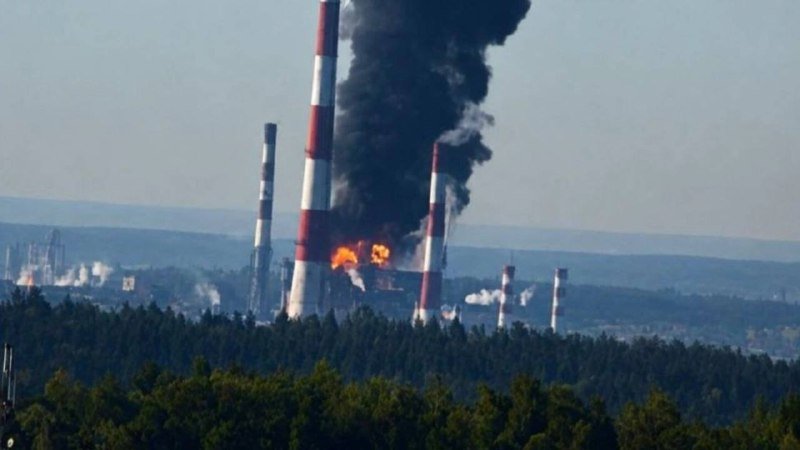
Between roughly 22:58 and 00:29 UTC on 1–2 July 2026, Kyiv took what looked like a textbook two-tier Russian missile package: Iskander and Zircon strikes first, then a procession of cruise missiles launched earlier by Russian strategic bombers, peppered with repeated ballistic hits. Video from the Shevchenkovsky district showed something catching a high-rise roof. Dust and debris came down inside a metro station. Telegram channels lit up with the usual emoji-roll. None of this is new in the fourth year of the full-scale invasion. The pattern, though, is.
This publication's reading is straightforward and uncomfortable: the campaign against the Ukrainian capital is no longer episodic punishment, scheduled around political theatre in Washington or Brussels. It is industrial. The pacing — bomber-launched cruise, then ballistic, then a second ballistic wave inside ninety minutes — is the cadence of an integrated long-range strike package, not a retaliatory spasm.
The operational picture
The first alerts began at 22:58 UTC on 1 July, with reports of Iskander and Zircon strikes landing in Kyiv, according to monitoring channels. Forty-three minutes later, the same feeds warned that cruise missiles launched earlier by strategic bombers had entered Ukrainian airspace and were on approach to the capital. At 23:41 UTC came word of repeated ballistic strikes in the city. By 00:29 UTC on 2 July, footage circulated of dust falling from metro-station ceilings; the same chain reported objects striking the roof of a Shevchenkovsky high-rise.
The sequence matters. A cruise-missile salvo, followed within an hour by ballistic correction, followed by a second ballistic wave, is what Russian planners call a "complex strike" — designed to exhaust air defence, catch mobile units reloading, and pressure the political centre simultaneously. Telegram-channel characterisation of a strike on a high-rise as possibly a SAM (surface-to-air missile) whose propellant had not burned off points in the same direction: the air-defence system is active, and incoming ordnance is being intercepted, but not all of it cleanly.
The deeper point is geography. Kyiv is roughly 750 kilometres from a Tu-95 launch point in the Saratov/Engels area, well inside the bombers' cruise-missile envelope. Every strike package from that axis lets Moscow blend air-, sea- and ground-launched weapons in a single window, making interception math harder for Ukrainian Patriot, IRIS-T and NASAMS crews. There is no reason, on the public evidence, to read the 1–2 July barrage as a one-off.
The counter-read — and why it holds weakly
The standard counter-narrative is that Russia is bargaining, not conquering: that these are escalatory signals aimed at Western capitals, calibrated to be lifted in exchange for sanctions relief or a frozen conflict. The bargaining logic is real. The problem is that on the available evidence, the strikes have continued across multiple shifts of Western posture — under Biden, through the early Trump-2 negotiations, into the current EU accession framework for Ukraine. Energy infrastructure, residential districts and military targets near civilian dormitories have all been hit, sometimes on the same night, without obvious correlation to a specific negotiation milestone.
A second counter-read is that air-defence is winning: the number of intercepted missiles is higher than at any prior point in the war, and damage should be discounted. Both can be true. Interception rates are not the same as casualties, and a city that wakes up to broken windows and a metro ceiling shedding plaster is not a city whose defences held.
Why the cadence is the story
Western commentary tends to dramatise each strike as a discrete horror. That framing produces genuine compassion and very little predictive purchase. The structural fact — what the 1–2 July pattern sits inside — is that Russia has been converting the war into a siege economy.
Three shifts have compounded since 2024. First, domestic-drone production rose steeply; published reporting from Reuters, BBC and Ukrainian outlets indicates the Kremlin is manufacturing Shahed-type systems at a run-rate that no longer requires Iranian supply. Second, missile output at the Kinzhal / Iskander / Kh-101 nodes has been re-tooled under sanctions pressure into higher, if degraded, throughput. Third, the target list has rationalised: less pretense at striking military-meaningful targets, more at generating sustained civilian exhaustion across the capital. The complex strike on Kyiv is not a mistake of aim; it is a feature of a budget.
This is the part of the war that Western pro-fatigue commentary gets wrong, treating each barrage as a sign that Russia is running out of options rather than as evidence that options have been re-prioritised. The two interpretations produce opposite policy responses.
Stakes, plain
If the current cadence holds, the plausible 12-month outcome is a Kyiv that functions under rolling air-defence but with mounting damage to its residential and energy grid, a Ukrainian defence economy that absorbs missiles rather than degrades them, and a Western donor base that learns to budget for Ukrainian resilience rather than Ukrainian victory. The Ukrainian state — and the established international-law premise that Ukraine is the invaded party and Russia the aggressor — does not disappear under that trajectory. The contested question is whether the West funds Kyiv to reverse ground or only to absorb the next barrage.
A plausible alternative: a sufficiently deep Patriot and IRIS-T replenishment pipeline, combined with the new domestic interceptor programmes Kyiv has been quietly scaling, forces Russia back into a more expensive, less sustainable strike mix. That is the trajectory Kyiv's Western partners say they prefer. The 1–2 July evidence suggests they have not yet chosen it.
What remains genuinely uncertain on the night is the casualty load. The available open-source feeds capture the strike pattern, the visible damage and the air-defence activity. They do not yield a clean death or injury count, and any number circulating in the first hours after a Kyiv barrage should be treated as preliminary. The picture will sharpen; the cadence, on the other hand, is already legible.
Desk note: Monexus leads with Ukrainian-source reporting and Western-wire coverage of the war; Russian state-aligned and Russian-adjacent milblogger channels appear here only as counter-claim material with explicit sourcing caveats.
Wire provenance
This editorial synthesis draws on the following public wire/social posts:
- https://t.me/s/DDGeopolitics
- https://t.me/DDGeopolitics
- https://t.me/DDGeopolitics
- https://t.me/DDGeopolitics
- https://t.me/DDGeopolitics