Kyiv Under Fire: Reading a Single Night of Russian Strikes
A cluster of Telegram channels logged more than a dozen Russian ballistic and drone launches against Kyiv on 1 July 2026. The pattern matters more than the count.
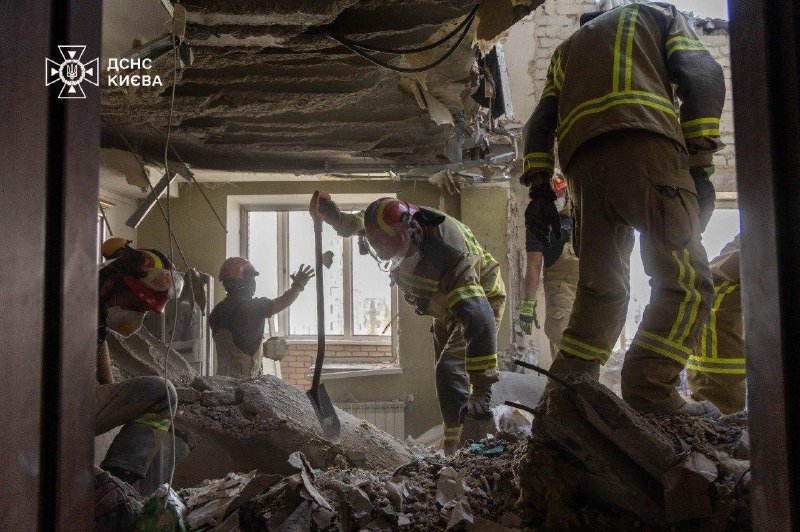
Between 22:06 UTC on 1 July 2026 and the early minutes of 2 July, residents of Kyiv logged more than a dozen Russian ballistic missile launches and a separate large Geran-2 drone attack against the capital. The cluster of channels tracking the raid — AMK_Mapping, vanek_nikolaev, intelslava and war_monitor — moved in lockstep, each post narrowing the count as air-defence units reported intercepts and impacts in real time.
The episode is a useful frame for reading the war at street level. It also exposes a recurring problem in how Western wire coverage translates these nights into English-language copy.
The night's arithmetic
The Telegram record reads as a rolling ledger. At 22:06 UTC on 1 July, AMK_Mapping reported "Explosions in Kyiv. Large Geran-2 drone attack." By 22:24 UTC, war_monitor logged a single unmanned aerial vehicle approaching Kyiv from the north. At 22:53 UTC the channel warned of "descent of ballistics," and within a minute AMK_Mapping counted two impacts in the city.
A second wave followed. Between 23:05 and 23:32 UTC — roughly half an hour — vanek_nikolaev and AMK_Mapping tracked what the channels described as multiple ballistic missiles, with at least two more impacts in Kyiv and the rest of the salvo steered toward western districts. By 23:32 UTC, AMK_Mapping posted the all-clear.
The channels disagree on details — count of missiles, whether individual rounds were intercepted or landed — but the spine of the night is consistent across them: a Geran-2 drone strike early in the evening, a pause of roughly twenty minutes, then a multi-missile barrage aimed at the capital.
What the Western wire usually does with this material
When a night like this one is translated for an English-reading audience, the rhythm is familiar. A Reuters or AFP bulletin picks up the Ukrainian air-force count, runs it past the city's military administration for a civilian toll, and publishes a tight three-paragraph note with the cumulative overnight figure. The Telegram channels — local, granular, sometimes contradictory — are treated as ambient noise rather than primary observation.
That hierarchy is not unreasonable. The channels are not journalists in the wire-service sense; their authors are enthusiasts with no institutional correction mechanism, and their post count frequently diverges from the official tally once the morning after-action review lands. But the channels also catch things the wires cannot — the order in which the salvos arrived, the direction of approach, the geographic split between central and western Kyiv — and that operational detail is precisely what a reader trying to understand the war needs.
The structural point
The pattern visible on the night of 1 July is now the standard Russian playbook against Kyiv. A long-range drone strike softens air defences, draws out interceptor missiles and reveals radar positions; a ballistic-missile barrage follows minutes later, exploiting whatever gaps the drone phase has opened. This sequencing has been visible in public reporting since at least the winter of 2022–23 and has only become more disciplined. The 1 July sequence — drones at 22:06, then ballistics from 22:53 onward — fits that template.
What is striking, looking at the cluster as a whole, is how thin the sourcing layer between the event and the English-language reader has become. The Telegram channels are, in effect, doing the frontline reporting that a Western wire stringer used to do. The wires translate. The reader trusts the translation more than the source.
What the evidence does and does not tell us
The channels logged roughly a dozen launch events and two or three confirmed impacts in Kyiv, with the rest of the salvo reportedly intercepted or steered to less populated areas. They do not specify which air-defence systems — Patriot, IRIS-T, NASAMS, the Ukrainian S-300 family — engaged the incoming missiles. They do not provide a civilian casualty count. The official Kyiv city military administration, which would normally publish both figures within hours of the all-clear, is not in this thread.
That gap matters. The four channels in this cluster are useful for sequencing and direction. They are not, on their own, sufficient for the questions a responsible piece of war reporting has to answer: who was hurt, what infrastructure was damaged, and how the night's count compares with the week before. For those, the morning-after briefing from the Ukrainian air force and the Kyiv military administration is the load-bearing source — and it is not represented here.
The stakes of treating Kyiv nights as ambient
If the English-language reader accepts the wires' compressed version of these nights without engaging with the granular channels, two things go missing. First, the pattern recognition: a reader who only sees daily tallies cannot see the drone-then-ballistic sequencing, which is the actual operational signature of the campaign. Second, the city's own voice: the channels closest to the ground are, increasingly, the channels that ground the reporting.
The war in Ukraine is being observed by a hybrid mesh of official briefings, local Telegram channels and Western wire translation. None of the three layers is sufficient on its own. A reader who understands only the third is reading a translation of a translation.
Monexus frames this as a sourcing problem before it is a military one: the night of 1 July 2026 was visible in real time to anyone running the right Telegram cluster, and almost invisible to anyone waiting for the morning wire.
Sources
- t.me/AMK_Mapping — "Explosions in Kyiv. Large Geran-2 drone attack." — 1 July 2026, 22:06 UTC
- t.me/AMK_Mapping — "2 impacts in Kyiv" — 1 July 2026, 22:54 UTC
- t.me/AMK_Mapping — "All clear. The other 3 missiles targeted western Kyiv" — 1 July 2026, 23:05 UTC
- t.me/AMK_Mapping — "Explosions in Kyiv" — 1 July 2026, 23:29 UTC
- t.me/AMK_Mapping — "Explosions in Kyiv. Impacts. All clear now" — 1 July 2026, 23:32 UTC
- t.me/vanek_nikolaev — "again 2 ballistics for Kyiv! and more ballistics for Kyiv!! 2 rockets" — 1 July 2026, 23:20 UTC
- t.me/vanek_nikolaev — "and more ballistics for Kyiv!! 2 missiles and more ballistics for Kyiv! 1 rocket" — 1 July 2026, 23:21 UTC
- t.me/vanek_nikolaev — "again ballistics to Kyiv!! 1 missile again ballistics to Kyiv!!! 1 rocket" — 1 July 2026, 23:31 UTC
- t.me/intelslava — "New wave of missiles heading toward Kyiv." — 1 July 2026, 23:25 UTC
- t.me/war_monitor — "1x unmanned aerial vehicle in the direction of Kyiv from the north" — 1 July 2026, 22:24 UTC
- t.me/war_monitor — "Kyiv - descent of ballistics!" — 1 July 2026, 22:53 UTC
Wire provenance
This editorial synthesis draws on the following public wire/social posts:
- https://t.me/AMK_Mapping
- https://t.me/vanek_nikolaev
- https://t.me/intelslava
- https://t.me/war_monitor