Russia Turns the Long-Range Missile Screws on Ukraine Overnight
Two overnight Telegram advisories from a frontline mapping account point to a layered Russian long-range package out of Kursk Oblast — Iskander-M and air-launched Kh-59/69 cruise missiles — without explaining why the tempo has picked up.
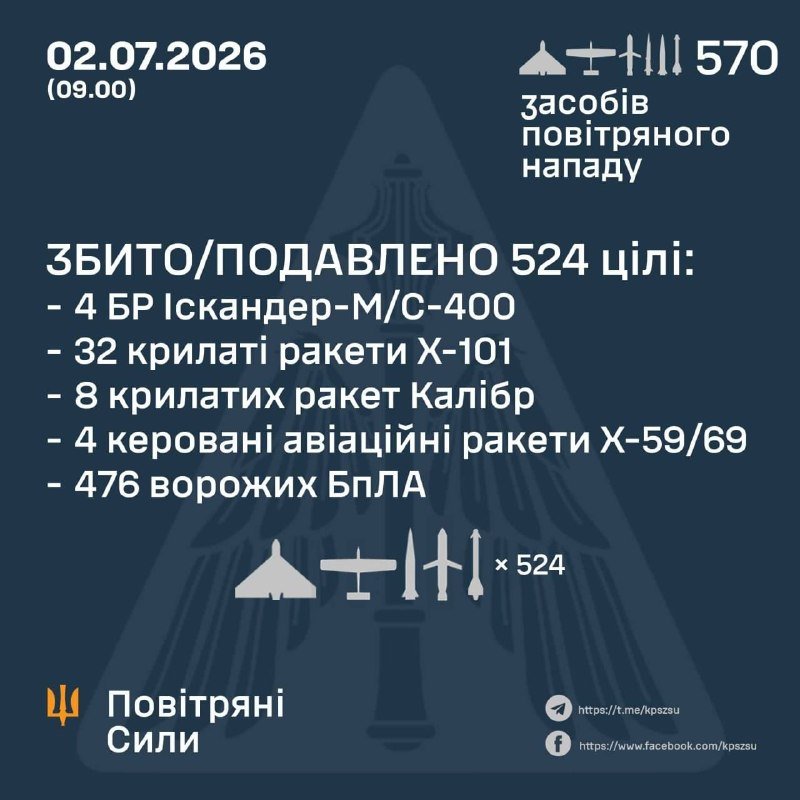
Between 23:55 UTC on 1 July 2026 and 00:50 UTC on 2 July, a frontline open-source mapping channel logged four separate advisories describing a layered Russian long-range strike package originating from Kursk Oblast, on territory Moscow has held since spring 2025.
The pattern, stripped of operational jargon, is this: a salvo in which short-range Iskander-M ballistic missiles were paired with air-launched Kh-59 and Kh-69 cruise missiles, the latter fired by at least one Su-57 fighter operating near Kurchatov. It is the kind of package Western analysts have spent two years calling routine, and the kind that, on any given night, can be more than routine.
What the four advisories actually say
The thread from AMK_Mapping is concise by design. The first entry, timestamped 1 July 2026 at 23:55 UTC, flags an Iskander-M threat originating from Kursk. A second alert, at 00:30 UTC on 2 July, specifies that at least some of the missiles in the package were Kh-59 or Kh-69 cruise munitions, launched by a Su-57 operating close to Kurchatov. Two further advisories, at 00:48 and 00:50 UTC, return to the Iskander-M designation, with a parenthetical noting the missiles are "probably" the ground-launched cruise variant, the Iskander-K.
The sequencing matters more than the count. Iskander-M is a quasi-ballistic system optimised for hardened targets and rapid re-tasking; pairing it with air-launched cruise missiles lets an attacker saturate Ukrainian air defence at multiple altitudes and trajectories simultaneously. That the Su-57 — Russia's low-observable flagship, still relatively rare in combat-configured numbers — was the launch platform is the more telling detail.
The piece no one has filed yet
Russian state outlets and Russian-aligned milbloggers routinely frame these salvos as calibrated retaliation for Ukrainian strikes on Russian territory. The Western wire line tends to read them as pressure tools aimed at Ukrainian critical infrastructure ahead of a heating-and-power season. Both framings are partly right, and neither tells the full story.
The missing piece is geography. Kursk Oblast is not a random launch point. It is the territory Moscow seized from Kyiv in a grinding 2025 offensive and continues to use as a forward basing area. Striking Ukraine from Kursk rather than from Belgorod or Voronezh shortens the missile flight time and reduces the warning window for Ukrainian air defences by tens of seconds. Theologians of air defence call this a launch-azimuth problem; the practical effect is that Ukrainian defenders in Sumy, Kharkiv and Chernihiv oblasts have less reaction time than they did a year ago. The longer Russia holds Kursk, the more compressible that warning window becomes.
The structural read, in plain terms
What the overnight advisories capture is the steady industrialisation of a strike campaign that began as opportunistic bombardment and is now functioning as an integrated kill chain. Three forces are converging.
First, capacity. Russia's domestic missile output has expanded faster than Western sanctions modelling predicted. Second, basing. The longer Moscow holds captured Ukrainian ground, the closer its launchers sit to the targets it cares about. Third, integration. Pairing Iskander-M with air-launched cruise munitions forces Ukrainian Patriot, IRIS-T and NASAMS crews to track two distinct threat classes at once — and forces Western donor governments to weigh interceptor stockpiles against a longer campaign than their procurement schedules were written for.
The pattern that emerges is not dramatic. It is the slow compounding of marginal advantages into a structural one, which is precisely the kind of escalation that does not generate cable-news urgency until a single bad night produces it.
What remains genuinely uncertain
The advisories do not specify how many missiles were launched, which targets in Ukraine were hit, or whether interceptors engaged the package. They also do not say whether the Su-57 launch was a one-off or part of a wider operational debut of the aircraft in a strike-launcher role. AMK_Mapping is an open-source channel with a track record, but its classifications are single-source and occasionally revised. Anyone treating the four advisories as a definitive count would be over-reading the data. The honest read is that two distinct Russian long-range systems were active from Kursk overnight, and that the tempo in this corridor is not slowing.
The stakes are straightforward. If the launch-azimuth advantage from Russian-held Kursk continues to compress Ukrainian reaction time, donor governments will face an earlier and more expensive interceptor replenishment cycle. Kyiv's defenders will face more nights like this one. And the diplomatic story of a war that "has not escalated" will continue to age poorly.
Desk note: Monexus logged the four overnight advisories as a layered Russian long-range package out of Kursk Oblast, rather than as four unrelated launches. The mapping channel's single-source nature is flagged; the structural reading — Kursk as a launch-azimuth advantage — is this publication's frame, not the channel's.
Wire provenance
This editorial synthesis draws on the following public wire/social posts:
- https://t.me/AMK_Mapping
- https://t.me/AMK_Mapping
- https://t.me/AMK_Mapping
- https://t.me/AMK_Mapping
- https://en.wikipedia.org/wiki/9K720_Iskander