Ukraine's Long Reach: How the Kstovo Strike Reshapes the Calculus of Russian Refining
Overnight, Ukrainian drones hit one of Russia's largest refineries more than 800km from the front line. The strike on AVT-6 at Kstovo signals that Kyiv's energy campaign is no longer a sideshow — it is reshaping the fiscal mathematics of the war.
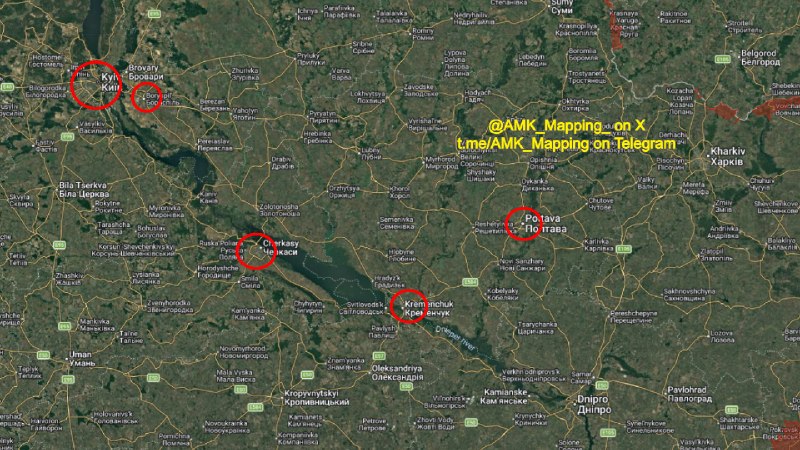
The first indicators arrived at 07:12 UTC on 2 July 2026: a Telegram channel with a track record of cataloguing Russian military and industrial damage reported that Ukrainian drones had struck the Lukoil-Nizhegorodnefteorgsintez refinery in Kstovo, Nizhny Novgorod region, overnight, hitting the AVT-6 primary oil processing unit while Russian forces struck residential buildings in Kyiv (noel_reports). Within an hour, Kyiv's English-language outlet Kyiv Post confirmed the same target, calling it one of Russia's largest oil refineries, and added that a key railway bridge in occupied territory had also been struck (Kyivpost_official). By 08:20 UTC, the mapping channel AMK_Mapping posted footage and location data showing large fires at the plant (AMK_Mapping). Three independent channels, two distinct editorial orientations, one conclusion: the strike on AVT-6 is real, and the operational symbolism is unmistakable.
What makes the Kstovo attack consequential is not the volume of fire — Russian refinery fires are now a near-weekly occurrence — but the distance from the front line and the specific unit disabled. The plant sits roughly 850 kilometres east of the Ukrainian border and processes feedstock feeding central Russian fuel markets. AVT-6 is a primary atmospheric-vacuum distillation column of the kind that defines a refinery's throughput capacity; damaging one does not merely dent a single product slate, it constrains the plant's ability to run feed at planned rates. The arithmetic, in other words, has moved.
The pattern beneath the headline
The Kstovo strike is the latest entry in a campaign that has accelerated since mid-2024 and is now showing cumulative effects on Russian downstream margins. Refineries deep inside European Russia — in Nizhny Novgorod, Tatarstan, Samara, and the Krasnodar region — have been hit by long-range drones and, in some cases, by missiles diverted from interceptor duty. Each strike on its own is recoverable: Russian crews are adept at patching distillation units, and Moscow has leaned on shadow-fleet logistics to import damaged components and intermediate feedstocks. What is harder to recover is the calendar. AVT-6 is the second primary unit at a top-ten refinery taken off-line in roughly six weeks, according to the mapping cited above; cumulative downtime is now eating into the seasonal maintenance window that Russian refiners traditionally use to plan turnarounds. That compression is the story — less a single dramatic blow than a slow squeeze on a system that was never designed to absorb continuous attrition.
The second-order effects show up in Russian domestic fuel pricing and in export flows. Each percentage point of unexpected refinery downtime translates into measurable upward pressure on wholesale gasoline and diesel, and Russia has periodically imposed export curbs and temporary gasoline bans to keep the domestic market supplied. Those interventions are not theoretical: in 2024 and 2025, Moscow responded to similar strikes with short-notice export restrictions that fed back into global product prices. The squeeze is not (yet) severe enough to collapse Russian refining, but it is reshaping the bargaining position of the Russian state with its own downstream operators, and it is narrowing the political space in which the federal budget can rely on hydrocarbon revenues holding steady.
Counter-narrative: how the other side sees it
The Russian-aligned framing — visible on milblogger channels and in the muted language of official briefings — is that these strikes are terror attacks on civilian infrastructure, that the refinery is a non-military target, and that Western-supplied weapons are being used to escalate. That framing deserves a fair hearing in any honest account, and it sits inside a real argument about the laws of armed conflict and the proportionality of attacks on dual-use energy infrastructure. It also, however, runs into the practical fact that Russian refining capacity directly finances the federal budget and feeds the logistics of an invading force: fuel is what moves tanks, trucks, and missiles, and refineries are sanctioned objects under the legal frameworks that several Western governments have adopted to constrain Russia's war-making capacity.
A more interesting counter-narrative comes from the Russian domestic-fiscal angle. Russian analysts have argued that the strikes, even cumulatively, cannot remove enough refining capacity to change the strategic picture; that Russia has enough redundancy to absorb the loss; and that the political effect on European publics — by raising global product prices — will, in time, soften Western support for Ukraine. There is evidence on both sides of that argument. What the data does not support is the strong claim that the strikes have been strategically meaningless. AVT-6 is not a symbolic target; it is an industrial node whose outage compresses margins across a regional cluster.
The structural frame, in plain language
This is what an industrial campaign looks like when the defending side has lost air superiority but retains deep territorial depth. Ukraine cannot — and has not claimed to — destroy the Russian oil industry outright. What it can do, and what it has been doing with increasing consistency, is impose incremental damage on a system whose planning horizon assumes peacetime maintenance cycles. The effect is not a single decision-point at which Moscow concedes; it is a slow degradation of the assumption that downstream capacity is a fixed input to war finance.
Three structural points follow. First, the centre of gravity of the conflict is shifting from the contact line to the deep rear. Drones launched from Ukrainian territory are now reaching targets that, two years ago, sat comfortably inside Russia's strategic depth. Second, the economics of hydrocarbon revenue — long treated as a stable feature of the war — are now a contested variable, with both sides aware that refining margins can move policy. Third, the political economy of Western support is being pulled in two directions at once: by Ukrainian success at imposing costs, and by the risk of those same costs spilling back into global product prices that affect European and Asian consumers.
Stakes and forward view
The near-term question is whether AVT-6 comes back on line within weeks or months. Russian turnaround crews have, in prior incidents, restored primary units faster than Western analysts expected, in part by cannibalising equipment from sister units and in part by sourcing components through third-country intermediaries that Western sanctions struggle to fully interdict. If AVT-6 returns inside a six-to-eight-week window, the strike will read as a tactical success that does not change the campaign arithmetic. If it does not — and if further strikes land on adjacent units in the cluster — the second half of 2026 will see Russian refiners operating with materially less flexibility, and Moscow's room to maneuver on the export side will narrow.
The medium-term question is whether the campaign can be sustained. Ukrainian drone production has scaled rapidly, but each long-range strike expends airframes that are not yet produced at peacetime industrial scale. The deeper question — what happens when the refining campaign runs out of new high-value targets and begins to repeat itself against already-damaged plants — is one Kyiv's planners will have to answer in the second half of this year.
The honest uncertainty, for now, sits in the Russian side. The mapping data and the official-channel confirmation establish that AVT-6 was hit. They do not, on their own, establish the full operational picture inside the plant, nor do they indicate the extent to which Russian crews have already isolated the unit and begun repairs. What is clear, even on the available evidence, is that the strike at Kstovo on the night of 1–2 July 2026 is not an isolated tactical event. It is the most visible marker yet of a campaign whose logic is to convert the depth of Russian territory from a strategic asset into a liability.
Desk note: the wire roundup of the Kstovo strike has so far been read as a discrete event; Monexus reads it as a node inside a six-quarter campaign of cumulative attrition on Russian downstream capacity.
Wire provenance
This editorial synthesis draws on the following public wire/social posts:
- https://t.me/noel_reports
- https://t.me/Kyivpost_official
- https://t.me/AMK_Mapping
- https://t.me/noel_reports