Iran stages a farewell fit for a wartime leader — and reveals what comes next
A multi-day farewell in central Tehran, with 1980s veterans leading the procession, is doing more than mourning a wartime leader. It is signalling to the Islamic Republic's adversaries — and to its own restive population — who inherits the post he held for thirty-six years.
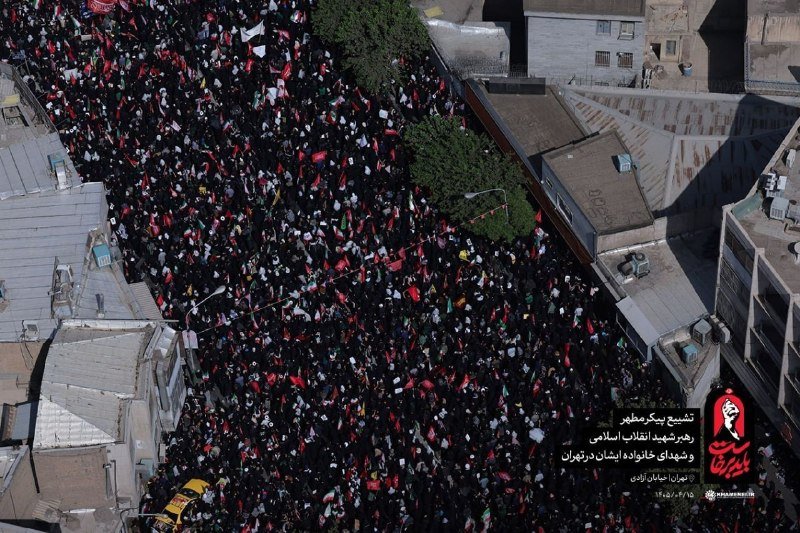
The farewell ceremony convened on the night of 3 July 2026 at the great mosque of Imam Khomeini on the southern edge of Tehran, and the choreography of the evening told most of the story before any cleric spoke. Teenagers who, in the regime's own telling, had spent 125 consecutive nights in the surrounding squares — a sustained vigil in the worst stretch of the war — processed into the mosque compound to receive the body of the leader killed in last month's Israeli air campaign. Within hours of the procession opening, Iranian state media was broadcasting extended footage of the crowds, with the Tasnim News English service highlighting both the 1980s-generation volunteers and the address by General Hassanzadeh, the officer appointed to run the farewell and burial operations [Tasnim, 2026-07-03T23:29; Tasnim, 2026-07-03T22:43; Tasnim, 2026-07-03T21:22].
The 1980s cohort matters because the Islamic Republic's foundational generation is the one being asked, explicitly, to ratify what comes next. The ceremony is the political act; the eulogies are the footnote.
A funeral staged as a coronation
The structure of the three-day programme — a mosque vigil in Tehran, a procession through the capital, and burial at a site whose name the regime has spent a decade turning into a civic shorthand — mirrors the rites that elevated Ayatollah Khomeini himself in 1989 and Ayatollah Khamenei in the decades after. The same buildings, the same Quranic framing, the same choreography of mourners transmuted into pledgers. The Tasnim broadcast placed Hassanzadeh, a Revolutionary Guards officer rather than a senior cleric, at the centre of the operational plan, an unusually military cast for a religious succession [Tasnim, 2026-07-03T21:22].
The framing in official messaging is unmistakeable. "Our martyred leader kept the country of Iran strong and did not allow the enemy to take a single bit of our country's soil and credit," one Tasnim read on the night, a line that does double duty: it closes the book on the war, and it pre-positions the next incumbent as the defender of a territory and a financial standing the establishment claims have held [Tasnim, 2026-07-03T21:54]. The teenagers of the 1980s, in this telling, are not just the mourners; they are the legitimising generation.
The candidate the ceremony is built around
Iran's succession procedure is opaque by design, but the visual grammar of the farewell narrows the field. Hassanzadeh's prominence, the explicit appeal to 1980s veterans, and the choice of Imam Khomeini's mosque as the principal venue all point in one direction: a transition organised by the Islamic Revolutionary Guard Corps and the war-generation clergy, with the Assembly of Experts ratifying a choice the security services have already made.
The most plausible name in this frame is Mojtaba Khamenei, the late Supreme Leader's second son, who has spent two decades building quiet influence over the Guards-aligned political machinery and who would offer the regime continuity of name and method at exactly the moment the wartime coalition is still mobilised. No Iranian state outlet has formally endorsed him; none needs to while the ceremony's staging speaks for it.
The counter-read: a more plural succession than the cameras suggest
The alternative reading is that the elaborate staging is a stress test rather than a coronation. Clerical factions wary of a hereditary succession, the reformist residual around former president Hassan Rouhani, and the bazaar classes hit hard by wartime sanctions and inflation are all watching the same footage and reaching different conclusions. In this version, the regime is buying time with pomp — letting the security services own the optics of the moment while a quieter contest plays out in Qom and in the Assembly of Experts' chamber.
The Iranian state outlets available to outside readers offer no evidence for that read; the messaging is monolithic, and a plurality of succession paths would not be a story that Tasnim would lead with at this hour. The honest version is that we are watching a managed unveiling, and only the management is on camera.
What it means outside the mosque
If a Guards-aligned continuity candidate inherits the post, three things follow. First, the Axis of Resistance — Hezbollah, the Iraqi Shia militias, the Houthi movement, and the residual Syrian and Palestinian networks — keeps its wartime command architecture intact, because the people who ran the war run the transition. Second, the nuclear file stays where Khamenei left it: suspended, deniable, recoverable. Third, the internal security posture tightens, because the legitimising case for a less-than-unanimous succession is that the republic's enemies are still at the gate.
That last point is the one the crowds at Imam Khomeini's mosque are being asked to seal, simply by being there.
What remains uncertain
The sources available in this thread do not name a successor, do not record a statement from the Assembly of Experts, and do not disclose where the burial will take place beyond references to a designated site. The 1980s framing is consistent with continuity and with managed contest; the official tone cannot distinguish between them. A confident read of the succession will require either a published fatwa from the Assembly, a major clerical dissent, or a discernible shift in the Guard's public posture — none of which has yet surfaced.
Desk note: where the Western wires have run the story as a regional-security transition, this publication has read the same primary footage as a domestic-legitimation event, with the 1980s cohort and the choice of Imam Khomeini's mosque doing the analytical work that wire copy has left to attribution.
Wire provenance
This editorial synthesis draws on the following public wire/social posts:
- https://t.me/s/tasnimnews_en
- https://t.me/s/tasnimnews_en
- https://t.me/s/tasnimnews_en
- https://t.me/s/tasnimnews_en