MFA Boston's 250th-anniversary reinstall puts the everyday in the same room as the imperial
Four hundred objects — a Mohawk sculptor's bust of George Washington, a matrilineal altar, a discarded Dunkin' cup — are now arranged to argue that the United States is a settlement, not a given.
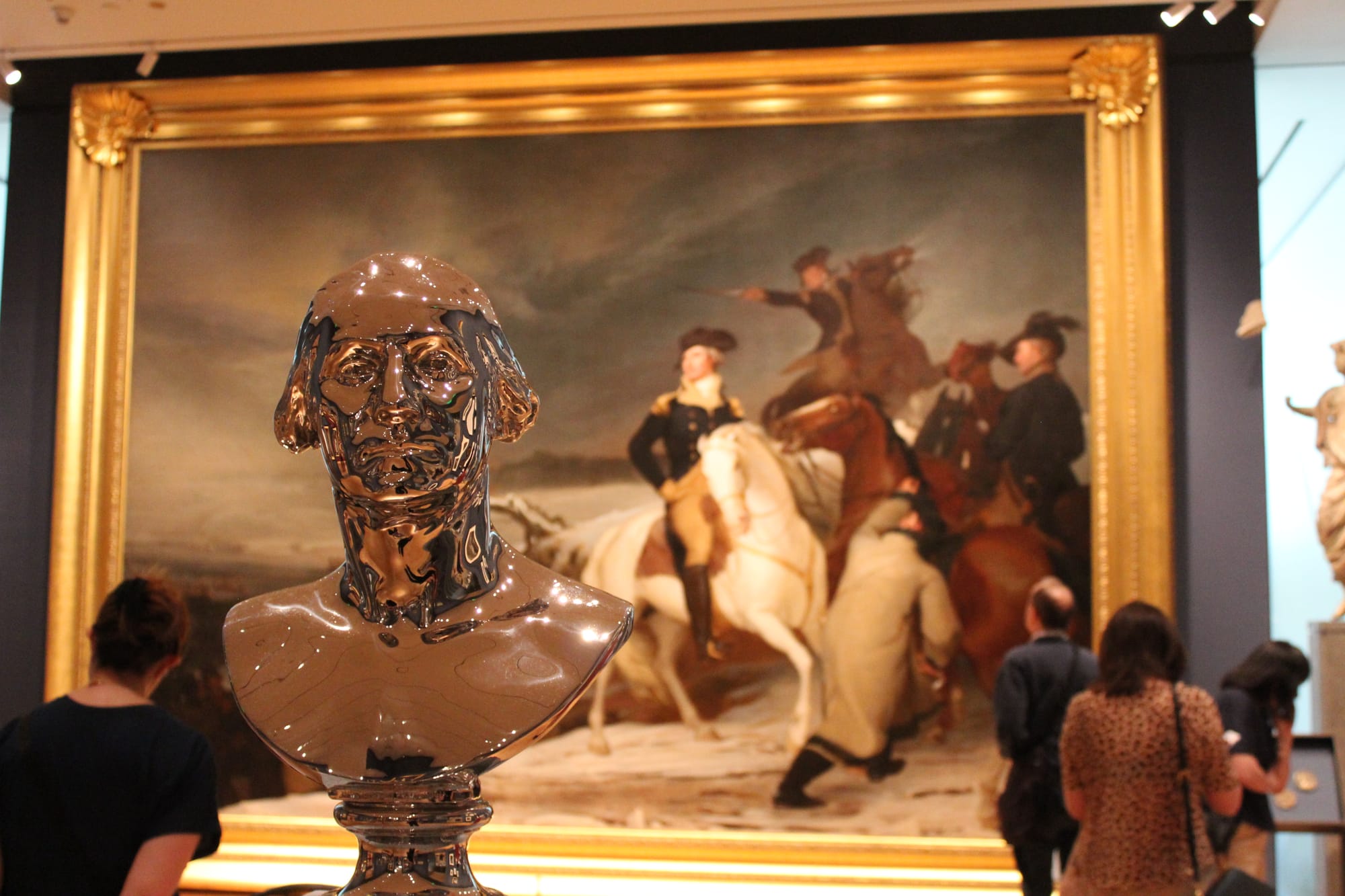
On 2 July 2026 the Museum of Fine Arts Boston reopened its suite of American galleries with a single provocation: that the story of the United States is best told by placing a matrilineal home altar, a discarded Dunkin' cup, and a Mohawk sculptor's take on George Washington in the same sentence. The 400-object reinstall, organised as part of the institution's 250th-anniversary programme, is not a topical exhibition. It is the museum's permanent reordering of itself, and the choices it has made will outlast every visiting curator.
The MFA's argument, plainly stated, is that the American past is not a procession of singular masterpieces but a layered settlement — of peoples, of objects, of the disposable and the revered. That is an editorial position as much as a museological one, and it sits inside a wider pressure on major US art institutions to be honest about provenance, exclusion and the everyday material lives of the people who actually lived next door to the paintings. What the new galleries test is whether a 155-year-old encyclopaedic museum can carry that argument without losing the visitors who came for the icons.
What changed on the walls
The reinstall distributes the 400 objects across the museum's American wing in a way that explicitly resists the standard chronology-from-east-to-west. According to Hyperallergic's 2 July 2026 walkthrough, the galleries now place a contemporary Mohawk bust of George Washington — a deliberate counter-monument — in dialogue with the eighteenth-century material it answers. The piece, by the Mohawk artist Kahstoogeñhaa Sky-Deer, treats the first president as a subject to be reconstructed rather than a figure to be venerated, and the museum has hung it so a viewer cannot miss the negotiation.
Equally consequential is the decision to elevate domestic and vernacular material to the same plane as fine-art objects. A matrilineal home altar — the kind of piece that has historically lived in ethnographic or decorative-arts wings — is now installed alongside easel painting. A used Dunkin' cup sits in a case of contemporary craft. The curatorial logic, as reported, is that daily life is part of the nation's visual record, not its footnote.
The museum has also reorganised by theme rather than by date, a shift that lets it braid Indigenous, African-diasporic, immigrant, and white-Anglo material into single rooms. That braid is the move. It makes the museum's prior period-room logic — each century a separate chapel — harder to defend as neutral.
The counter-read
The pushback the museum should expect, and probably already hears in its own boardroom, is that an encyclopaedic institution is not a parliament. It is a steward of objects whose primary job is preservation and access, and the case for chronological hang rests on the discipline of art history itself — on the proposition that an 1820s portrait reads differently once you have walked through the 1790s. Threading a 2024 vernacular object into the 1820s case, on this view, is a curatorial imposition that smuggles contemporary politics into the gallery.
That critique has real weight. Museums that over-program their permanent collections risk treating the object as illustration of a thesis the visitor was always meant to agree with. The MFA's defence, evident in the reinstall's willingness to mix registers — sacred altar, ceremonial bust, branded paper cup — is that the previous arrangement was equally a thesis, just one that hid itself as default. There is no view from nowhere, the reinstall implicitly argues; there is only a view whose interests you have to declare.
What the structural shift is, in plain terms
The MFA is not the first major American museum to take this on, but it is the largest by collection breadth to do so in its 250th-anniversary year, and the symbolic alignment matters. A semi-quincentennial is the kind of date at which institutions either stage a triumphal procession or admit that the country is a settlement — built on, with, and against the peoples who were already here. The MFA has chosen the second framing. It has done so by changing the object mix, not by adding a wall label.
This is consistent with a broader pressure on US museums that has accelerated since the early 2020s: provenance research, returns and loans to source communities, and a willingness to label the colonial context of acquisitions that were once presented as straightforward gifts or purchases. The MFA's move generalises that pressure. It says: if you can do this in the Native American wing, you can do it everywhere. The everyday object becomes the test case — if a Dunkin' cup is admissible, then the museum's prior exclusion of working-class and immigrant material was a choice, not a shortage.
The financial and audience stakes are real. A reinstall of this scale requires wall construction, case fabrication, conservation review and a public campaign that competes with the museum's ticketed special exhibitions. The MFA has 250th-anniversary programming to amortise those costs, but the underlying question is whether visitors come for the icons or for the argument. The next eighteen months of attendance figures, when they are reported, will answer that.
The contestable ground
Several claims inside the reinstall's framing remain genuinely contested rather than settled. The interpretive weight given to any single object — how much a contemporary sculptor's reframing of Washington is allowed to govern the reading of an eighteenth-century case — is an editorial decision a museum makes alone. Visitor research on whether the new hang teaches more or confuses more is not in the public record as of 2 July 2026. And the curatorial assumption that vernacular material functions as a corrective to elite collections is itself a position that some art historians will dispute as romantic; the counter-case is that a museum's job is precisely to set the elite object in its best light, not to dilute it with the disposable.
None of that weakens the MFA's central move. The 250th-anniversary date forced a choice between two institutional defaults — parade or reckoning — and the museum has chosen the harder one. Whether the choice travels depends on whether peer institutions decide, in their own anniversary years and outside them, that the everyday is no longer the footnote.
This piece foregrounded object-level reporting from Hyperallergic's 2 July 2026 walkthrough of the MFA Boston reinstall, rather than the anniversary press release, because the install's editorial argument lives in the case layout and not in the marketing copy.