Spain and Portugal move on at the 2026 World Cup as hosts press ahead on accessibility
Spain swept Austria 3-0 and Portugal edged Croatia 2-1 to reach the round of 16, while the host federation highlights how blind supporters navigate the tournament.
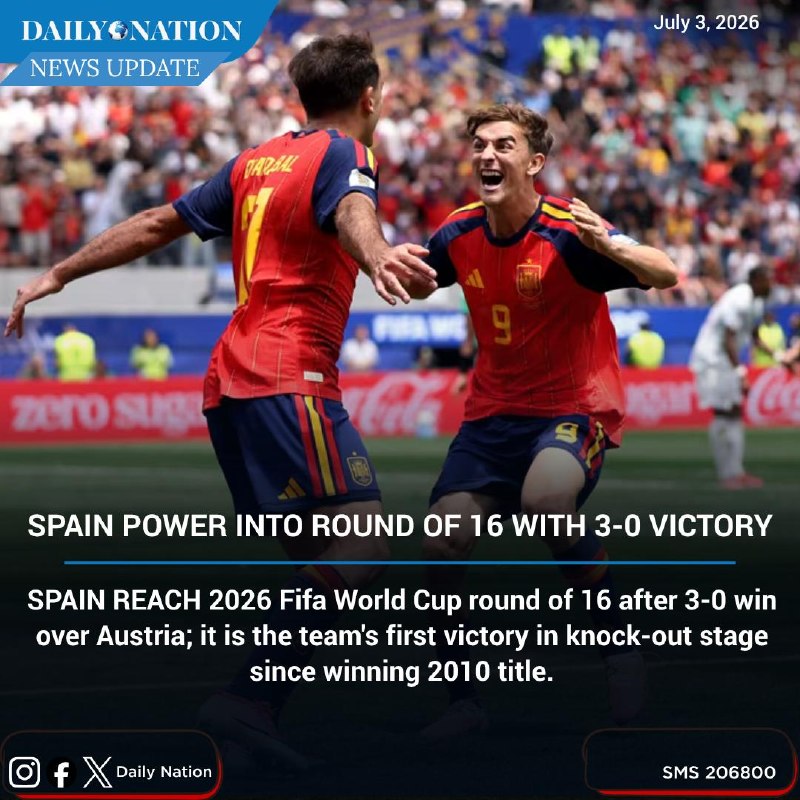
Spain sealed top spot in its group and a place in the knockout rounds of the 2026 FIFA World Cup with a 3-0 win over Austria on 2 July, the first time the Iberian side has tasted victory in a World Cup knockout match since lifting the trophy in South Africa in 2010. Portugal joined them through the other side of the bracket, edging Croatia 2-1 in the same matchday window. The two Iberian results, confirmed within hours of each other on 3 July 2026, set up the round-of-16 ties and gave the European heavyweights a clean passage into the business end of a tournament that has been engineered, from the outset, as the most accessible World Cup yet staged.
The headline result was Spain's. The 3-0 line over Austria, reported on 3 July by Telegram channel @DailyNation, gave La Roja the group win and a return to the knockout stage — a stage they had last won at in Johannesburg in 2010. Portugal's 2-1 defeat of Croatia, logged by @wfwitness on the same matchday, sent the 2016 European champions through. Both results arrived as part of a packed group-stage closing slate that has, by design, arrived earlier in the calendar than at any previous men's World Cup.
A knockout win, sixteen years on
Spain's last knockout-stage victory at a World Cup final tournament was the 1-0 defeat of the Netherlands in the 2010 final at Soccer City. Since then, the national team has gone out at the group stage (2014), the round of 16 (2018), the round of 16 (2022) on penalties to Morocco, and bowed out at the group stage of Euro 2024 before rebuilding under the current set-up. The win over Austria does not, on its own, rewind any of that history. But it does end the specific drought — Spain has, for the first time since 2010, won a knockout-phase match at the World Cup, even if the round-of-16 itself still has to be negotiated.
A note on framing: Austria arrived as a competent, organised side, not a pushover. Reports from the Telegram match feed describe a clean Spain performance rather than a record rout, and that distinction matters. Group-stage football rarely tells you what a side is; knockout football almost always does. Spain will learn more about itself in the next match than it did in this one.
Portugal, quietly efficient
Portugal's 2-1 over Croatia, also confirmed on 3 July 2026 via @wfwitness, produced the kind of result that reads duller on paper than it felt on the ground. Croatia, the 2018 finalists and 2022 third-place side, have been a stubborn match-up for Portugal in recent tournament cycles and were again here. A two-one scoreline against a side of Croatia's tournament pedigree is the sort of result that tends to look routine only in retrospect. Portugal's path through the bracket now runs through whichever side emerges from the group's runner-up slot — and the team's deeper squad, relative to their 2022 campaign in Qatar, should give the coaching staff more room to rotate than the 2022 squad enjoyed in the desert.
Accessibility sits at the centre, not the edges
Away from the pitch, the tournament's accessibility pitch moved from marketing line to operational reality. A short video circulated on 3 July 2026 via CGTN's official X account, captioned "How blind fans experience the FIFA World Cup," showing audio-described commentary, tactile orientation maps, and guide-dog-friendly concourses at one of the host venues. The clip was brief — under two minutes — and that brevity is part of the point: the features shown are now mundane parts of the matchday experience in 2026, not novelty add-ons.
That matters because this is the first 48-team, three-nation men's World Cup, hosted across the United States, Mexico and Canada. The scale is roughly twice the stadium footprint of any previous edition and several multiples of any previous host nation's transit network. Building in audio-description rows, sensory rooms and tactile wayfinding from the start is cheaper than retrofitting them. The visual framing of the CGTN clip — emphasising quiet concourses, written and audio guides, and visible service staff — is also a quiet rejoinder to a long critique that football's biggest tournament treats disabled supporters as an afterthought.
The unresolved question is whether the new infrastructure travels. Mexico City's Estadio Azteca is, in corporate-memory terms, a familiar venue. The newer US and Canadian stadiums are not. Whether the tactile maps and audio-description feeds become standard at, for example, the 2030 edition — co-hosted by Spain, Portugal and Morocco — depends less on technology than on whether the host federations and FIFA's accessibility unit keep the budget line open once the opening-week headlines fade.
Stakes and what to watch next
Two structural points sit underneath the 3 July results. First, the tournament's compressed group stage is now closing faster than at any previous men's World Cup, and the round of 16 will begin within days rather than weeks. Squad depth, not starting-XI quality, is the variable that decides how far a side goes. Spain and Portugal both have deeper benches than the squads they brought to Russia 2018 and Qatar 2022; whether they use that depth is the open question.
Second, the host federation's accessibility programme will be judged on consistency, not launch-day optics. The early footage suggests the floor is high. The audit is in what happens in the stadiums that have not yet been shown in highlight clips, on the nights when no prime-time audience is watching.
A reminder of what remains uncertain: the source material for this dispatch is three Telegram channel notes and an official X post from CGTN. It does not contain minute-by-minute accounts of either match, individual goal scorers, or stadium-level crowd figures. The reporting is sufficient to establish the results and their proximity in time. It is not sufficient to characterise either performance in tactical detail. That detail will come from the wires and the dedicated football press over the next 24 to 48 hours, and this publication will update as corroboration arrives.
Wire provenance
This editorial synthesis draws on the following public wire/social posts:
- https://t.me/s/DailyNation
- https://t.me/s/wfwitness
- https://en.wikipedia.org/wiki/2010_FIFA_World_Cup_Final
- https://en.wikipedia.org/wiki/2026_FIFA_World_Cup