Tehran stages a farewell — and a statement
Hours before the formal funeral of Iran's supreme leader, hundreds gathered at Tehran's central mosque. The choreography of the rite is itself the message — and the succession question is now the story.
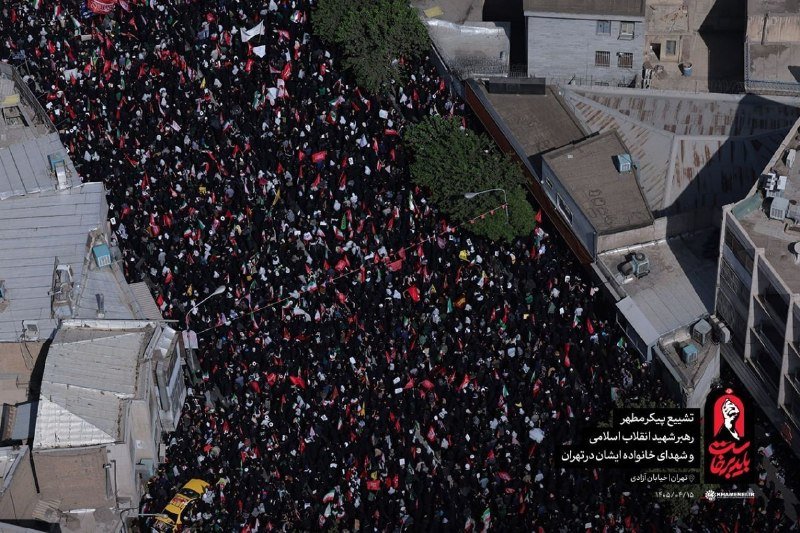
Hours before the formal funeral rite was scheduled to begin on the night of 3 July 2026, hundreds of mourners were already massed outside the main gate of Tehran's central mosque. State-aligned reporting from Tasnim News described the western flank of the building filling up more than an hour ahead of the ceremony, with families streaming in throughout the early evening and crowd density visibly intensifying as the start time approached. Pilgrim guidance notices circulated the same evening — accommodation, parking, services — the routine administrative choreography of a state-organised farewell. The visual orderliness of the night, and the language used to describe it, is itself the political product.
The phrase Tasnim's editorial line repeated across its 3 July posts — "martyr leader of the revolution" — does ideological work. It places the deceased inside the same register as fallen soldiers of the Iran–Iraq war, converting a leadership transition into a sacred narrative. Western wires that have not yet published correspondences in detail should be read carefully when they do: the framing choices on each side are not interchangeable, and the Iranian framing is the one being delivered, in the Iranian language, to Iranian audiences in real time.
The rite as broadcast
State-aligned footage did not merely document the gathering; it staged it. The cuts between the western flank, the main gate, and the interior of the mosque build a single panoramic claim: that the regime's central institutions and the street are aligned in grief. Tasnim's repeated hashtag cadence — #Badarqa_Aghai_Shahid_Iran, roughly "the brother of martyrdom" — fuses a religious idiom with a national-civic one. A reader sitting in London or Ankara sees the same frames a viewer in Tehran sees, and that parity is the point. The funeral is, in effect, a synchronised signal to three audiences simultaneously: the domestic public, who must be shown that the system holds; the regional axis, which will measure the size and solemnity of the crowd as a proxy for resilience; and Western chancelleries, which will read the optic for what it implies about succession.
What Tasnim is not telling us
What the wire does not say is at least as informative as what it does. Tasnim's reporting names no successor, no Assembly of Experts meeting, no procedural timeline. That silence is structural. In a system where the supreme leader's identity is itself a controlled disclosure, the public-facing channel signals mourning without preempting the institutions that will, in coming days, move to name a replacement. Reporting that treats the funeral as a self-contained event misses the dynamic: the rite sets the emotional baseline; the institutions will set the political one.
The succession question underneath the ceremony
The obvious counter-narrative — that this is a managed performance, not an organic outpouring — is also incomplete. The depth of street turnout in central Tehran is harder to fake at this scale than Western commentary often assumes, and dismissing it wholesale underwrites the same dismissiveness applied to every mass mobilisation the regime's opponents have mounted. A more honest read holds both: the funeral is choreographed, and the grief is real, and the choreography is what gives the grief its political weight. Monexus's judgment is that the choreography is doing more work than the numbers.
The structural point underneath the news is older than the present crisis. Where authority flows through institutions, succession is a process. Where authority flows through a single office whose occupant is treated, in the official register, as a martyr-leader, succession is a confrontation between factions that have spent decades preparing for it. The street is a backdrop. The real contest is in the rooms the cameras are not yet allowed into, and the foreign-policy read of the next seventy-two hours will be a downstream consequence of who wins that contest.
Stakes
If the succession resolves inside the existing clerical-security consensus, Iran's regional posture — the axis of resistance posture that has been the operative phrase in Iranian discourse for two decades — survives intact, and the diplomatic calendar with the United States and the Gulf states, which had been moving fitfully before the announcement, re-stabilises around a known interlocutor. If it does not, and the contest leaks into the public sphere the way succession fights have in other one-party systems, then the regional theatre becomes more unpredictable even as the central ritual appears, for one evening, to be unifying. The funeral is the frame; the frame is about to be tested. Monexus will track the institutional signals — clerical council statements, military honours, foreign dignitaries on the guest list — as the cleaner indicator.
Desk note: Monexus ran this as opinion rather than news because the reporting picture, as of 3 July 2026, is dominated by a single state-aligned outlet whose editorial line is itself the subject. Where Western wires publish confirmed correspondent material in the next 24 hours, the news desk will reassess and update.
Wire provenance
This editorial synthesis draws on the following public wire/social posts:
- https://t.me/tasnimnews_en
- https://t.me/tasnimnews_en/27034
- https://t.me/tasnimnews_en/27036
- https://t.me/tasnimnews_en/27038
- https://t.me/tasnimnews_en/27040