Tehran prepares to bury a 'martyred leader' — and an old argument returns
The Islamic Republic has spent days choreographing a farewell for a 'martyred' leader. The choreography is the message — to its citizens, its rivals, and the street.
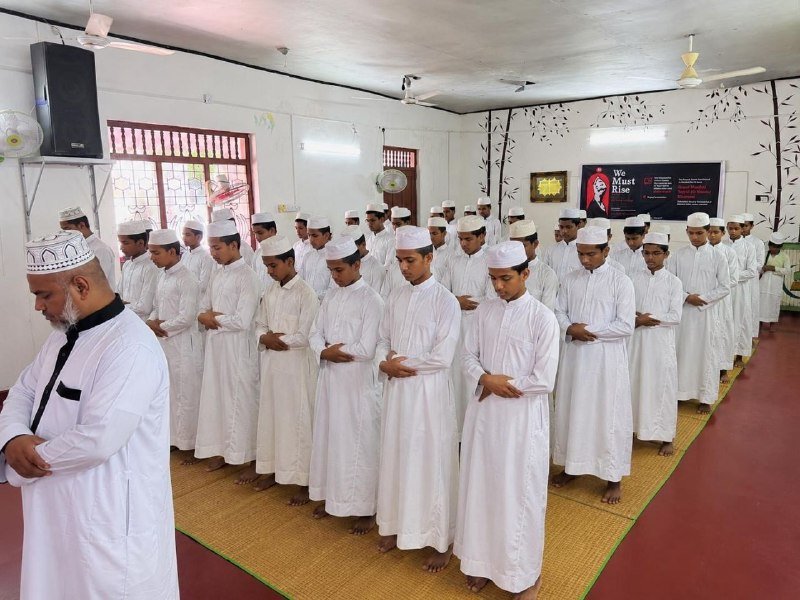
By 21:39 UTC on 3 July 2026, the western colonnade of a central Tehran mosque was already filling up for a funeral that, by official script, was not an ordinary funeral. State-aligned Tasnim News was running rolling visual coverage of mourners gathering more than five hours before the ceremony was scheduled to begin. The framing — "the martyred leader of the revolution," "the farewell of Mr. Shahid of Iran," "the great of the world is gone" — had been dialled in for hours: goodbye ceremonies to a "Shahid" whose body, according to a Tasnim report filed at 23:14 UTC, was being prepared inside the same mosque as crowds massed outside.
The case for treating this as theatre first and grief second is straightforward, and it does not require any clever framing about who is genuinely mourning and who is being herded through a set-piece. The Iranian state's editorial desk has spent the better part of a day staging this — pilgrimage guides for accommodation and parking, a centralised hashtag campaign (#must_rise), young girls spinning the flag inside the prayer hall, the eastern door of the mosque opened on cue. None of that proves the grief is manufactured. All of it proves that grief, in an authoritarian system where public space is rationed, is something the state knows how to organise.
What the staging is actually for
The oddity is not that Iran mourns its leaders; the oddity is the specific vocabulary being deployed around this one. "Martyr," in the Islamic Republic's lexicon, is a technical term reserved for those killed on behalf of the system — war dead, assassinated officials, "martyrs of the revolution." Slapping it onto the body of a sitting leader, while the same regime continues to insist on its monopoly of legitimate violence, is a tell. It tells the street what the leadership wants to be said about this man's departure, and it tells rivals — Israel, the Gulf states, the United States — what Iran is willing to imply about how he died.
The implication is doing the work the official communiqués cannot: it stitches a martyr narrative to a still-unexplained exit, without ever having to say the words assassination, sabotage, or foreign hand. Western wire desks, locked out of Tehran by their own visa rules and the regime's press accreditation regime, will repeat "according to state media" until the cows come home. That repetition, not the facts themselves, is the threat. A martyrdom claim is a precondition for retaliation; it is the rhetorical muster that allows the IRGC to act later without further legal choreography at home.
The state has not said the quiet part out loud
Tasnim's coverage throughout 3 July is careful. The dead man is a "martyred revolutionary leader." The mourners are a "people who do not tire of bidding farewell." The attendance is "comprehensive." What Tasnim does not say is who killed him, why, when, or whether this is now a national security event with kinetic implications. As of the most recent thread item — a 23:37 UTC photograph of the mosque's opened eastern door — there has been no public naming of the adversary.
That silence does not mean no intelligence exists inside the building. It means the leadership is holding the attribution in reserve. The funeral is the bait. Anyone hoping to cash in their martyrdom card in the next seventy-two hours will have to do so through the regime's chosen vocabulary, not their own. Western outlets that treat the staged grief as evidence of "regime weakness" — because the ritual looks overproduced, because the hashtag feels imposed, because young girls spinning flags reads as choreographed to a Western eye — are misreading the genre. Authoritarian regimes do not stage funerals because they are weak. They stage funerals because they want every screen in the country tuned to a story they control, before anyone else can publish an alternative one. That this works, repeatedly, is the actual story.
Why outside framing keeps getting it wrong
Iran-watchers in Washington, Tel Aviv, and the London policy world tend to read any unusual religious display in Tehran as either (a) desperation, or (b) a cynical performance aimed at a domestic base the regime secretly despises. Both readings miss the more boring truth: large-scale state mourning in the Islamic Republic is not aimed primarily at the dead. It is aimed at the rest of the leadership. A public funeral, well-attended, with a martyrdom script attached, is a piece of internal succession politics projected onto a religious stage. It declares which faction owns the narrative before the actual power-vacuum negotiations begin.
This piece is not arguing that the mourners are not mourners, nor that every mother, brother, and pensioner filing past the body is a stage-managed actor. That reading is its own kind of Western conceit — the idea that everyone under authoritarian rule is merely performing. The honest description is more uncomfortable: in a system where public space is scarce, the line between genuine grief and required attendance is genuinely blurred, and attempting to untangle it from London or Washington is mostly projection.
What remains genuinely uncertain
The thread evidence is enough to support the narrow claim that Iran is running a heavy-handed martyrdom script for this farewell. It is not enough — and no honest reading could claim it is — to say who is dead, how they died, what faction now controls the Supreme National Security Council, or whether the next seventy-two hours bring escalation or a managed transition. The state-aligned wire has not named the successor, has not named the killer, and has not named a date beyond the funeral itself. Anything written with more confidence than that on the day of the funeral is being written for an audience, not a record.
The still-unanswered question — who arranged a "martyrdom" in a country that has not had one in this slot for decades — is doing the most political work of the week, even though no one has said it out loud yet. When that answer arrives, it will arrive in a vocabulary the regime itself controls. Until then, the only honest position is that the funeral is real, the staging is real, the grief is real for some and instrumental for others, and the silence at the centre is the loudest signal of all.
— Monexus framed this as it read on the state-aligned wire alone, with explicit caveats about what that wire cannot say.
Wire provenance
This editorial synthesis draws on the following public wire/social posts:
- https://t.me/tasnimnews_en/1
- https://t.me/tasnimnews_en/2
- https://t.me/tasnimnews_en/3
- https://t.me/tasnimnews_en/4
- https://t.me/tasnimnews_en/5
- https://t.me/tasnimnews_en/6
- https://t.me/tasnimnews_en/7
- https://t.me/tasnimnews_en/8
- https://t.me/tasnimnews_en/9