Tehran fills the Grand Mosalla: the choreography of a leadership handover
State media is staging a three-city farewell featuring 45 foreign delegations. Behind the pageantry lies a contest over who inherits an embattled republic.
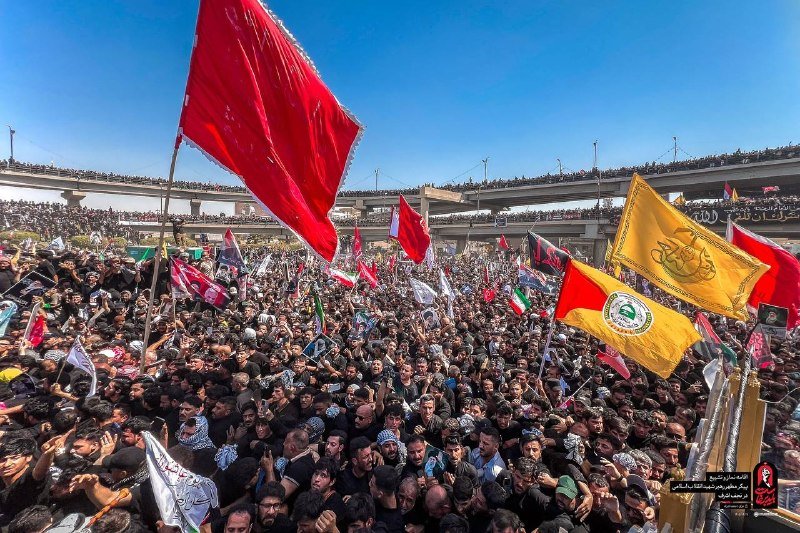
The coffin arrived before dawn. By 03:15 UTC on 3 July 2026, Iran's state television was already broadcasting images of the casket crossing into the Grand Mosalla in central Tehran — the largest prayer hall in the country and the customary stage for the clerical establishment's most carefully staged moments. Ayatollah Seyyed Ali Khamenei, who had led the Islamic Republic since 1989, was being readied for a funeral procession that state media said would carry his remains through three cities and draw mourning delegations from more than 45 countries, accompanied by what Iran's broadcasters described as at least 14,000 journalists.
The pageantry is dense with signals. Three-city funeral marches, foreign-head-of-state turnouts and credentialed press totals are the standard vocabulary of a regime that has long understood legitimacy as a televised performance. Iran's President Masoud Pezeshkian, framing the day's events in the official register, told the nation that the "martyrdom of the Leader" had brought "deep sorrow to the hearts of our nation, the Islamic Ummah, and all the people of the free world" — language that fuses religious register with political claim. The funeral, in other words, is not only about mourning. It is the opening sequence of a succession drama that will reshape the Middle East's most consequential state.
A regime rehearsing itself
Three things are happening at once in the footage. Mourning is being performed for a domestic audience that has spent the last two years under sanctions, currency collapse and intermittent street unrest. A diplomatic tableau is being assembled for an external audience — Iraqi, Lebanese, Yemeni, Sudanese and Russian delegations whose presence is itself a roster of Iran's remaining allies. And an internal succession narrative is being seeded, in which the frames around the coffin matter as much as the body inside it.
The decision to designate Khamenei a "martyr" — a title reserved in Shi'a political vocabulary for those killed in the service of the faith — is itself a step beyond conventional funerary language for an incumbent leader. It does two things at once. It retroactively sacralises the body, and it inflates the political cost of any successor who treats the inheritance as a routine transfer of office rather than the custodianship of a martyr's project.
The coalition that turns up tells you the coalition
The 45-country figure is the number worth watching. Funeral diplomacy is one of the few reliable gauges left of an embattled state's remaining alignments. A Western non-presence — or a Western low-level presence — would tell you Iran has accepted its isolation. A heavy Russian, Chinese, Iraqi and Syrian turn-out tells you the opposite: Tehran is signalling that the wartime diplomatic network it built around the "axis of resistance" still travels when called.
The press contingent — 14,000, per Press TV's framing — is the second instrument. Authorised coverage is permitted and amplified; independent coverage inside Iran is not. That imbalance will determine what the rest of the world sees, and at what length.
Reading the pageantry skeptically
The most plausible alternative interpretation is the most boring one: this is a logistics operation with a long planning horizon, dressed up by Iranian state media as historical rupture. Funerals of supreme leaders have rehearsed counterparts in every institutional religious state from the Vatican to Confucian dynasties. The martyrdom vocabulary may also function as a coordination device — concentrating elite attention, suppressing intra-clerical manoeuvring during a vulnerable interregnum, and granting the security services a mission in an atmosphere of national grief.
The dominant framing holds, but only partially. The regime is performing grief, and the grief is partly real. It is also performing unity, and the unity is contested. Pezeshkian's public remarks are the language of a coalition that does not entirely agree with itself, and the size of the foreign turnout will be measured against how many of Iran's adversaries bother sending even perfunctory messages of condolence.
Stakes: who inherits, and over what
The succession question is the obvious one — which senior cleric, which faction within the Islamic Revolutionary Guard Corps-aligned network, which balance between the elected Pezeshkian government and the unelected institutions of the state will now take ownership of Khamenei's portfolio. But the harder question sits underneath it: whether Iran's regional architecture survives a leadership change without an internal re-pricing of the bargains it has struck with Hezbollah, with the Houthis in Yemen, with Baghdad's Shia militias, and with Moscow's wartime diplomacy.
If the interregnum holds — a clerical assembly, a designated acting Supreme Leader, a managed transfer of authority — then the funeral will be remembered as choreography. If it does not — if the "martyrdom" frame is read by a faction as licence for harder choices — then the foreign ministers streaming into Tehran are not paying respects. They are auditing a succession.
What remains uncertain
The thread material does not specify the cause of Khamenei's death, the exact sequence of mourning days, or the composition of any acting-council structure. Iranian state media has not, in the items available, named an interim authority. The "martyrdom" designation — repeated across all four Press TV items surfaced on 3 July — will colour the answer to all three questions when it arrives. Until then, the Grand Mosalla is full of mourners who are also, in their different ways, candidates.
This publication frames Iran's leadership transition as a choreographed political act with regional consequences, drawing on Iranian state media as the primary available source — a framing that should be read alongside the same outlets' editorial positions on Iran.
Wire provenance
This editorial synthesis draws on the following public wire/social posts:
- https://t.me/presstv/1
- https://t.me/presstv/2
- https://t.me/presstv/3
- https://t.me/presstv/4