Tehran's farewell to the 'leader of the ummah' is a managed ritual — and a signal worth reading
State-aligned footage from Tehran shows a carefully orchestrated farewell at Mosla, with traffic locked down and a 'leader of the ummah' framed for a domestic and regional audience. The choreography tells us more than the official line.
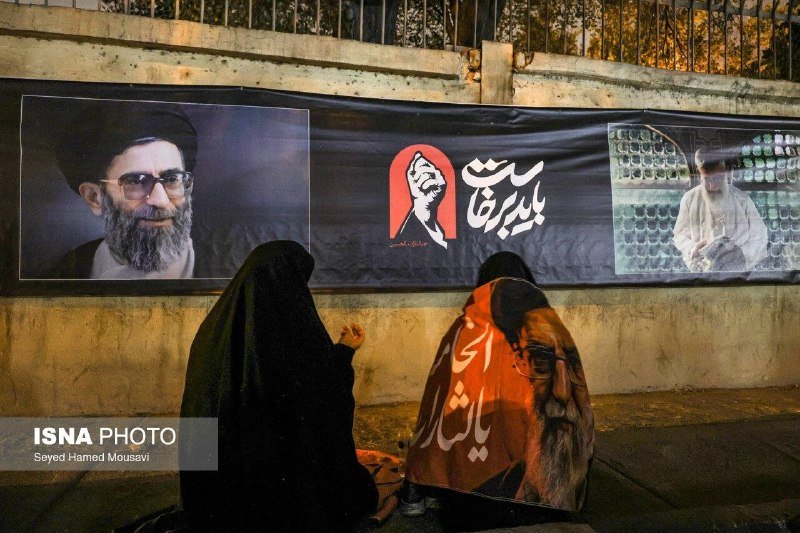
The images out of central Tehran on the evening of 3 July 2026 are small, hand-held, and deliberately procedural. A Fars News Agency clip circulated at 22:34 UTC shows the interior of a Tehran mosque "hours before the start of the farewell ceremony with the leader of the ummah," its carpets still being walked through by organisers rather than mourners. A second dispatch at 22:29 UTC lays out traffic restrictions in the Mosla area; a third, at 23:27 UTC, frames the mood outside the doors as "the expectations of the people" waiting to enter. Read separately, these are logistics notes. Read together, they are the standard grammar of an Iranian state ritual: the city sealed, the cameras positioned, the slogan already chosen.
The interesting analytical move is not whether the ceremony will draw a crowd — it almost certainly will, given the apparatus behind it — but what the choice of frame tells us about the audience the producers have in mind. Fars is not a Western wire and does not pretend to be; it is the outlet of choice for the Islamic Republic's security and political class. When Fars's social desk leads with the phrase leader of the ummah — a title that situates the deceased above the Iranian nation and inside the wider Shia community — the frame is being aimed well beyond the borders of Tehran province.
A managed public square
Three observations follow from the thread. First, the security perimeter is dense enough to be a story in its own right. Traffic restrictions around Mosla are not unusual for state funerals in the capital, but the explicit "details of traffic restrictions" frame, pushed more than an hour before the doors open, signals an audience expected to approach on foot and to be herded. Second, the interior footage is conspicuously empty at the time of recording: state-aligned outlets normally release video of crowds only after the crowds exist. Releasing an empty hall first is a scheduling cue — this is where you go, this is when you arrive — dressed as journalism. Third, the "expectations of the people" clip is a piece of voice-stealing; it is the regime's editors putting words into the mouths of attendees before they have spoken.
This is not cynical uniqueness on the Islamic Republic's part. Managed grief is a normal instrument of statecraft from Beijing to Brussels. What is distinctive is the layering: the Islamic Republic runs a domestic frame (the nation mourns its dead) and a transnational frame (the ummah honours one of its figures) in parallel, using the same cameras, the same anchors, and the same Fars chyron.
The slogan does the work
The phrase leader of the ummah is doing heavy lifting. In Iranian domestic politics, it pulls the ceremony out of factional territory: whatever the deceased's institutional role inside the Republic, the framing insists the loss is felt by Sunnis, by Shia communities in Iraq, Lebanon, Bahrain and Pakistan, and by the diaspora. In regional politics, the phrase implies a continuing claim to a cross-sectarian leadership role that Gulf monarchies and Turkey contest in their own ways. The fact that Fars — rather than state broadcaster IRIB — is leading with this language suggests the message is calibrated for an external audience that already speaks the Fars cadence: allied militias, sympathetic clerics abroad, and the Arabic- and Urdu-language channels that republish Fars material verbatim.
The counter-reading is straightforward and should be stated. A line of mosques across the Shia world holds funerals every week; many are framed in similar terms by sympathetic outlets; not every such frame is a strategic signal. The Republic may simply be honouring a senior figure with the standard liturgy, and Western analysts are right to be wary of reading every camera angle as a press release. That said, the explicit, hours-long pre-publicity cycle, the traffic choreography, and the repeated ummah phrasing together exceed what a routine ceremony would produce.
What the choreography tells us about the moment
Three structural reads are defensible on the available evidence. The first is institutional consolidation: after two years of leadership turnover debate in the Islamic Republic, the visual vocabulary of a major farewell is being deployed with full apparatus, suggesting a political class that wants the optics of unity on screen. The second is a regional positioning move: at a moment when the wider Middle East is negotiating the aftermath of the Gaza war, the Syrian transition, and renewed pressure on Iran's nuclear file, any ceremony framed as a Shia occasion is also an implicit reminder that Tehran can still convene. The third, more cautiously, is a domestic morale operation: the Republic's economy is under sustained strain, and rituals that re-anchor national identity around a familiar figure remain one of the cheaper levers the state can pull.
What remains genuinely uncertain — and the available footage does not resolve — is the identity, seniority, and biographical specifics of the figure being mourned. Fars's phrasing is generic enough to encompass several plausible scenarios: a senior cleric, a long-serving Friday-imam, a wartime commander, or a foreign fighter treated as an Iranian hero. The thread does not name the deceased, and the desk declines to infer a name where the source material is silent.
Stakes worth naming
For readers outside Iran, the analytical work is to read the framing, not to take the framing at face value. State-aligned video is evidence that a ceremony is being staged in a particular way; it is not, on its own, evidence of the size, sincerity, or political weight of the crowd that eventually arrives. The traffic restrictions tell us how the state wants the day to look; the ummah phrasing tells us who the state wants watching. The gap between those two audiences is where the news actually lives.
Desk note: Monexus framed this as a study in ritual choreography rather than as an obituary, because the source material on 3 July 2026 was operational — traffic plans, empty halls, expectation-setting clips — rather than biographical. Where Fars framed the ceremony as a transnational Shia moment, this publication has held the line that the framing is itself the news.
Wire provenance
This editorial synthesis draws on the following public wire/social posts:
- https://t.me/s/farsna
- https://t.me/s/farsna
- https://t.me/s/farsna