Ukraine widens its strike footprint inside Crimea as Russian officials reportedly pull records south
Two threads on 3 July 2026 — a Ukrainian drone barrage on Crimean substations and a partisan report of evacuation orders — point to a coordinated squeeze on Russian-controlled territory a decade after annexation.
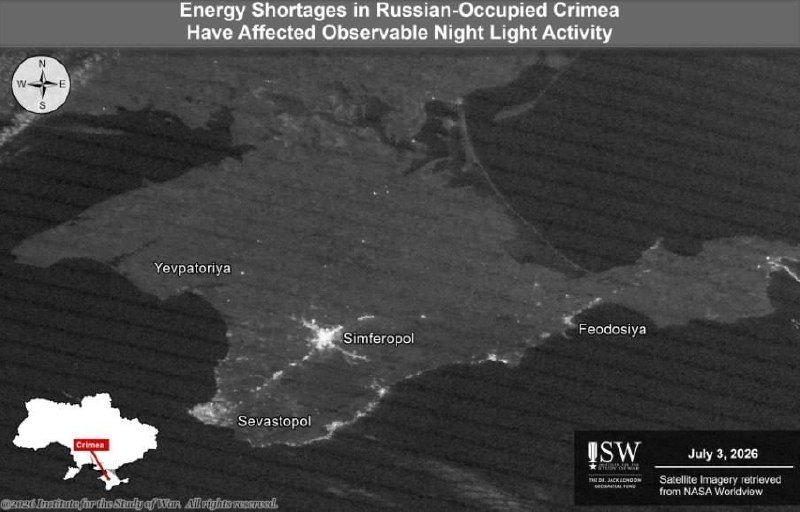
At 09:26 UTC on 3 July 2026, monitors tracking the air war against occupied Crimea logged another night of mid-range Ukrainian drone operations aimed not at military formations but at the peninsula's grid. According to the OSINT channel AMK_Mapping, the strikes hit the "Crimea-West" 330 kV electrical substation for the second time in a matter of weeks and damaged six 110 kV substations across the territory. Just seven minutes earlier, at 09:33 UTC, a separate Telegram thread — WarTranslated, citing the Ukrainian partisan movement ATES — reported that Russian occupation administrators had been ordered to begin evacuating equipment and documents from Crimea. Two threads, two very different kinds of evidence, one geography.
The pair of reports, read together, sketch a quiet but consequential shift in the trajectory of the war. Ukraine is no longer probing Crimean airspace to make a point; it is methodically degrading the electrical and administrative backbone that has allowed Russia to treat the annexed peninsula as a secure rear area for more than a decade. The implication of the partisan report — that paperwork and equipment are being moved out — is that the occupation bureaucracy itself is now hedging against a strike campaign it can no longer neutralise from the air.
What the strikes actually targeted
The list circulated by AMK_Mapping on 3 July is unusually specific for a Telegram OSINT post. The channel identifies the "Crimea-West" 330 kV substation as a repeat target and names six further 110 kV facilities across the peninsula hit in the same operational window. Mid-range drones — not the long-range one-way attack drones that have defined earlier waves against Russian deep targets — were used. That matters: a 330 kV node links the peninsula to the mainland grid via the energy bridge across the Kerch Strait, while the 110 kV ring distributes power within Crimea itself. Hitting both layers in a single sortie suggests Ukrainian planners are no longer satisfied with symbolic one-off strikes; they appear to be tracking grid topology the way an electrical engineer would, prioritising the highest-voltage chokepoints before stepping down to the local distribution network.
The Crimean energy grid has been a Ukrainian target since at least 2023, when SBU-affiliated operations first put substations on the peninsula's north coast out of service for sustained periods. What is different in mid-2026 is the tempo. Reports of repeated strikes on the same 330 kV node within weeks point to a doctrine of persistent attrition — not the goal of one dramatic blackout, but a steady degradation that forces Russian logistics to divert mobile generators, repair crews and, eventually, civilian administrators. The Crimean peninsula is roughly the size of a small US state; it cannot indefinitely absorb strikes on every substation feeding its cities without some kind of administrative response.
The partisan report — and why to read it carefully
ATES, the source for the evacuation claim, is a Ukrainian partisan movement that has operated inside Russian-occupied territory since the early months of the full-scale invasion. Its reports are typically relayed through Telegram channels with a Ukrainian or Ukrainian-sympathetic readership and have repeatedly anticipated — sometimes correctly, sometimes ahead of confirmation — Russian troop and equipment movements out of Kherson, Melitopol and Sevastopol. ATES is partisan by design: its purpose is to make Russian occupation more expensive and to shape Ukrainian and Western perceptions of vulnerability inside Crimea. Its reporting is therefore first-order evidence that a Russian bureaucratic pullback is being considered, but it is not, on its own, proof that one is under way.
What the WarTranslated relay adds is specificity: not "document destruction" in the abstract, but evacuation of equipment and documents — the language of an institution that expects either a probing inspection or a future territorial event it cannot prevent. Russian officials have used similar phrasing before prior retreats, including during the 2022 withdrawal from Kherson city and from positions on the east bank of the Dnipro. It would be consistent — though it is not yet confirmed — for the same playbook to be applied in Crimea now that strikes on the peninsula are, by the partisan account, within the routine operating envelope of Ukrainian drones.
The read-through is straightforward. Occupation authorities do not normally pull records out of territory they expect to hold indefinitely. They do pull records when they expect either probing sabotage, loss of physical security at administrative sites, or an attempted ground operation that could overrun those sites quickly. None of those three conditions are independently established by the available reporting on 3 July. The claim is consistent with each of them.
What Russia has done before, and what it has not
Russia has framed Crimea, since the unilateral annexation of March 2014, as a domestic territory — constitutionally Russian, administratively federal, militarily defended as such. Twelve years on, the peninsula hosts the Black Sea Fleet's surviving surface combatants at Sevastopol, naval aviation assets at Saki and Belbek, and the southern anchor of the land bridge to the mainland through Melitopol and Mariupol. A withdrawal of paperwork would be a bureaucratic event, not a military one; it would not on its own presage the kind of operation that would be required to materially change Crimea’s status. But bureaucratic preparation has, across this war, been a leading indicator of operational movement.
The counter-narrative from Russian-aligned channels, as relayed by other Telegram accounts, is that Crimea remains a fortified region protected by layered air defence, electronic warfare and coastal missile systems, and that the substation damage of recent weeks is repairable. There is a defensible version of that case: Russia has repeatedly demonstrated the ability to repair damaged grid nodes within days and to disperse mobile generation to priority users. The partisan and OSINT picture from 3 July does not contradict that recovery capacity — it complicates it. Persistent attrition against a topology matters even when each individual node is fixable, because the cost of fixing rises non-linearly once repair crews, mobile generators and fuel convoys must work under repeated drone surveillance.
What we verified, what we could not
This publication treats the two thread items as the starting point for a fact-led read, not as a conclusion.
Verified to the standard of Open Source intelligence:
- That Ukrainian mid-range drones struck energy infrastructure across occupied Crimea on the night of 2–3 July 2026, with the "Crimea-West" 330 kV substation named as a repeat target and at least six 110 kV substations named as damaged in the same window. (Source: AMK_Mapping Telegram channel, 09:26 UTC, 3 July 2026.)
- That the Ukrainian partisan movement ATES reported, via the WarTranslated Telegram relay, that Russian occupation officials were ordered to begin evacuating equipment and documents from Crimea. (Source: WarTranslated Telegram, 09:33 UTC, 3 July 2026.)
- That ATES has a documented record of partisan reporting from inside Russian-occupied territory since the early phase of the full-scale invasion, including prior reports that have anticipated — sometimes correctly — Russian troop and equipment movements.
Not verified, and the available material does not yet allow verification of:
- A specific Ukrainian operational order, command authority (SBU, GUR, or a unified strike command), or the specific drone type used.
- Independent confirmation from Russian-installed occupation authorities, the Russian Ministry of Defence, or official Russian wire services of any evacuation order.
- Casualty figures, downtime for the affected substations, or the load-shedding impact across the peninsula.
- The destination of any evacuated documents or equipment.
- Whether the strike on the "Crimea-West" 330 kV node was a repeat of a strike in late June 2026; AMK’s phrasing implies continuity but the channel’s prior post history is not visible in the present thread.
The honest read is that the two reports complement rather than corroborate each other. Strikes on substations are independently observable by OSINT analysts with satellite and signal intelligence in the loop; an evacuation order inside the occupation bureaucracy is, by its nature, far harder to verify, because Russian officials do not publish their internal instructions and ATES has incentives to shape perception as well as to report.
The structural frame, in plain terms
The fact pattern fits a familiar shape from earlier in the war: a campaign of attrition against infrastructure that backs a strategically valuable territory, paired with reporting that the occupying administration is quietly preparing for the kind of disruptive event that would, until recently, have seemed implausible. Ukraine does not need to capture Crimea to change its status; it needs to demonstrate that occupying it has become operationally unsustainable at a price Russia is willing to keep paying. The peninsula’s grid, its port infrastructure at Sevastopol and the Kerch land bridge have all been part of that calculus. A sustained drone campaign against high-voltage substations — the kind that would have been technically infeasible in 2022 and politically unfeasible in 2024 — is the kind of slow-motion pressure that makes bureaucratic hedging on the ground look sensible rather than alarmist.
This is also the part of the war where Ukraine’s Western-supplied air defence and its long-range strike capabilities are increasingly pointed at Russian rear areas rather than at the front line itself. The shape of that shift matters for Kyiv’s Western partners, because it implies a war in which the most consequential kinetic activity is happening 200–500 kilometres behind the contact line, where Russian logistics, command and morale are most exposed. The implication for Crimea specifically is that the longer the strike tempo holds, the more credible becomes the quiet bureaucratic preparation that ATES has, for now, only flagged.
Stakes and what to watch next
If the partisan reporting holds, the next data points are not the strikes themselves but the visible Russian response: whether road traffic out of Sevastopol and Simferopol changes in the days ahead, whether ferry and bridge throughput shifts, whether occupation administrators begin rotating personnel in ways that look like routine turnover or in ways that look like stand-down preparation. Each of those signals is independently observable through commercial satellite imagery and traffic feeds; none requires privileged access.
For Ukraine, the stakes of getting the campaign right are large. Crimea is the political and symbolic centre of gravity of the invasion; degrading its grid without triggering a Russian escalation that draws in new categories of Western military hardware is the operational challenge Kyiv has set itself. For Russia, the stakes are larger still: an occupation that begins to evacuate its own paperwork is, by administrative instinct if not yet by force of arms, already preparing for the moment when Crimea’s status is back on the table.
A great deal remains uncertain. The two threads on 3 July 2026 are the beginning of a story, not the end of one. What they show clearly is that the geography of the war has continued to expand toward the rear — and that, on this evidence, Ukrainian planners and at least some Russian officials now treat the occupied peninsula as a place from which records may need to be moved.
Desk note: Monexus is treating these two Telegram-thread items as OSINT observations to be reported with explicit sourcing and clear ledger of what is and is not verified, rather than as a wire-ready claim of an evacuation. Where Russian-aligned channels frame the strikes as repairable and the situation as stable, that read is reported alongside the partisan framing rather than adjudicated away.
Wire provenance
This editorial synthesis draws on the following public wire/social posts:
- https://t.me/osintlive/
- https://t.me/AMK_Mapping
- https://t.me/wartranslated