Ritual and Rivalry: Reading the "Death to America" Chants at Shahid Beheshti
Footage from a Tehran metro station, captured on 4 July 2026, reframes an old slogan as a working piece of street politics — and a reminder that public theatre, not polling, often tells you where a regime thinks its margin of safety lies.
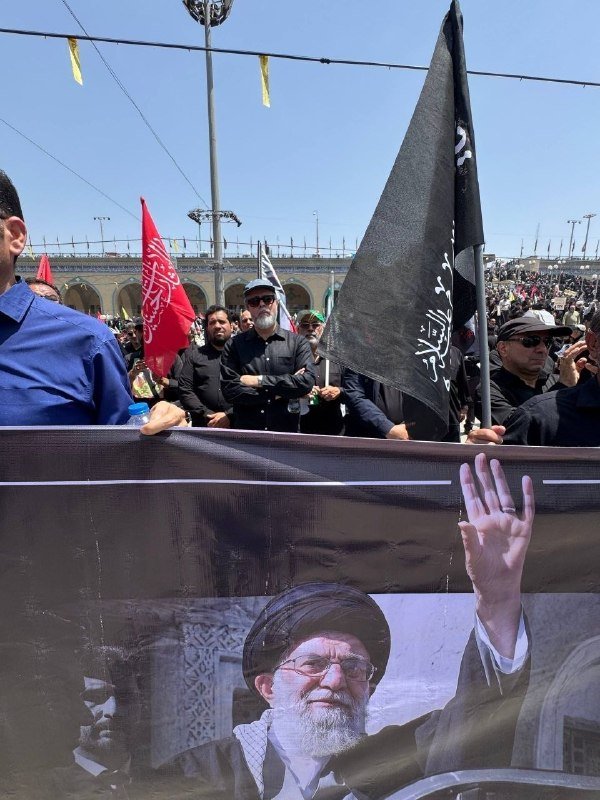
On the morning of 4 July 2026, in the Shahid Beheshti station on Tehran's metro, a group of passengers filled a crowded platform with a chant that has not lost its edge in nearly half a century: "Death to America." Two outlets carried the footage within minutes of each other — the Telegram channel Clash Report at 10:41 UTC, and the Fars News Agency channel at 10:14 UTC, attributing the clip to an audience submission. Both show the same scene: commuters, banners, a metronomic Arabic-Persian cadence echoing off tiled walls that still bear the station's pre-revolutionary bones. There is no news in the chant itself. The news is in how publicly, and how routinely, it now travels.
For decades the slogan has functioned less as a literal threat than as a piece of choreographed dissent — the closing line of every official address, the refrain at Friday prayers, the punctuation mark at state funerals. Its recurrence in a metro station, posted by an audience contributor to Fars and circulated by an open-source monitor, suggests two things at once. It signals that the regime continues to treat anti-American sentiment as a load-bearing civic ritual, not a vestigial one. And it suggests that the audience submitting it — and the press organs amplifying it — see value in demonstrating that the ritual still survives the trip across town and into the underground.
A slogan as infrastructure
The "Death to America" chant is older than the metro line it was filmed on. It long predates the 1979 revolution and was adopted, repurposed, and institutionalised in the years that followed. By the 1990s it had hardened into a set-piece ending for official addresses; by the 2010s it was a non-negotiable flourish at state funerals for figures such as Qasem Soleimani. The novelty on 4 July 2026 is not the slogan. It is the venue. Public transit in Tehran carries millions of passengers a day, and the decision to record, submit, and amplify a chant from a working metro station tells you something about where the regime assumes its captive audience now lives.
Fars News Agency, the outlet that received the audience video, is itself part of that infrastructure: an Iranian state-aligned wire whose reporting should be treated as a primary source for what the Islamic Republic chooses to publicise, and as counter-claim material for almost everything else. Its decision to circulate a commuter clip, rather than a podium clip, reflects a calculation. The state wants the slogan to read as the people's voice, not the establishment's. A metro platform full of chanting passengers does more work than a podium of generals.
What the framing leaves out
The Western wire read of such footage tends to be flat: "Iranians chant anti-American slogans; regime propaganda continues." The framing has the virtue of brevity and the vice of inaccuracy. It treats the chant as content rather than theatre, and elides the question of who is performing for whom. Iran is a society of roughly 88 million people, with deep disagreements about the relationship to Washington and to the country's own clerical elite. Treating a commuter clip as a referendum — or as a sign that nothing has shifted in fifty years — mistakes a staged display of unity for a survey of opinion.
The counter-read is no less uncomfortable for the Western framing. Polling on anti-American sentiment in Iran has, for as long as it has been conducted, returned numbers that would be considered politically toxic in any Western democracy. The slogan has staying power because, beyond whatever performance the regime extracts from it on demand, the underlying reservoir it draws from has not drained. The interesting question is not whether the chant is sincere. It is which constituencies the regime believes it can still mobilise in public space without contradiction.
A pattern, not an incident
Footage like this circulates because it slots into a recognisable pattern: state-aligned media frames; foreign monitors translate and re-circulate; Western outlets either reproduce or ignore. The mechanism is older than any one administration in Tehran or Washington. It is the way a forty-seven-year-old slogan gets to keep its job.
For those watching from Washington, the operational lesson is not new. Public theatre of this kind tells you where the regime believes its margin of safety lies — in the street, in the mosque, on the metro platform, on the anniversary. It does not tell you what happens inside the JCPOA negotiating room, or inside the Green Movement's surviving networks, or inside the bazaars of south Tehran. Slogans are infrastructure. Diplomacy is the rest of the building.
What remains uncertain
Both pieces of source material are clips and captions. Neither names a date of filming beyond the upload time; neither identifies the participants or estimates the size of the gathering. The footage is consistent with the kind of organised flash demonstration that Iranian state-aligned channels have staged in public spaces for years, but the source items do not confirm that this particular clip is scripted rather than spontaneous. Readers should treat the scene as documented — it happened, in that station, on the morning of 4 July 2026 — and as ambiguous about whether the chants were a routine the regime knows it can trigger or a moment of genuine crowd initiative. The slogan is unambiguous. The crowd's degree of organisation is not.
Desk note: Monexus has chosen to foreground both Fars and Clash Report as the documentary record of the clip, framing the chant as state-aligned public theatre rather than as evidence about Iranian public opinion. We have resisted the temptation to import polling numbers we cannot verify from the supplied sources, and have held the Western reductive read alongside the structural one.
Wire provenance
This editorial synthesis draws on the following public wire/social posts:
- https://t.me/ClashReport
- https://t.me/farsna