Dimitrov and Fery bring the unlikely to Wimbledon's second week
A world number 146 and a British wildcard both reached Wimbledon's last 16 on 4 July 2026, threading two very different comeback stories through the same afternoon at the All England Club.
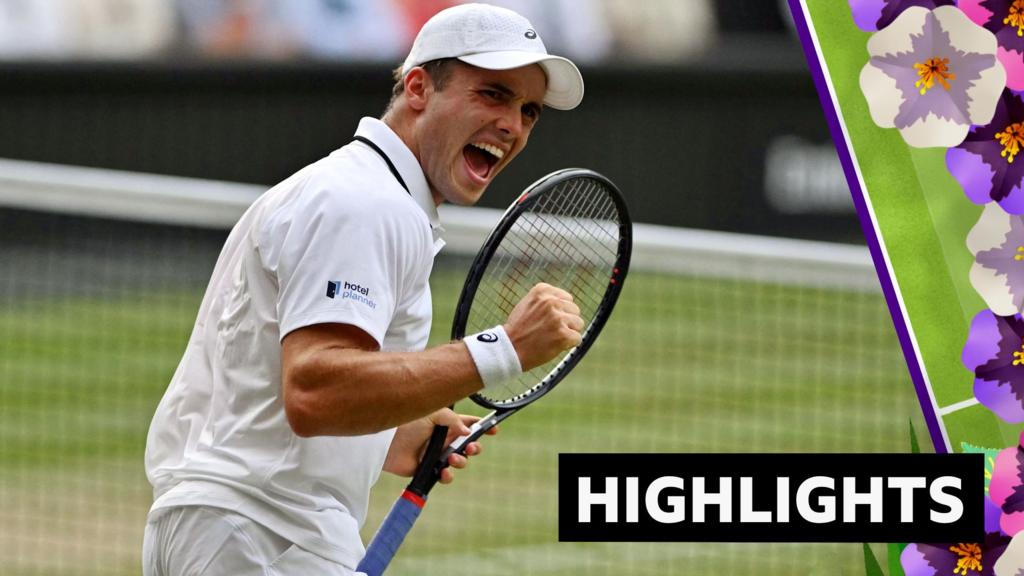
Grigor Dimitrov, the world number 146, beat Italy's Matteo Berrettini in five sets on Centre Court late on Friday afternoon, booking a fourth-round meeting with Great Britain's Arthur Fery and guaranteeing that an unseeded qualifier will face a former top-10 player in Wimbledon's last 16 on Saturday. Hours earlier, Fery himself had beaten Belgium's Zizou Bergs in another five-setter, surviving three nosebleeds and a string of medical time-outs to keep British home singles interest alive at the All England Club.
Two five-set wins, neither involving a seed in the top 50, and a fourth-round tie no projection model would have predicted at the start of the week — that is the second-week picture at SW19 as it stood at the close of play on 4 July 2026. It is also a useful corrective to the assumption that the men's draw has hardened into a closed shop.
Dimitrov finds something old, and something new
Dimitrov's 6-3 4-6 4-6 6-3 6-4 victory was his first back-to-back wins at Wimbledon since 2019, and his first five-set win at a major since the 2019 US Open, according to BBC Sport's report on the match. He trailed by a set and a break at one stage against Berrettini, an Italian whose own grass-court pedigree includes the 2021 Wimbledon final, and steadied the match with the kind of first-strike tennis that once carried him to the world number three ranking. "I want to rewrite my Wimbledon story," Dimitrov told BBC Sport afterwards, an unusually direct acknowledgement that the last few seasons — a slide from the top 10 to outside the top 100, a shoulder reconstruction, a ranking rebuilt tournament by tournament — had been on his mind.
The numbers matter because rankings flatten the picture. A 146th-ranked player should, on paper, be fodder for the third round. That Dimitrov is not is partly a function of his draw — Berrettini, dangerous on grass but now ranked outside the top 30, is the kind of opponent a returning veteran can punish if his first serve is landing — and partly a function of the tour's wider stratification, where the bottom half of the top 100 is genuinely contestable.
Fery, bloodied and unbowed
Fery's win over Bergs, the Eastbourne champion a week ago, was the more unusual story. The British wildcard lost the first set, took the second on a tie-break, and then found himself leaving the court three separate times to deal with nosebleeds that, by his own account to BBC Sport, took some time to settle. Sky Sports' report on the match described a sequence of medical time-outs that briefly turned the player's bench into a triage station. "It will take some time to really digest," Fery said afterwards, in comments that doubled as an admission that he had not quite processed what had happened.
That a qualifier should reach the fourth round of a slam is not in itself remarkable — Fery is not the first wildcard to do so — but the combination of circumstances is. Bergs arrived at SW19 with form and confidence; Fery arrived with a wildcard and a ranking outside the top 150. The fifth set, played in front of a home crowd increasingly invested in the story, settled into a pattern familiar to anyone who has watched a wildcard run: the under-ranked player stops trying to play the occasion and starts playing the ball. Fery did that.
A draw that now reads differently
The fourth round, as it shapes up after Friday's results, threads two very different career arcs together: Dimitrov, 34, trying to confirm that his body and his game have both held; Fery, 24, trying to confirm that a single week can be the start of something rather than a footnote. The seedings, such as they were, did not survive the first week. The bookmakers' boards will reset by Saturday morning.
There is a structural point worth making here without overstating it. The men's tour at grand slams has spent the last decade talking about depth — the argument that the gap between the top 10 and the top 100 has closed. That argument usually lives in spreadsheets. On 4 July 2026 it was visible on Court One, where a player ranked 146 played with the calm of someone who had been here before, and on the outside courts, where a wildcard who had never won a tour-level match on grass until this fortnight finished the job in five sets with cotton wool up his nose.
What the sources do — and do not — tell us
The reporting from BBC Sport and Sky Sports is consistent on the basic facts: the two scorelines, the medical time-outs, the quotes from both players, and the calendar. Neither outlet has yet published details of Fery's medical evaluation beyond the player's own description of nosebleeds and the need to stop play. Neither has speculated on the cause. That is the right place to leave it — a physical symptom described by the player, recorded by the broadcasters, and not yet the subject of an independent medical read.
It is also worth saying plainly what the day was not. It was not an upset in the traditional sense. Dimitrov and Fery were both priced long at the start of the tournament, but neither was playing outside their realistic level — Dimitrov because grass has always rewarded his game, Fery because the wildcard system exists precisely to put a home player in this position. What the day produced was a re-rating, not a shock. Whether the re-rating holds into next week is a question for Saturday's fourth round, not Friday's highlight reel.
The Monexus sports desk treats wildcard and ranking-rebuild stories with the same evidence bar as seeded-favourite coverage: scorelines from the wire, quotes from the player, and no editorial padding where the record is thin.