France, Egypt, and the Quiet Politics of a Prediction Market
Polymarket's pricing tells a story the bracket doesn't — and a Texas AG is turning secondary-market opacity into a 2026 campaign issue.
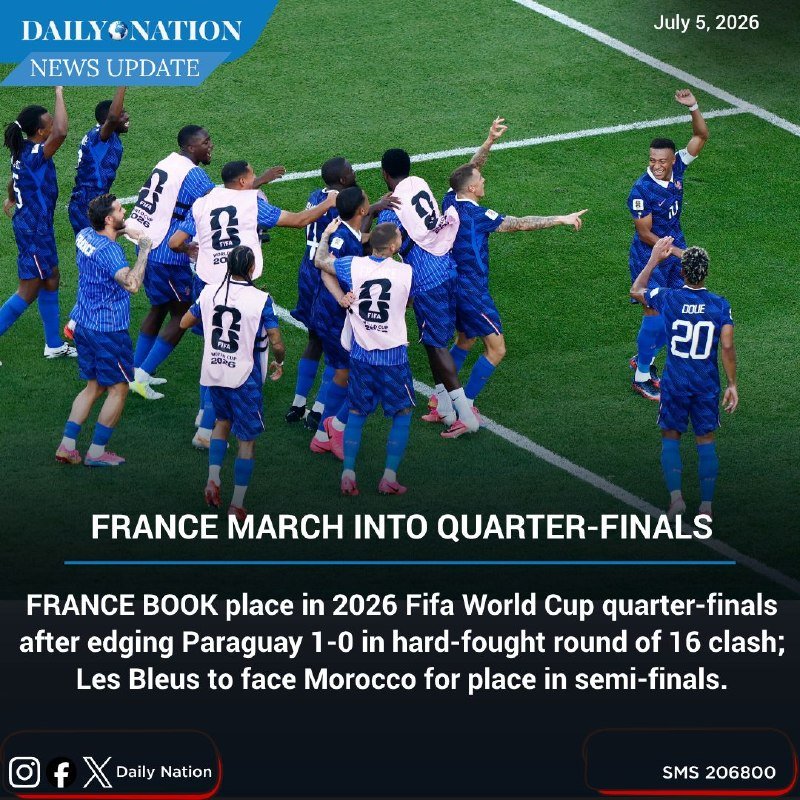
On 4 July 2026, the prediction market Polymarket priced France at roughly 36 percent to win the 2026 World Cup — the highest implied probability of any team on the board. The number arrived hours after a market-moving post on X flagged that France had advanced to its fourth consecutive World Cup quarterfinal, the kind of run that turns sentiment into money faster than federations can issue statements. The same platform is now hosting a quieter, more revealing trade: a Texas-led legal assault on the secondary ticketing market that says more about how the United States is preparing to police this World Cup than any press release from FIFA.
France is the market's favourite for reasons the bracket alone cannot explain. Past performance, squad depth, and Didier Deschamps' willingness to rotate explain only so much. The deeper read is that Polymarket's pricing reflects a concentration of capital betting on institutional continuity — on the team that, whatever its flaws, has been to the final in two of the last three tournaments. Egypt's first-ever World Cup knockout win, recorded on the platform on 3 July 2026, is a different signal: a national federation punching above its implied odds, with implications for confederation politics, broadcast rights in the Arab world, and the commercial value of being the first African side still standing at this stage.
What Polymarket is actually pricing
A prediction market is not a poll. It is a continuous double auction in which participants post capital behind a claim, and the price settles where the marginal buyer and seller meet. The 36 percent figure on France is therefore best read as a weighted average of what informed money is willing to stake — including professional bettors, syndicate accounts, and traders using the contract for portfolio hedging rather than fandom. That distinction matters when the same platform surfaces a story like Egypt's breakthrough, where the price move on 3 July 2026 almost certainly reflected a thinner book of liquidity and a more idiosyncratic distribution of beliefs.
The risk, as any trader who lived through the 2024 election cycle knows, is that thin books move on narrative. A single large wager — or a coordinated cluster of them — can drag implied probability away from fundamentals. Monexus finds that the cleaner read of these two data points is comparative: France is being priced as the institutional default, and Egypt is being priced as a tail outcome with real, recently demonstrated probability mass. Both can be true. The interesting question is whether the Egyptian trade is being driven by supporters, by arbitrageurs pricing in broadcast value, or by something simpler: a country that has waited decades for this stage.
The ticketing story hiding under the football
Two days before France priced as favourite, the Texas Attorney General's office announced an investigation into StubHub over alleged "ghost ticketing" at the World Cup — listings for seats the seller does not actually control, scalped through bots and resold before inventory is verified. The investigation lands inside a broader pattern of state-level enforcement action against secondary platforms that has gathered momentum since the Live Nation–Ticketmaster antitrust suit. For a tournament hosted across eleven US metropolitan areas, the political incentive to be seen prosecuting ticketing fraud is enormous, and Texas has positioned itself as the lead plaintiff in that fight.
The structural frame is plain. A World Cup is the largest single-event demand shock in sports. Hospitality operators, league partners, and secondary platforms all compete for the residual inventory that primary allocation leaves behind. When the resale layer is opaque — when the right to a seat is decoupled from the obligation to deliver one — the consumer pays twice and the venue absorbs the reputational damage. Texas is betting that 2026 is the cycle in which state attorneys general, working in concert, can extract concessions that federal regulators have so far declined to pursue. If the StubHub probe produces a settlement with disclosure requirements, expect copycat filings in New York, California, and Illinois before the semifinals.
Why France still matters more than the market suggests
Les Bleus' run to a fourth straight quarterfinal is itself a small piece of evidence in a longer argument about European football's institutional depth. France's player pool is structurally wider than its rivals' — the federation's academy-to-senior pathway has now produced two generational cohorts in a row, and the result is a squad that can absorb injuries to starters without dropping out of the top tier of contenders. The market is pricing that depth correctly. What the market may be under-pricing is fatigue: this group has now been together across four major tournaments, and the question of whether Deschamps rotates by preference or by necessity is the kind of question that only resolves in the knockout rounds.
Egypt's run, by contrast, is being priced as upside. The team has not been here before, and the marginal trader's reference class is unusually small. That asymmetry — France priced for continuity, Egypt priced for variance — is the most useful single read of the current board. It is also the read most likely to be wrong, because variance is precisely what the knockout stage exists to produce.
The stakes
If France lifts the trophy on 19 July 2026, the prediction-market thesis is vindicated, the federation's academy model gets another data point in its favour, and Polymarket's order book is vindicated as a price-discovery mechanism. If Egypt goes deeper than the market currently prices, the more interesting question is what that does to the commercial valuation of African football in the next broadcast-rights cycle — and whether the Qatar 2022 precedent (a non-traditional footballing nation using a tournament to rewrite its sports-economy footprint) is replicable in a country without sovereign wealth to underwrite it. The ticketing investigation, meanwhile, will outlast the final whistle. Whatever settlement emerges from the Texas probe will set the floor for secondary-market conduct across the next decade of US-hosted mega-events, including the 2028 Olympics in Los Angeles.
Desk note: Monexus read the Polymarket price action on 3–4 July 2026 against the Texas AG's announcement of the StubHub probe. Where wire coverage has framed prediction markets primarily as a 2024 election controversy, this piece treats the World Cup board as a separate asset class with its own liquidity profile. The contested claim — that thin books can move on narrative — is offered as a working hypothesis rather than a finding; the sources do not specify the participant composition behind either the France or Egypt trades.