The funeral that Iran staged, and the one it didn't
Fars News footage of children in wheelchairs pledging soldier-hood at the 'farewell ceremony for the martyred leader' is a textbook in how a state manufactures consent — and what it cannot.
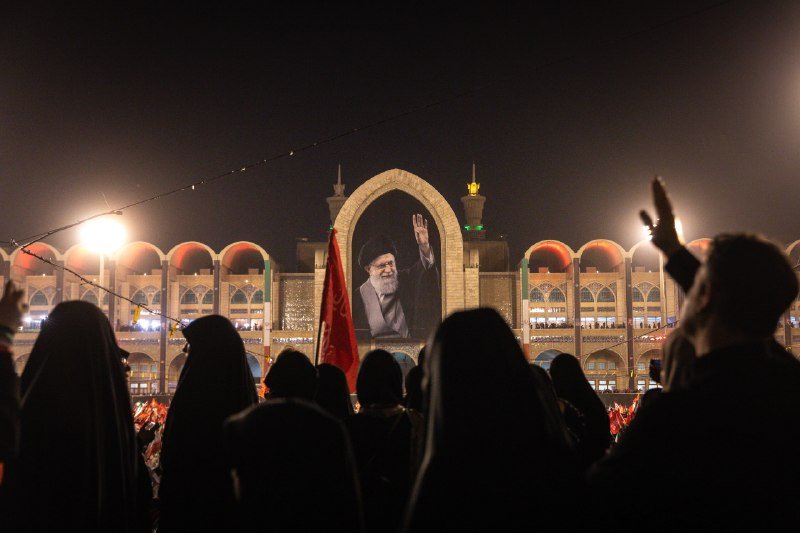
On 4 July 2026, at 16:17 UTC, the Iranian outlet Fars News posted a video clip from Qom showing crowds gathering to "chase" a coffin — "Mr. Martyr of Iran," the channel called him. Forty-two minutes later, Fars had footage of a girl in a wheelchair sobbing at the farewell ceremony. By 16:59 UTC, the channel was publishing back-to-back clips of children at the same ceremony, including one who had "brought herself with a wheelchair" to bid goodbye to "the martyred leader," and another pledging to "be a soldier of my leader." Within an afternoon, the broadcast cycle had moved from procession to pledge-of-service, packaged and re-posted across Telegram in the same hour. It is, in microcosm, how the Islamic Republic performs grief at scale.
The scene is the story. Not because anything in the footage is necessarily false — children do cry at funerals; people do turn out in provincial cities for figures they revered. The story is what the camera is pointed at, what the captions frame, and what is conspicuously absent: a counter-narrative, a dissenter, an empty street. A funeral, like an election, is staged not by faking what happens but by editing what the public is permitted to see of it.
The grammar of the frame
Fars's captioning is the giveaway. "Martyr" is not a noun that has slipped into the wire by accident; in Iranian state-media register, it carries a fixed doctrinal load — the dead who died for the system are elevated, and their elevation is the system's credential. The wheelchair girl, the child pledging soldier-hood, the procession through Qom: each is a unit in a sentence whose verb is legitimacy. The grammar repeats because it works. State-aligned channels have spent four decades learning that a child's face at a coffin photographs better than a minister's communiqué, and that "I will be a soldier" reads as innocence rather than recruitment.
The technique is older than the Islamic Republic. Leni Riefenstahl understood it; Soviet newsreel did it for half a century. What is specifically Iranian is the speed — the way Fars can move from raw phone footage to captioned, packaged, channel-branded content inside an hour, then loop the same frames across Telegram, X, and state TV. On 4 July, between 16:17 and 16:59 UTC, Fars published at least three distinct clips from a single event, each carrying a slightly different emotional payload: procession, grief, pledge. That is not journalism; it is a publishing schedule built around mood management.
What the camera leaves out
The opposite of a state funeral is rarely a riot. It is silence. Iranian civil society has spent the better part of two decades learning to mourn in forms the cameras do not record — indoor vigils, unposted candle-lights, graves visited before dawn. The 2022 death of Mahsa Amini produced exactly this pattern: footage of the state's orchestrated response, and a parallel archive of small, ordinary grief that circulated in DMs and on private channels rather than on Fars. The funeral-as-performance logic is most legible when one notices how uniform the frame is. If the channel can find a wheelchair and a child within forty minutes of a procession in Qom, and can frame both inside the same minute, the absence of older mourners, of opposition figures, of any face that is not performing veneration, is itself the editorial decision.
This is also why Western wire coverage of Iranian state funerals tends to read flat. The reporter files a pool piece from the official press stand; the photographs come from the same angles; the published image is interchangeable with the Fars cut. There is no independent camera at these events. The regime is, in a literal sense, the only producer of the footage that will be cited as evidence of public mood.
The counter-narrative that won't quite cohere
The standard Western reading goes: this is theatre, and the audience is captive. That is partly right and partly smug. It is right that the Fars cycle is engineered. It is wrong to assume the engineering fails. Polling in Iran is unreliable by design, but attendance at these ceremonies is not exclusively coerced, and the basij-volunteer cadre that fills the back rows of any procession does not explain the front. A better reading holds both at once: the funeral is choreographed to maximise the appearance of voluntary grief, the apparatus for that choreography is real and competent, and the resulting image is therefore neither pure truth nor pure fabrication but a third thing — a state-manufactured consensus that functions by including enough genuine sentiment to make its manufacture invisible.
The harder question is whether the frame is tightening or fraying. In 2020 the funeral of Mohsen Fakhrizadeh, the nuclear scientist killed in Absard, produced similar Fars footage with similar captions; the cycle since then has lengthened, not shortened. The Islamic Republic's central political problem in 2026 is succession: an aged Supreme Leader, a paralysed economy, a society that has repeatedly signalled its distance from the state's vocabulary of martyrdom. Theatrical grief is what a regime produces when its real political instruments have narrowed.
Stakes, plainly stated
The reading audience for these clips is not primarily domestic. Inside Iran, the population that consumes Fars is small and self-selecting. The clips are aimed outward — at the Iranian diaspora, at regional audiences in Iraq and Lebanon, at Western editors looking for a colour piece, and at the United Nations delegations that will, in due course, be asked to take the pulse of a country whose pulse is being broadcast in three-second loops. When the camera is the only arbiter of what counts as a public mood, foreign-policy decisions taken on the basis of "the Iranian street" are taken on footage the Iranian state produced. That is the stakes — not whether the children cried, but whether the rest of us are reading the picture correctly.
What remains uncertain, even after watching the cycle for an afternoon, is whether the framing is working inside Iran at the depth it once did. The sources we have are the state's own; they cannot tell us how the unfilmed half of the country is responding. The honest reading is that the Islamic Republic remains expert at the grammar of the martyr-funeral, and that expertise is now doing work it was not designed for.
Desk note: Monexus treated Fars News's thread as the primary wire — the only wire, in fact, that produced footage of the 4 July ceremony — and read its captions as state register rather than as descriptive journalism. The piece sits inside the MENA desk's standing instruction to treat Iranian state media as legitimate primary source on its own staging, while flagging the editorial frame as a frame.
Wire provenance
This editorial synthesis draws on the following public wire/social posts:
- https://t.me/farsna/1
- https://t.me/farsna/2
- https://t.me/farsna/3