Iran buries a family, and a question: who pays for the next round?
At a prayer ceremony in southern Iran, a state-aligned farewell doubles as a public signal about the next phase of confrontation with Israel and the United States.
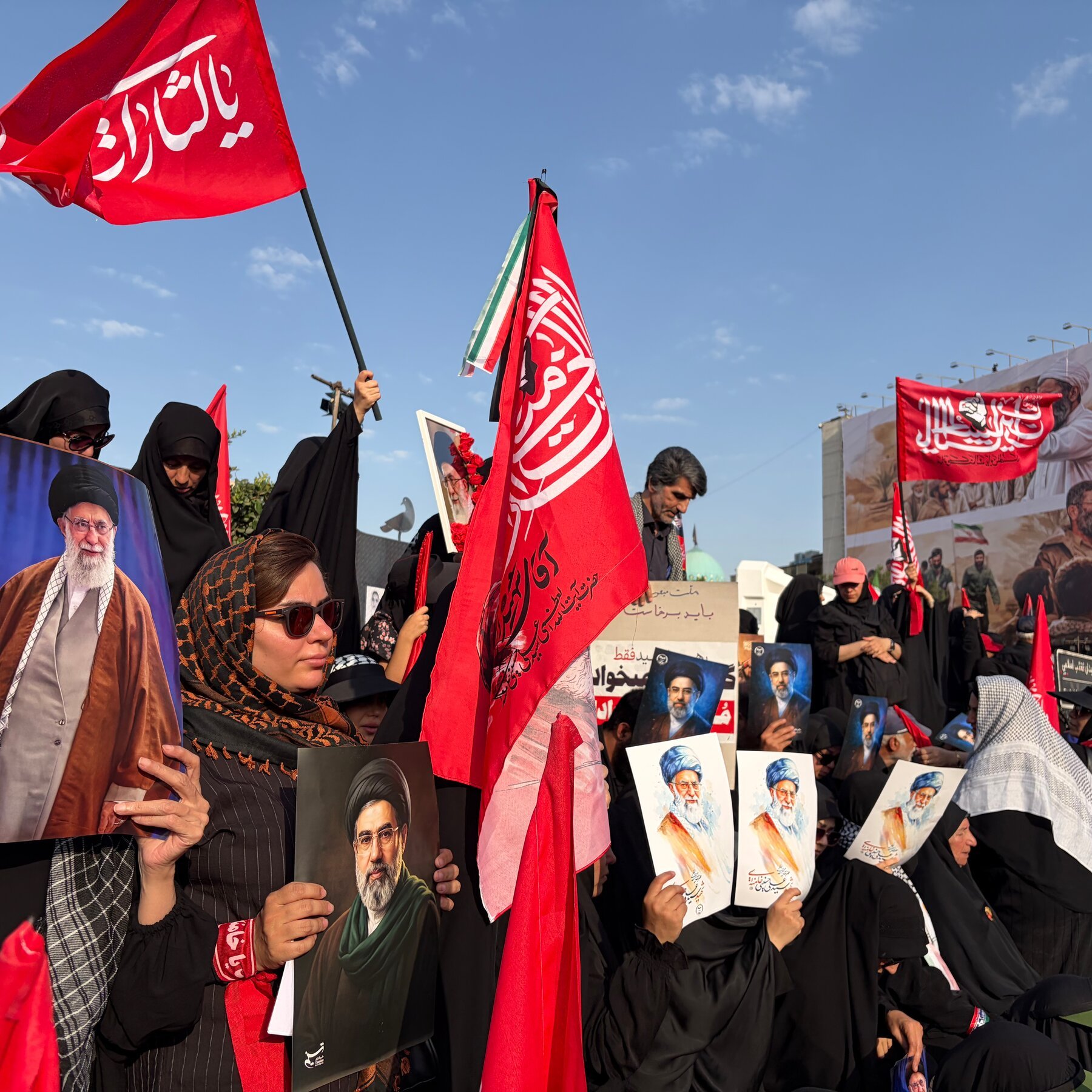
Mourners filled the Imam Khomeini Mosque in Tehran before dawn on 4 July 2026, with a funeral prayer scheduled there at 06:00 local time for a man referred to in Iranian state-aligned coverage as "Imam Mujahid" along with members of his family described as "martyrs," according to a series of posts from the Al-Alam network on Telegram. The clips show crowds chanting "Labik ya Seyyed Mojtaba" — a slogan associated with Mojtaba Khamenei, the second son of Supreme Leader Ali Khamenei — over the casket, alongside footage of grieving relatives that the channel released throughout the morning.
What the Iranian state is selling as a martyr's farewell is also a political signal. Funerals of this kind, with their chants, framed portraits and tightly orchestrated symbolism, are how the Islamic Republic consolidates its security narrative in public space: a martyrdom frame is conferred on a dead fighter and his family, the slogan ritual rehearses a loyalty hierarchy, and the broadcast registers both with the domestic base and with foreign audiences that read Iranian politics the way diplomats once read funeral cortèges in Moscow.
The framing the state is offering
Iranian state media is presenting the death as a martyrdom event — a framing that, in the Republic's political vocabulary, confers religious and political legitimacy on the dead and obliges the living. The Al-Alam posts, published at 06:23 UTC and 05:40 UTC on 4 July, centre the slogan and the mourning, not the cause of death or the institutional affiliation of those killed. That silence is itself a tell: in this kind of state-aligned coverage, the operational details of who was killed, by whom, and where are routinely withheld when the state wants the symbolic payload — martyrdom, loyalty, defiance — to do its work unencumbered by facts that could be argued with.
The framing the state is avoiding
The parallel question — and the one the chants are designed to make harder to ask — is the operational one. The sources available to this publication do not specify the location, date or circumstances of the killing, the institutional role of "Imam Mujahid" inside Iran's security architecture, the identities of the family members described as martyrs, or which external actor the Iranian state ultimately blames. Without those details, a reader cannot test the martyrdom claim, only register it. That asymmetry — full ritual, thin facts — is the structural pattern of how Tehran's security narratives propagate: the slogan travels; the file stays closed.
What this ceremony is actually for
Read against the broader calendar, the funeral sits inside a familiar Iranian practice of using grief to harden deterrence. The repeated slogan invoking Mojtaba Khamenei is unusual in its explicit, public, surname-only register and is best understood as a statement about succession and command, not a stray chant. The Islamic Republic has, since 2024, made a practice of using mourning rituals to signal whose authority is now contiguous with which martyrdom — particularly after strikes attributed to Israel that have killed senior Islamic Revolutionary Guard Corps figures and their families inside Iranian territory. The 4 July ceremony follows that script.
The structural frame is straightforward. Confrontations between Israel and Iran have moved from proxy arenas into direct, reciprocal strikes on the homeland of each side over the past two years. Each killing of an Iranian security figure or a member of his family inside Iran has been followed by a state funeral that doubles as a deterrent message: the next round will cost more, and the cost will be paid here. The chants aimed at Mojtaba Khamenei raise that wager — they tell an Israeli and an American audience that the next escalation will be answered by the part of the system that survives its leader, not the one that depends on him.
Stakes, and what the sources do not yet let us say
The short-term stakes are tactical. The funeral will be read inside Iran as proof that the security establishment absorbs blows and continues; outside Iran, particularly in Jerusalem and Washington, it will be read for whether the chants imply a more aggressive next phase of retaliation. The medium-term stakes are about succession. The public, repeated invocation of Mojtaba Khamenei in a martyrdom ritual is the kind of signal that, in a system where the Supreme Leader's eventual replacement is an open question, markets and intelligence services price as information.
What remains genuinely uncertain, on the evidence available, is the underlying event. The sources do not specify when or where the killing occurred, who is being mourned beyond the honorific "Imam Mujahid," or whether the Islamic Republic has formally attributed the death to an external actor. Until those facts emerge, the chants are louder than the case — and that, in Iranian political theatre, is sometimes the point.
This piece relies on Iranian state-aligned Telegram coverage; Monexus reports what the channel is saying, notes what it is not, and leaves the reader to weigh the gap.
Wire provenance
This editorial synthesis draws on the following public wire/social posts:
- https://t.me/alalamfa
- https://t.me/alalamfa
- https://t.me/alalamfa