Iran buries a 'martyr' and rehearses a political vocabulary the West cannot translate
State media coverage of a Tehran farewell ceremony for a figure branded 'Mr. Martyr of Iran' is less a news report than a display of a political vocabulary the Western press keeps failing to read on its own terms.
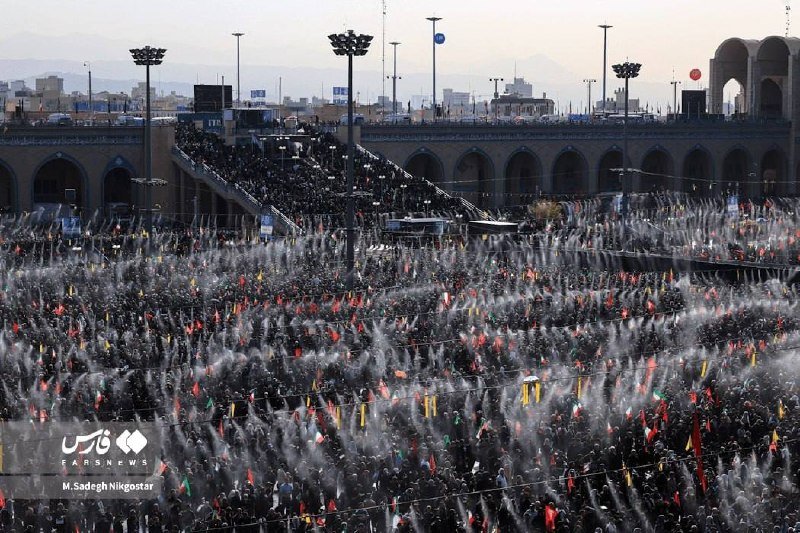
In the hours before dawn on 4 July 2026, Iranian state media filled its morning feeds with the sound of a single mosque. Outside the Imam Khomeini Mosque in central Tehran, mourners chanted a phrase — Labik ya Khamenei, "at your service, Khamenei" — that anchors a political vocabulary the Islamic Republic has been refining since 1979. Inside, the eulogist Nariman Panahi sang a Karbala lamentation. Verses from the Qur'an were recited. The absent figure being mourned was repeatedly styled as Aghai Shahid-e Iran — "Mr. Martyr of Iran." Tasnim News and Mehr News carried the proceedings live, itemising the slogans, the chants, the mourners, and the religious cadences with the cadence of a state-organised broadcast rather than a news event.
The Western press, when it bothers to translate a moment like this, usually reads it as theatre: choreographed grief in service of a regime that deploys martyrdom as a domestic prop. That reading is not wrong, but it is incomplete. What is actually on display in the Telegram feeds of Tasnim and Mehr is a working political grammar — a system of slogans, gestures and reference points through which the Islamic Republic converts private grief into public authority. Until Western editors learn to read that grammar on its own terms, they will keep mistranslating Iranian politics, and the policy that follows from those mistranslations will keep arriving late.
What the feeds actually show
The Telegram channels of Tasnim News English and Mehr News published a steady stream of clips and captions through the early morning UTC of 4 July 2026. At 04:50 UTC, Tasnim carried a Karbala eulogy by Panahi at the farewell ceremony; at 04:58 UTC, Mehr posted a longer excerpt of Panahi's lamentation; at 05:15 UTC, Tasnim aired a second Panahi performance; at 05:31 UTC, the channel recorded the slogan Labik ya Khamenei ringing through the courtyard; at 06:24 UTC, mourners chanted Labik ya Hossein; and at 06:34 UTC, Tasnim published recitation from the Qur'an at the same ceremony. The date is given in the Iranian calendar as 13/4/1405.
The content is, on its face, religious. The political content is in the sequencing, the hashtags, and the framing. Every clip is tagged #Badarqa_Aghai_Shahid_Iran and #must_rise, an instruction that translates roughly as "the flag of Iran's martyr must be raised." The absent figure is never named in plain prose. He is Aghai Shahid — the martyred master — a title that fuses the religious register of Karbala with the political register of the Republic. The slogans answer each other across the morning: Labik ya Hossein ("at your service, Hussein") on the religious side; Labik ya Khamenei ("at your service, Khamenei") on the political side, the chant that has become the audible signature of post-2022 Iranian street politics.
Why the Western translation falls short
Most Anglophone coverage of Iranian state mourning reads it through one of two templates. The first treats it as performance for a domestic audience that the regime cannot otherwise hold together — a useful, slightly condescending frame that assumes the population watches cynically. The second treats it as a security signal, a measurement of elite cohesion or factional alignment inside the Islamic Republic. Both templates miss what the morning's coverage is actually doing: it is being published, in English, on Telegram, by state-aligned outlets whose English desks exist precisely to put this vocabulary into circulation beyond Iran's borders.
The decision to publish in English is the tell. Tasnim's English feed is not aimed at the bazaar in south Tehran. It is aimed at a regional and global audience — Lebanese, Iraqi, Yemeni, Bahraini, Pakistani and Afghan audiences who already share the Karbala grammar, and at Western editors who do not. The use of must_rise in the hashtags is a clue: it gestures upward, at a claim of authority that is also a claim to relevance. The chanting of Labik ya Khamenei inside a Hossein ceremony collapses the distance between sacred loyalty and political loyalty in a way that needs no translation for Shia publics across the region and considerable translation for Western ones.
What is at stake in the framing
When Western outlets file these clips as colour, they cede the interpretive ground to two of the least useful frames on offer. The first is the secularist frame, which reads religious politics as façade and discounts the participants' own self-understanding. The second is the security-state frame, which reads everything in the region as an extension of Iranian power projection and turns mourners into proxies. Neither frame asks how a system of slogans — Labik, Shaheed, Karbala — actually organises authority inside the Republic, and how that authority travels when state media exports it through English-language Telegram.
There is a structural point worth stating plainly. A political order that can bind grief, religion and authority into a single chant, and that can then publish that chant in English on the morning of a major ceremony, is not a brittle order. It is an order with a working transmission belt from street to screen to foreign reader. Western policy tends to be written as if the Islamic Republic is constantly on the verge of delegitimation; the broadcasts that arrived in the 04:50 to 06:34 UTC window on 4 July 2026 suggest that the regime's domestic grammar is still being actively composed, in real time, for an audience larger than itself.
The contested ground
The most plausible counter-reading is straightforward: this is grief being choreographed, and choreographed grief is not the same as genuine political authority. Sceptics will argue that the same slogans have been deployed at many funerals, that turnout at official ceremonies is partly organised, and that the English-language framing is designed for a foreign audience that will only ever consume it as background noise. Each of those objections has force. None of them refutes the larger point, which is that a regime whose mourning rituals travel this fluently across media and across borders is doing something that the standard Western analytical vocabulary is poorly equipped to describe.
The sources do not specify the identity of the absent figure being mourned, nor the circumstances of his death, and they do not name which institution carried the body to the mosque. Until those facts are established, the rest is reading. But the reading itself — the hashtags, the slogans, the sequencing of Karbala lamentation with Labik ya Khamenei, the deliberate English publication of every clip — is the news. It tells a reader of Iranian politics something important about the system's confidence and about the gap between what is being said in Persian and what is being performed in English. Western editors who treat the gap as a translation problem rather than a political fact will keep arriving at the wrong policy.
— Monexus Staff Writer
Wire provenance
This editorial synthesis draws on the following public wire/social posts:
- https://t.me/tasnimnews_en
- https://t.me/mehrnews
- https://t.me/tasnimnews_en
- https://t.me/tasnimnews_en