Iran's martyrdom narrative and the choreography of vengeance
Tehran's official media has begun scripting the response to the killing of Ali Khamenei. The state apparatus is preparing a public, ritualised campaign that doubles as a warning to rivals at home and abroad.
Lead
Within hours of the announcement that Ali Khamenei — the Islamic Republic's longest-serving supreme leader — had been killed alongside members of his family, Iran's Intelligence Ministry publicly committed to pursuing what it called "justice" against those it held responsible. The pledge, distributed through state-aligned outlets on 4 July 2026, sets the rhetorical tone for a successor government that has yet to be formally named. PressTV carried the ministry's vow in full, framing the killing as an act to be answered rather than mourned.
Nut graf
What is unfolding in Tehran is not simply a period of official grief. It is the staged opening of a vengeance script — part ritual, part deterrence, part internal signalling. The choreography of mourning is the choreography of mobilisation, and the difference between the two is mostly a matter of where the camera is pointed.
Mourning as message
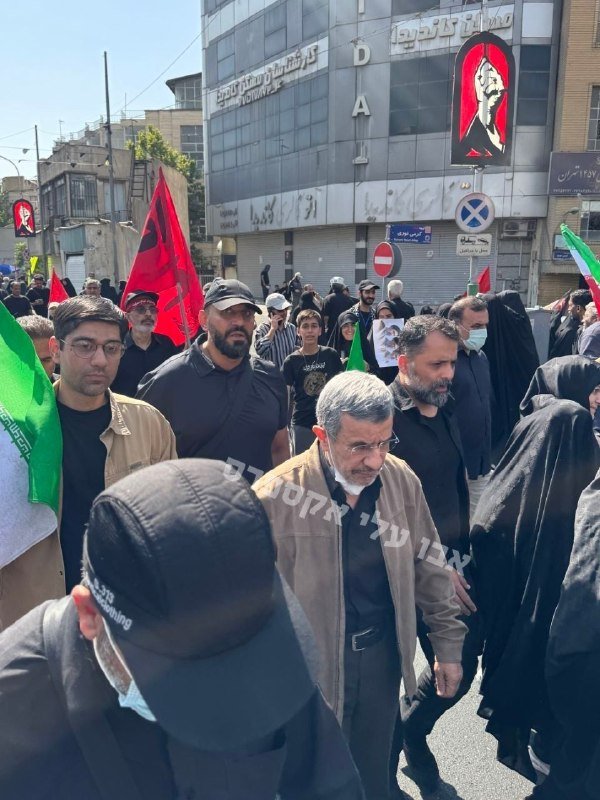
State media moved with notable speed. By 06:35 UTC on 4 July, Islamic Republic of Iran Broadcasting (IRIB) head Peyman Jebelli had appeared at the farewell ceremony for Khamenei and his family, an image distributed through the PressTV channel on Telegram. A second near-identical post followed at 07:44 UTC, and by 08:12 UTC the Intelligence Ministry's pledge of retribution had been added to the feed. In a normal Iranian political cycle, the gap between a leader's death and a unified state script would measure in days. Here, it was under twelve hours.
That pace matters. It signals that the institution around Khamenei did not fracture on contact with the news — at least not in any way visible on the broadcast record. The farewells and the vow of "avenging the blood of the martyred Leader" are now circulating as a single, coherent package: grief, then menace, in that order.
The grammar of vengeance
Iranian state vocabulary on such occasions is dense and deliberate. "Martyrdom" — used here in both the press captions and the Intelligence Ministry's framing — carries an eschatological freight that predates the current crisis. It binds the dead leader into a longer register of sacrifice that the state has used, for four decades, to license retaliation. Once the martyrdom frame is fixed in the official text, the retaliatory act that follows is morally pre-empted: it becomes a duty rather than a choice.
This is the part of the script that travels well beyond Iran's borders. The phrase "justice will be pursued against… the perpetrators" does not specify a perpetrator. It does not need to. The ambiguity is the point. Tehran keeps open the list of possible addressees — Israel, the United States, Kurdish opposition groups, domestic rivals — while the act of public vowing forces every potential target to recalculate.
Who is being addressed
Read narrowly, the Intelligence Ministry's statement is a procedural commitment: a security organ telling a domestic and external audience that a criminal act will be investigated. Read in context, it is doing several jobs at once.
First, it is a message to the security establishment itself: there will be no vacuum. The Intelligence Ministry, the IRGC, and IRIB are all visibly present in the broadcast record of the farewell, and all are speaking with a single voice. In any succession — and a Khamenei succession is the most consequential the Islamic Republic has faced since 1989 — the question of which institution leads is the question of which institution survives intact. The press footage of Jebelli at the ceremony is a quiet reminder that the broadcast arm of the state is aligned.
Second, it is a message to Israel's intelligence and political leadership, who will weigh what a martyrdom-framed succession means for Iranian operational tempo. Third, it is a message to the United States, where any escalation cycle now feeds back into an election calendar and an oil market. Fourth, and least remarked, it is a message to Iran's own population: that the state has not lost its capacity to project, and that the moral vocabulary of the Republic remains operative.
Stakes and uncertainty
If the trajectory holds, the next weeks will be defined by two parallel tracks: an internal succession whose mechanics remain opaque, and an external retaliation whose timing and target will be deliberately opaque until they are not. Tehran's strategic tradition favours ambiguity up to the moment of action, and the martyrdom frame now in circulation gives that ambiguity a moral cover.
What is genuinely uncertain is the scale. The Intelligence Ministry's pledge, as carried on PressTV's Telegram channel on 4 July, names no perpetrator and no timetable. The broadcast register is high and the diplomatic register is, for the moment, silent — which is itself a tell. States that intend calibrated signalling usually let their foreign ministries speak first. When the intelligence services speak first, and in the vocabulary of vengeance, the audience is being prepared for something louder than a statement.
This publication will be watching for three signals in the coming days: the name attached to the supreme-leadership role during the formal mourning period; the first foreign-policy utterance from the new caretaking apparatus; and the operational tempo of the IRGC's regional proxies. Any one of those will reveal whether the martyrdom script is being staged for deterrence or for something more kinetic.
Desk note
Monexus is reading the Iranian state media feed as the primary input here, because it is the feed doing the framing work. The script is the story; the underlying facts of the assassination are being developed in separate reporting and will be re-examined once wire confirmations arrive.
Wire provenance
This editorial synthesis draws on the following public wire/social posts:
- https://t.me/presstv/1
- https://t.me/presstv/2
- https://t.me/presstv/3