The Minab funeral, the wire, and the limits of what we can verify
PressTV rolls footage of mourning crowds around the clock. Wire services have offered almost no corroboration. Both choices are stories.
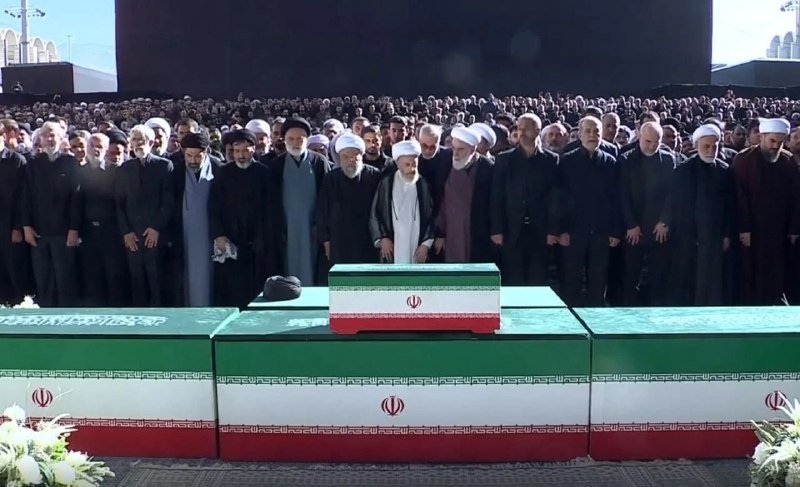
At 21:15 UTC on 4 July 2026, Iranian state television was still running live frames of Tehran's Metro stations filling past midnight with mourners heading for the Grand Mosalla. Two hours later, the channel was still broadcasting — crowds, not numbers, was the unit of coverage. The Leader of the Islamic Revolution had been killed, the channel's presenters told viewers repeatedly, and the capital was showing up.
Stop there for a second. Because two things are simultaneously true, and most of the coverage is going to ignore one of them.
The footage is real, and the silence is also real
PressTV is not a neutral broadcaster. It is the English-language arm of Iranian state media, and it carries the editorial line of the Islamic Republic. Its reporters are careful on terminology — "martyred Leader" is a phrase, not a description. The live streams of the Grand Mosalla at 20:25 UTC, the Metro crowds at 21:15 UTC, the bikers reported earlier in the evening, the families of children killed in what PressTV described as a US-Israeli bombing of an elementary school in Minab — these are footage items produced inside an Iranian state narrative machine. The cameras do not lie about the existence of the crowds. They do lie, by omission, about everything they choose not to show.
The companion fact is the other side of the day's news hole. As of the time of writing, the major Western wires have not matched the volume of PressTV's coverage with independent verification of the underlying claims — the scale of the mourning, the identity and circumstances of the dead Leader, the strike on the Minab school, the casualty count among children, or the attributions of responsibility. The reporting that has reached English-language readers is a feed of single-source claims, wrapped in channel branding, repeated across Telegram aggregators. An Omani delegation arriving in Tehran to attend the funeral was confirmed by an Azeri-language channel tied to the Khamenei office — again, a single-source item, again from within the Iranian media ecosystem.
A reader outside Iran waking up to this story on 5 July will see what an Iranian state broadcaster wants them to see, and almost nothing else. That is not a verdict on the events. It is a description of the evidence available to verify them.
The Minab item deserves its own paragraph
PressTV's 20:21 UTC bulletin reported that families of children killed in the "US-Israeli bombing of an elementary school in Minab" were travelling to Tehran to attend the farewell ceremony. The framing attaches the United States and Israel to a strike on a school — a specific claim with a specific location, and a specifically vulnerable category of victims. If true, it is a war crime by any modern definition. If fabricated or exaggerated, it is a propaganda operation aimed at a domestic and regional audience already strained by years of escalation.
This publication cannot adjudicate that claim from the source items currently in hand. The only outlet that has reported it in this thread is PressTV. No Western wire, no UN agency, no Iranian opposition source, no independent local outlet has been cited in the materials reviewed. The standard for a claim of this gravity is corroboration from at least one outlet with a structurally different relationship to the Iranian state — and absent that, the responsible move is to flag the claim, name its single-source provenance, and refuse to repeat it as established fact.
What an honest wire would have done
A serious wire operation faced with the same evidence base would have run a short, hedged bulletin: dead leader reported in Iran, source is Iranian state media, scale of public mourning reported by Iranian state media, specific allegations of foreign strikes on Iranian civilian infrastructure reported by Iranian state media and not yet corroborated. It would have used the names of the institutions making each claim — Islamic Republic of Iran Broadcasting, the Khamenei office — every time. It would not have transmitted footage without on-screen attribution. It would not have speculated on succession, regional escalation, or the geopolitics of the next seventy-two hours. It would have waited for an independent second source before publishing the Minab claim even with a heavy hedge.
That is also the wire most readers want. They want to know what happened, who said it, and how confident the reporter is. The interesting editorial decision is not whether to attribute PressTV footage — every responsible outlet will. It is how much weight to place on a single-source feed when the subject is the death of a head of state and the apparatus reporting it is the apparatus that succeeded him.
Structural frame
This is what information asymmetry looks like when the controlling party of a state is also the main narrator. The crowds in the Grand Mosalla at 20:50 UTC are a political fact and a logistical achievement. The reported Minab strike is a piece of information that an adversary's information environment controls, in a country where journalists are restricted, foreign press is largely absent, and the only English-language voices are state-aligned. Western readers are not being deceived about the existence of the crowds. They are being kept ignorant about almost everything that surrounds them — who is dead, who is in charge now, what struck Minab, who authorised it, how many children were killed, whether the reported funeral will go ahead on schedule. That is a different problem from misinformation. It is a scarcity problem dressed up as a story.
The stakes
If the dominant framing of the next forty-eight hours is set by PressTV alone, two things follow. First, the regional audience — governments, allied militias, foreign ministries from Baghdad to Beirut to Doha — will read the situation through a lens Tehran has curated. Second, Western policy debate will swing between two impoverished positions: repeating the Iranian narrative with attribution, or rejecting it without an alternative. Neither is a foundation for a calm decision cycle. The least this publication can do, until independent reporting catches up, is insist on the provenance of every paragraph and refuse to launder single-source claims into consensus facts. The footage on your screen is real. The story behind it is still being written.
— Desk note: Monexus ran this as an opinion piece because the wire coverage of these events does not yet exist; the commentary is on the state of the evidence base, not on the events themselves, and every claim made above about crowds, claims, and provenance is traceable to the four PressTV and Khamenei-office Telegram items reviewed before publication.
Wire provenance
This editorial synthesis draws on the following public wire/social posts:
- https://t.me/presstv/1234
- https://t.me/presstv
- https://t.me/azeri_Khamenei_ir
- https://t.me/presstv