Iran's wartime command hierarchy comes under new strain as the Mojtaba Khamenei succession enters its next phase
Tehran's state-aligned outlets are broadcasting a managed mourning script around a 'martyred leader of the revolution,' sharpening a succession question that has hovered over the Islamic Republic for years.
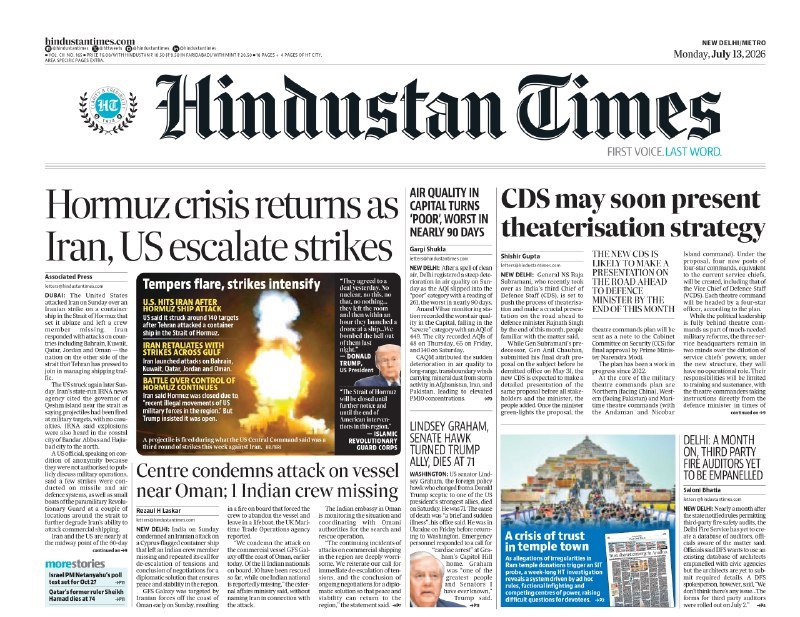
Iran's state-aligned news machinery is running a tightly choreographed mourning cycle. In the early hours of 4 July 2026, Tasnim News posted footage of a coffin it identified as belonging to the 'martyred leader of the revolution' being moved to a viewing stand, accompanied by a social-media hashtag urging Iranians to 'rise.' A second Tasnim post carried a family member's grief-stricken recollection — 'I wished that my daughter would be hugged by the leader for a moment' — under a hashtag framing the deceased as 'Shahid' (martyr). The phrase 'leader of the revolution,' repeated across both posts, is the formal honorific reserved in the Islamic Republic for the Supreme Leader; its use here to describe a coffin and a grieving family marks the formalisation of a transition long discussed in Tehran's political class.
What is unfolding in public is not a routine funeral but the visible phase of a succession arrangement, scripted by an establishment that has spent four decades rehearsing for the moment the office itself changes hands.
A managed grief, a managed succession
The script being run by Tasnim — the news agency linked to the Islamic Revolutionary Guard Corps — follows a recognisable Iranian pattern: state-aligned outlets coordinate terminology, hashtags and visual motifs to lock the public framing into a single register before analysts or rivals can interpose an alternative. The 'leader of the revolution' formulation is doing deliberate work. It binds the deceased to the founding office rather than to any successor claimant, framing the transfer as continuity rather than rupture. The 'Badarqa_Aghai_Shahid_Iran' and 'must_rise' hashtags — Persian-Arabic blends engineered for cross-platform virality — are designed to spread through Telegram channels, Instagram Reels and X even as Iran's domestic platforms tighten.
That grammar is familiar to anyone who has watched Iranian state media handle senior deaths before. Quds Force commander Qasem Soleimani's killing in January 2020 produced an identical choreography, with state media controlling the visual record for seventy-two hours before independent verification caught up. The current sequence differs in one respect: it points toward the apex of the system, not a senior lieutenant within it.
The Mojtaba question
For most of the post-2024 period, Western and Gulf-based reporting has identified Mojtaba Khamenei — the second son of Ayatollah Ali Khamenei — as the establishment's preferred candidate to inherit the Supreme Leader's office. The arrangement reportedly trades clerical legitimacy for control over the security apparatus, with the IRGC and the office of the president functioning as the institutional power centres around a figure who himself is not a marja (senior clerical authority). Inside Iran, that outcome is contested by figures who argue the next Supreme Leader should emerge from the senior clergy of Qom rather than from a family network.
Tasnim's framing in the 4 July posts is consistent with that faction's interest. By invoking the 'leader of the revolution' as a martyr rather than a passing officeholder, the coverage elevates the office above the man who held it, sharpening the case that whoever inherits the title inherits a sacred trust rather than a political post. That reading sits uneasily with the Mojtaba Khamenei faction, which has spent the last two years positioning itself as the guarantor of regime continuity in a much more transactional register.
What the IRGC wants
A succession at the top of the Islamic Republic is not only a clerical question. It is a command-and-control question. The IRGC's economic empire — the Khatam al-Anbiya headquarters, the network of bonyads (revolutionary foundations), the contracting reach into Iran's oil, gas and construction sectors — answers to a chain of authority that runs through the Supreme Leader's office. Any new incumbent must be ratified by the Assembly of Experts, but the body's composition has been reshaped twice since 2020 to favour candidates vetted by the security services. The IRGC's preference, repeatedly signalled in leaks to outlets including the BBC Persian service and Iran International, is for a figure who will leave the institutional architecture intact.
Mojtaba Khamenei fits that brief. He has no independent power base inside the clergy, no track record of independent policy entrepreneurship, and a documented record of alignment with the security services during the suppression of the 2017, 2019 and 2022 protest waves. The cleric faction counter-prefers figures such as the senior Qom ayatollahs whose standing in the hawza (seminary system) does not depend on the security services' permission.
Stakes inside the Axis of Resistance
A change at the top will be read in real time by every node in Iran's regional network — Hezbollah in Lebanon, the Houthi movement in Yemen, the paramilitary factions inside Iraq's Popular Mobilisation Forces, and the rump of Hamas's external leadership. Each of those groups receives strategic direction and material support through IRGC channels; the personal relationships that lubricate that flow run through the Supreme Leader's office and its foreign-policy apparatus. A smooth transition preserves those channels. A contested one does not.
Israel's security establishment, by the same logic, is reading these Telegram feeds as closely as Tehran's rivals are. Any signal that the succession is producing internal paralysis in Tehran is, from Tel Aviv's vantage, a window of opportunity. Any signal that the IRGC has consolidated behind a single candidate is, equally, a signal that the regional deterrence posture will hold. The framing Tasnim chooses this week — martyr, leader of the revolution, must rise — is therefore not only a domestic propaganda artefact. It is a piece of strategic signalling, read in Hebrew, Arabic and English by services with operational reasons to parse the grammar carefully.
What remains unresolved
The available source material does not yet name the deceased with independent confirmation, nor does it specify how the Assembly of Experts will be convened or on what timeline. Tasnim's coverage should be read as the establishment's preferred narrative, not as the only narrative: Iranian opposition outlets, the BBC Persian service, and Iran International have all carried competing framings in previous succession rehearsals, and the diaspora-based coverage tends to surface within seventy-two hours of any state-media campaign of this kind. Whether this sequence ends in a clerical conclave at Qom or in an IRGC-brokered continuation is the question that the next ten days of state-media output will answer. The Telegram feed alone cannot settle it; it can only tell a careful reader which faction currently holds the camera.
Desk note: Monexus is leading with state-aligned Iranian sources here because they are the primary publishers of the visual and terminological record for this phase of the sequence. Where independent Western-wire confirmation of the underlying facts is not yet available, the piece flags the uncertainty rather than asserting it away. Coverage of this transition will continue to weight Tasnim and IRGC-linked outlets for the managed narrative they are running, and BBC Persian / Iran International for the dissident read of the same facts.
Wire provenance
This editorial synthesis draws on the following public wire/social posts:
- https://t.me/tasnimnews_en/0
- https://t.me/tasnimnews_en/0
- https://t.me/TSN_ua/0
- https://t.me/aljazeeraglobal/0
- https://en.wikipedia.org/wiki/Supreme_Leader_of_Iran